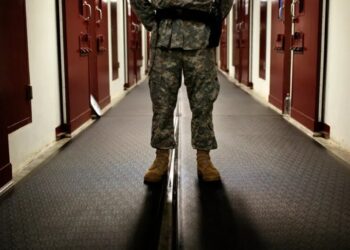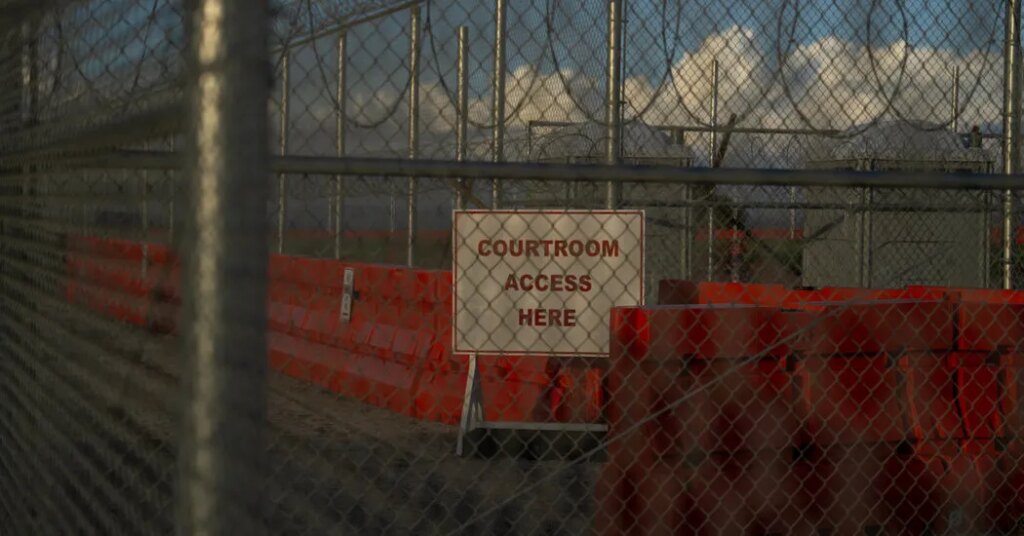
The U.S. war court at Guantánamo Bay is a court like no other, and the one case that is headed to trial this year illustrates just how unusual it is.
For starters, many witnesses in the case — the bombing of the U.S.S. Cole — are likely to testify by video.
Legal experts say U.S. death-penalty trials require in-person testimony. But the court can only compel government employees to travel to the U.S. Navy base in Cuba for the trial of a Saudi prisoner who is accused in the bombing that killed 17 sailors on Oct. 12, 2000.
The defendant, Abd al-Rahim al-Nashiri, is charged with orchestrating the attack. Even if he is found not guilty, the court cannot set him free.
Mr. Nashiri can be held indefinitely as a wartime detainee in the U.S. conflict with Al Qaeda, and a national security review panel with no connection to the court has the authority to decide which Guantánamo detainees are too dangerous to let go or which can be sent to the custody of another country.
The U.S. military officers who are chosen for the jury should be informed about that unusual aspect of Guantánamo detention, the defense lawyers wrote in a filing last week. “It runs contrary to how any American would understand any criminal proceeding to occur,” they said.
The Cole bombing and its aftermath are seen as precursors to the Sept. 11 attacks and its long-delayed trial. Al Qaeda is blamed in both acts of terrorism, and men accused in the two cases are being prosecuted for war crimes. Both cases involve defendants who were tortured while in C.I.A. custody.
But the Cole trial is going first, as the first capital trial in the military commissions that were set up after Sept. 11. Suicide bombers attacked the Cole while it was on a refueling stop in the port of Aden, Yemen, on Oct. 12, 2000. Jury selection is scheduled to start on Oct. 19.
Prosecutors propose that witnesses testifying remotely would appear on a larger-than life-size screen and answer questions posed by lawyers in the courtroom. The court recently took testimony by video in the pretrial hearings from the South of France, the United Emirates and McLean, Va. There were mixed results, including an inaudible witness, wobbly images and an interruption triggered by a missile alert in the war against Iran.
Clayton G. Trivett Jr., the lead prosecutor, said many of the 130 trial witnesses are retired from the military or have left government jobs. Both roles would have required they travel to Guantánamo Bay. Also, some sailors who survived the suicide bombing are still suffering post-traumatic stress disorder and fear that coming to the base would further worsen their trauma, he said.
The remote witnesses will be able to testify via video link at sites that include a suite at a Defense Department building near the Pentagon, secure conferencing facilities on U.S. bases and government offices across the country.
Witnesses who refuse to go to those sites could be picked up by U.S. Marshals. For witnesses who are willing to testify but cannot travel, prosecutors plan to send a staff member with a laptop to their home so they can testify by a secured link.
Death penalty experts said they could not think of a previous example of a capital trial that depended on remote testimony. They criticized the proposal as at odds with a defendant’s constitutional right to confront a witness testifying against him.
Jessica Manuele, a defense lawyer for Mr. Nashiri, asked the judge to move the trial to a courtroom in the United States, where civilian and government witnesses could be subpoenaed.
In court last week, the judge, Col. Matthew S. Fitzgerald, reminded Ms. Manuele that wartime prisoners brought to Guantánamo after the Sept. 11 attacks cannot legally be transferred to U.S. soil.
Robin Maher, the executive director of the Death Penalty Information Center, said that holding remote capital trials was discussed during the coronavirus pandemic. But defense lawyers on those cases opposed going forward, and those trials were postponed until trial participants could assemble in court.
“In capital cases especially, it is critical for jurors to be able to assess demeanor and credibility of witnesses using a variety of factors that won’t come through on a Zoom link,” Ms. Maher said in an interview.
Robert Dunham, another veteran capital defender, said there have been a few exceptions, such as when the witness is a child. But both experts said a jury needs to see a witness in court to evaluate their demeanor and credibility.
Prosecutors also want three men who have been convicted of terrorism crimes in federal court to testify in the Cole case. But Mr. Trivett said the naval commander of the base might not allow them on the base for security reasons, which would also require them to testify remotely.
Whether Mr. Nashiri is fit to stand trial also recently emerged as a key issue, and one that could delay the trial start date.
It was also disclosed last month that the judge ordered a mental health evaluation of Mr. Nashiri, called a sanity board, with a deadline of Oct. 16. If the Army psychiatrist who is conducting the evaluation takes the full allotted time, he will be providing his confidential findings to the judge at the same time the Pentagon begins mobilizing up to 360 military officers from bases in the United States and overseas for the jury pool at Guantánamo.
In 2013, a court-ordered military board diagnosed Mr. Nashiri with PTSD and depression. The board also called him an antisocial narcissist, but it declared him fit for trial.
Then in August, Mr. Nashiri’s lawyers obtained permission to have a civilian psychiatrist meet with Mr. Nashiri. That doctor, Terry Kupers, said the prisoner had a traumatic brain injury and neurocognitive disorder that made him unfit to stand trial.
The judge said Mr. Nashiri was fit but ordered the sanity board evaluation “in an abundance of caution.”
The judge also made clear that, after jury selection, the panel members will be sent back home, possibly until early 2027, to pack up for a many monthslong stay at Guantánamo.
Some lawyers have predicted that, if Mr. Nashiri is convicted, the trial and punishment phase may take up much of next year.
The post Unusual Issues at War Court Stand Out as a Case Finally Heads to Trial appeared first on New York Times.