In a new setback to prosecutors in the Sept. 11 case, a military judge on Friday excluded the confessions of another prisoner accused of helping the hijackers who carried out the attacks.
The 51-page ruling was not immediately released. But lawyers who read it said Lt. Col. Michael Schrama, the judge, suppressed the interrogations of Mustafa al-Hawsawi at Guantánamo Bay in 2007.
Last month, the judge also threw out the confessions of Khalid Shaikh Mohammed, the man accused of being the mastermind of the plot that killed nearly 3,000 people.
Mr. Mohammed’s statements have always been challenged because the government used torture to question him in secret C.I.A. prisons years before he was charged.
Four men are charged in a joint death-penalty case for conspiring in the plot 25 years ago, and judges have now excluded the confessions of three of them. A ruling is pending on the fourth, Walid bin Attash.
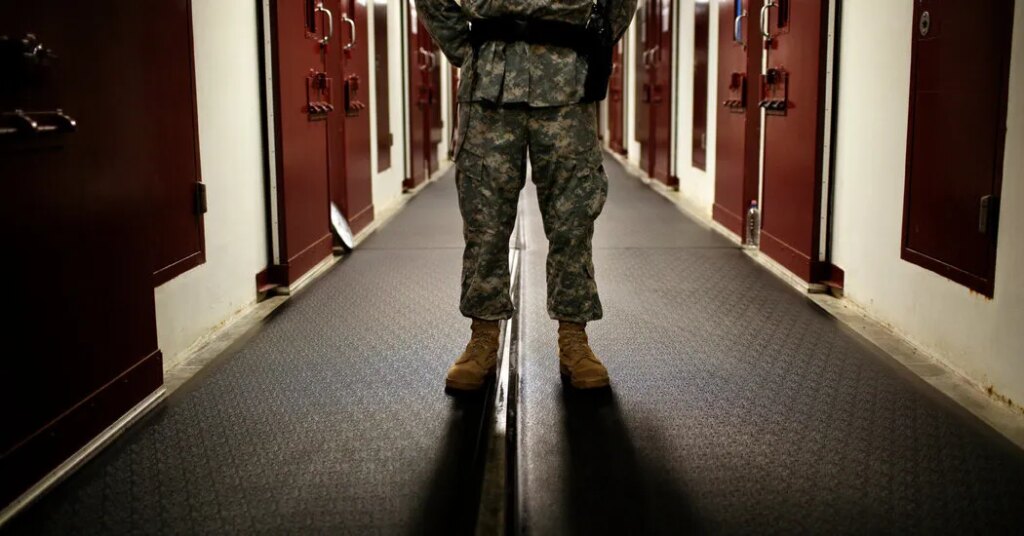
In the instance of Mr. Hawsawi, the judge said it was not necessary to decide whether he was tortured, only whether he voluntarily admitted his role in the plot when he was questioned by federal agents in a former C.I.A. prison compound at Guantánamo in January 2007.
“A detainee who is shackled, transported to a former C.I.A. black site, and intentionally kept ignorant of both his right to remain silent and the inadmissibility of his prior coerced confessions, cannot be said to be making an ‘essentially free and unconstrained choice,’” he wrote.
Lawyers who read the ruling said the judge emphasized that agents who questioned Mr. Hawsawi at Guantánamo explicitly omitted a reading of a classic Miranda warning of his right to remain silent over four days in January 2007. Nor was he told that his previous statements to the C.I.A. could not be used against him.
He had been held by the United States since March 2003 but was not allowed to see a lawyer. The agents who interrogated him in 2007 “specifically excluded an advisement of the right to counsel,” the judge wrote, according to an extract obtained by The New York Times.
Prosecutors have long considered the admissions made in the 2007 interrogations to be their best evidence against the men who are accused of conspiring in the attacks.
Other evidence prosecutors plan to use at the trial includes statements from other prisoners, transcripts of overseas phone calls and documents involving wire transfers.
Prosecutors told relatives of the victims of the Sept. 11 attacks last month that they decided not to appeal the ruling in the instance of Mr. Mohammed in order to preserve a June 2028 trial date in the case.
Mr. Hawsawi has often appeared as the most sickly of the defendants, and he has typically volunteered to waive court appearances and remain in his solitary cell at the wartime prison.
For years, he has sat in court on a special pillow or in a padded rehabilitation chair. His lawyers have said he was sodomized while in C.I.A. custody.
Investigations of the secret “black site” program found that Mr. Hawsawi was subjected to a rough, damaging rectal cavity search and also was subjected to a quasi-medical procedure called rectal rehydration.
The post Judge Throws Out Another Confession in Sept. 11 Case appeared first on New York Times.