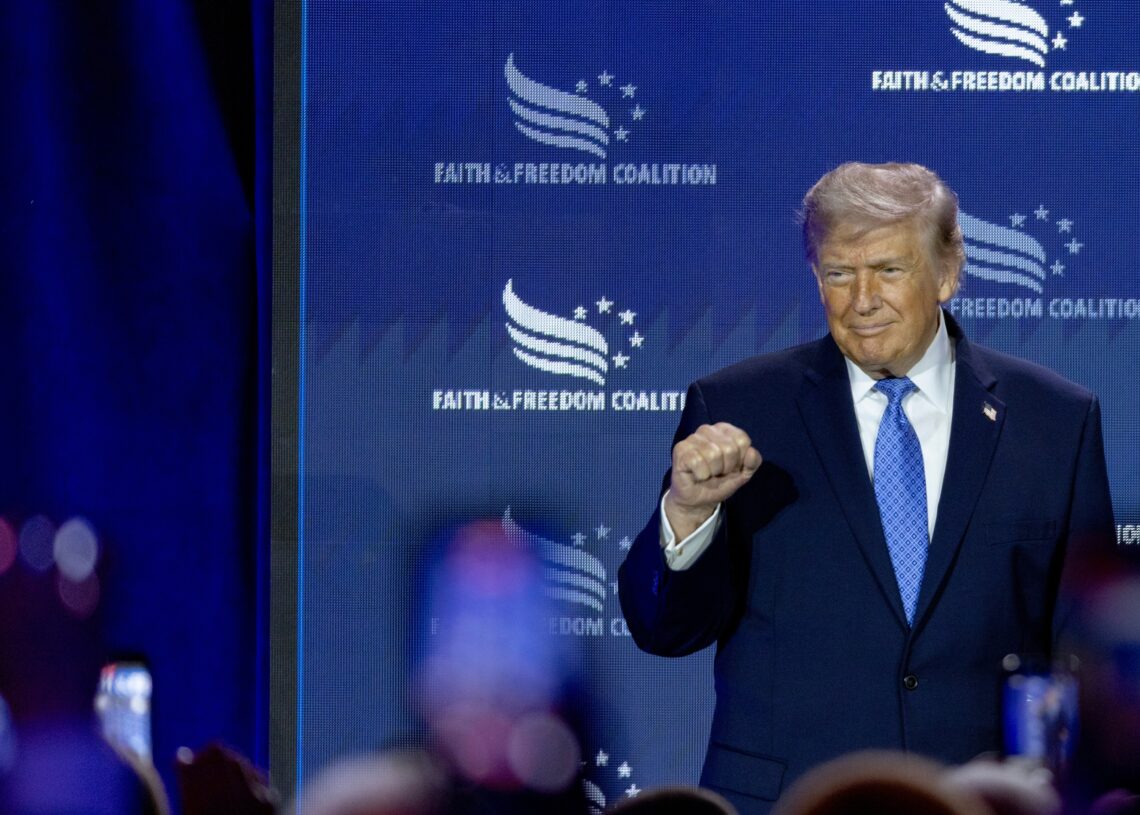
Donald Trump championed international religious freedom in his first term, turning a long-standing bipartisan cause into a foreign-policy priority. His administration gave the Office of International Religious Freedom a higher position within the State Department’s bureaucracy, stressed religious freedom in its 2017 National Security Strategy and appointed officials focused on religious freedom at the National Security Council and United States Agency for International Development.
Trump’s second term has been dramatically different. Trump has failed to issue statutorily required annual reports, inflicted DOGE-style cuts on religious freedom advocacy groups and demoted the religious freedom office within the State Department’s hierarchy. The 2025 National Security Strategy spoke skeptically of promoting “social change” in foreign countries, reflecting a retreat from the human rights advocacy of which the religious freedom agenda is a part. Far from prioritizing religious freedom through the NSC and USAID, Trump sidelined the former and gutted the latter.
Some religious freedom advocates have called the Trump administration’s new approach “a betrayal.” But the challenges faced by international religious freedom extend far beyond the current White House. They arise from broad disillusionment with international bodies and idealistic foreign policy. Unless advocates can adapt to this reality, official backing for international religious freedom will continue to decline.
Though Trump has advanced the turn away from a human-rights-based foreign policy, it probably would have happened without him. As a July report by the Everett Center for Global Religious Freedom put it, “political priorities in the United States and Europe are shifting back towards hard interests, reverting to the historical norm in foreign affairs.” This change is apparent in the fact that European governments, too, are cutting funding for religious freedom advocacy.
What explains this retreat from a cause that once enjoyed wide support? Efforts to promote religious freedom depend on a belief that American power — hard and soft — can be used to spread freedom and democracy. That idea has been challenged on both the progressive left and the populist right. U.S. interventions in the Middle East are invoked on both sides of the aisle to suggest that America is not a beacon of liberty but an agent of chaos.
On the right, this dim view of American power is complemented by growing skepticism of human rights as a tool of foreign policy. In 2011, Secretary of State Hillary Clinton gave a major speech declaring that “gay rights are human rights, and human rights are gay rights.” Her address was accompanied by a policy change from the Obama administration, which prioritized LGBTQ rights in diplomacy and foreign aid. Religious freedom advocates adapted to this new reality. Sam Brownback, the ambassador at large for international religious freedom during Trump’s first term, has argued that “the countries in the world that are best on LGBTQ rights are also best on religious freedom.”
For conservatives, these changes in rhetoric and policy contributed to a sense that the international promotion of human rights, including religious freedom, was a partisan cause, colored by conceptions of LGBTQ rights with which many Americans disagreed. This suspicion accorded with Trumpian fears over the power of “the deep state.” When Trump returned to office, a profound mistrust of the federal bureaucracy helped to justify cuts to aid programs that had long enjoyed bipartisan support.
The changing politics of immigration have also upended support for religious refugees. Beginning with the arrival of the Pilgrims at Plymouth Rock, America has been seen as a sanctuary for those fleeing religious persecution. President Joe Biden invoked this tradition when he responded to a question about whether there is a “human right” to migrate by mentioning Jews fleeing Nazi Germany.
Trump has spoken of migration not as a humanitarian matter but in terms of public safety and national security. Voters have responded by putting him in the White House twice, and Trump has delivered on his rhetoric by radically limiting America’s openness to religious refugees. According to a September report from the Christian aid group World Relief, the U.S. refugee admissions program had not resettled a single person fleeing religious persecution over the prior year.
Religious freedom advocates have good reason to criticize the Trump administration’s policies. But their influence will continue to wane unless they can find a new language in which to articulate their concerns — one that is clearly tied to national interest. That will mean speaking of religious freedom not as part of a long menu of human rights but as something that advances America’s traditions and security needs. It will mean relying less on international bodies and declarations, and more on discrete initiatives capable of commanding popular support.
An opportunity to do just that opened up this month, when Trump nominated Cissie Graham Lynch, the granddaughter of evangelist Billy Graham, to serve as ambassador at large for international religious freedom. He has also appointed prominent voices such as Bishop Robert Barron to the U.S. Commission on International Religious Freedom. In the name of American greatness, they should let freedom ring.
The post This ‘betrayal’ of religious freedom reflects forces beyond Trump appeared first on Washington Post.