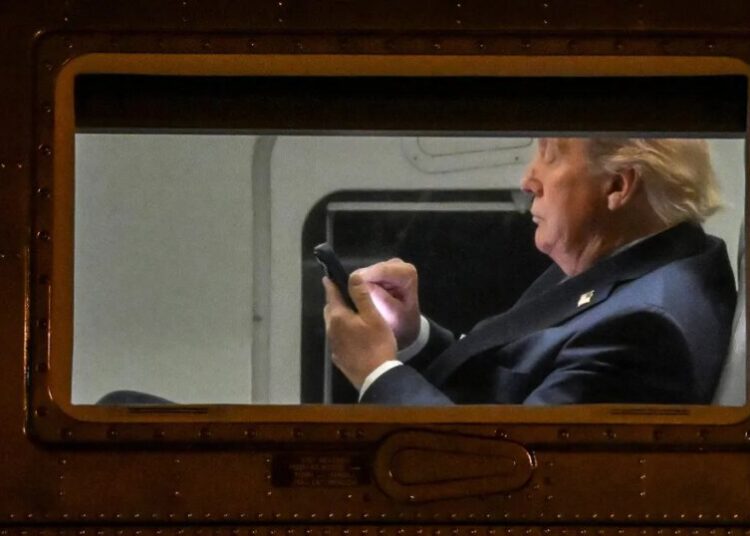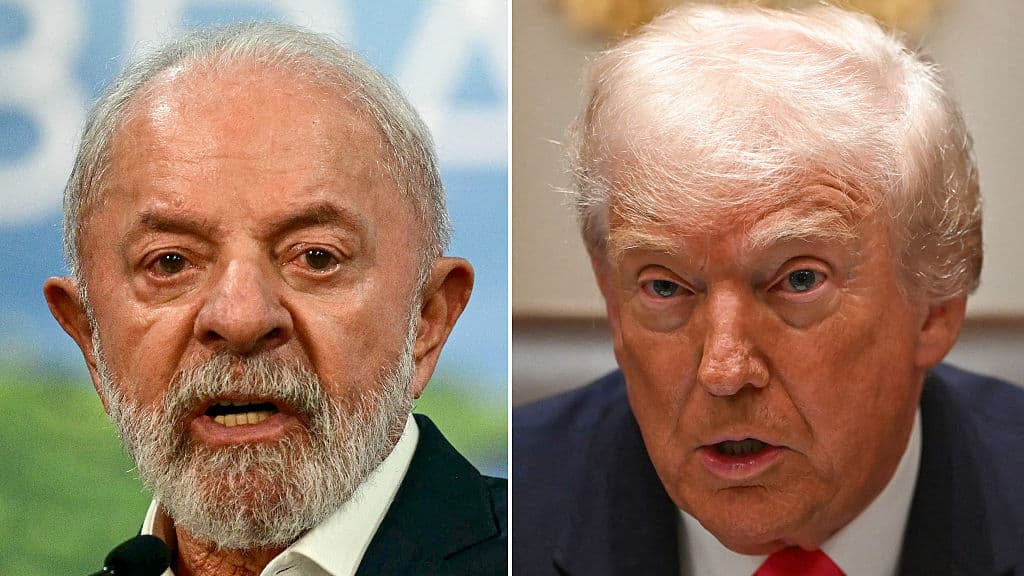
President Donald Trump on Thursday said he is following the upcoming Brazilian election “very closely,” referring to Brazil as a “very important” country. “The people of Brazil are fantastic people,” he told reporters outside the White House. “It’s a very important election.”
The U.S. State Department later announced the suspension of its consular services in Brazil ahead of the election taking place on Sunday, citing unspecified security concerns. “U.S. citizens seeking emergency assistance during this time should not come to the Embassy, the Consulates, or other U.S. diplomatic facilities,” the security alert advised.
Brazilians are heading to the polls for a set of federal elections spanning congressional and gubernatorial races, alongside the first round of the presidential election votes. It’s set to be a decisive moment for Latin America’s largest nation, as the region has seen a shift toward the right in recent years. An Oct. 25 runoff is expected, as polls show a tight contest between leftist President Luiz Inácio Lula da Silva and far-right Sen. Flávio Bolsonaro, the son of former President Jair Bolsonaro, who was convicted last year for plotting a coup to overturn his 2022 election loss. Trump led the conservative voices denouncing the conviction, referring to the trial as a “witch hunt.”
While Trump has acknowledged his active interest as Brazil votes on its political future, there are concerns he could be too involved. Trump and his Administration have been accused of attempting to interfere with the high-stakes overseas election.
In a letter sent to Secretary of State Marco Rubio in late September, Democratic lawmakers expressed “grave concern” over what they referred to as “the Administration’s coordinated effort to threaten our strategic alliance with Brazil and undermine the Western Hemisphere’s second-largest democracy ahead of its upcoming presidential election.”
“Over the course of President Trump’s second term, we have seen U.S. officials engage in a sustained, multifaceted campaign of interference and destabilization in Brazil,” the lawmakers said in the Sept. 24 letter, signed by 30 House Democrats and Independent Sen. Bernie Sanders of Vermont, who caucuses with the Democratic Party.
In another letter sent to Rubio on Monday, three Democratic Senators voiced similar concerns about potential U.S. interference.
“This effort first escalated sharply during the summer of 2025, with the [U.S.] Administration deploying tariffs and targeted sanctions to attempt to shape the Brazilian Supreme Court’s verdict in the trial of former President Jair Bolsonaro on charges of attempting to foment a military coup to stay in power,” said the Senators, noting that the tariff pressure escalated in July this year when the Trump Administration moved to impose a new 25% tariff on many imports from Brazil—a decision labeled a “lamentable milestone” by Lula’s office.
The Senators argued that the “campaign directed at Brazil’s authorities resumed with the appointment of Darren Beattie as a senior advisor on Brazil issues in the State Department.” Beattie served as a White House speech writer in Trump’s first term, but was axed for attending a gathering of white supremacists. He returned to the fold early on in Trump’s second term. When serving as undersecretary for public diplomacy and public affairs last year, he called one of Brazil’s Supreme Court Judges a “key architect of the censorship and persecution complex directed against Bolsonaro and his supporters.”
Accusing the Trump Administration of using “diplomatic, economic, and political pressure in ways that risk weakening [Brazil’s] democratic institutions [and] undermining confidence in Brazil’s electoral process,” the Senators closed the letter by asking the Administration to “commit to recognizing the certified outcome of Brazil’s 2026 democratic elections.”
The White House has staunchly rejected claims of interference in Brazil’s elections.
“Conservative leaders are winning elections across the Western Hemisphere on their own merit because everyone sees the success of President Trump’s policies,” said White House spokesperson Anna Kelly in a statement to TIME. “These claims are nonsense.”
President Lula has also expressed concern over Trump’s interest in his country’s election. “I have already told President Trump it is very important that the U.S. do not interfere in Brazil’s elections,” he said in a Sept. 22 interview. “Brazilian elections are the concern of the Brazilian people. American elections are the concern of the American people.”
Lula added that he is “very worried about Marco Rubio,” claiming that the U.S. Secretary of State “is very closely connected to Bolsonaro’s people,” though he stressed that this was only “suspicion.” TIME has reached out to the State Department for comment.
How the Trump Administration has been accused of meddling in Brazil’s affairs
Trump has not formally endorsed either candidate in Brazil’s presidential race, but his defense of former Brazilian President Bolsonaro, who was last year sentenced to 27 years in prison, is well documented.
After Trump criticized the trial proceedings as a “terrible thing” in July 2025, the Trump Administration increased pressure on Brazil’s government by imposing punishing 50% tariffs— extended in part due to Bolsonaro’s treatment in the courts—and directing the office of the U.S. Trade Representative (USTR) to investigate trade relations with the country.
The State Department added to the pressure later that same month, when Rubio called Supreme Court Justice Alexandre de Moraes’ actions a “political witch hunt against Jair Bolsonaro” and announced visa restrictions on Moraes, unspecified judicial allies, and their immediate families.
Feliciano de Sá Guimarães, an associate professor at the Institute of International Relations at the University of São Paulo, says Lula was able to turn the economic pressure into a political argument of his own.
“Lula realized that he could play [these threats] in his favor for electoral purposes,” he says, explaining that Lula used the concept of “rally round the flag,” meaning that once a country is targeted by another, “the incumbent President can rally the people and say, ‘look our sovereignty is under attack.’”
The theme of sovereignty has featured prominently in Lula’s 2026 government manifesto, which points to Trump’s tariffs as damaging the Brazilian economy.
Guimarães says the U.S. Administration has since slightly altered its strategy, favoring an approach that could instead benefit Lula’s opposition.
Flávio Bolsonaromet with Trump, Rubio, and Vice President J.D. Vance at the White House in May. Trump later described the Brazilian lawmaker as a “smart young man, who loves his country very much.” Shortly after that meeting, the U.S. Administration on May 28 designated Primeiro Comando da Capital and Comando Vermelho—two Brazilian gangs—as terrorist organizations, with Bolsonaro appearing to take credit for the move in the media.
Guimarães says the issue may have resonated in Brazil due to public concerns about crime.
“Brazilians are so desperate with the situation of crime in the country that they are resorting to support any initiative, whether it’s coming from the federal government or a foreign power to fix the problem,” Guimarães explains, so the move could be seen to strengthen Bolsonaro’s chances with the electorate.
Economic pressure has continued as well. After ordering the USTR to investigate Brazil’s trade practices last year, the office imposed 25% tariffs on the country in July under Section 301, for what it described as unfair trade practices.
Other disputes have further heightened diplomatic tensions. At the end of July, Brazil denied visas to two U.S. State Department officials,accusing them of trying to interfere in the upcoming election. Shortly afterward, Brazilian Ambassador Maria Luiza Ribeiro Viotti had her U.S. visa revoked.
Is the Trump Administration influencing Latin America’s rightward-turn?
Since returning to office, Trump has sought to exert U.S. influence more directly across Latin America.
In November 2025, the Trump Administration released its National Security Strategy, which highlighted a return to U.S. dominance in the Western Hemisphere and the beginning of the implementation of the “Donroe Doctrine,” an informal term for Trump’s reinterpretation of the 19th-century Monroe Doctrine.
“The corollary of the ‘Donroe Doctrine’ is trying to stop the influence of extra regional powers in Latin America, mainly China,” says Guimarães.
Trump has also showcased his support for right-wing candidates across the region.
In 2025, he endorsed close ally Javier Milei in Argentina’s midterm elections and supported Tito Asfura to become the next President of Honduras.
In June, he gave his “complete and total endorsement” to right-wing challenger Abelardo de la Espriella in Colombia’s June presidential election. (The Trump-backed populist went on to win the race.)
In response to Trump’s endorsement, House Democrats had sent a letter to Rubio expressing concern over what they said was “the brazen interference of senior U.S. officials, including President Trump” in Colombia’s election. “This interference involves the full-throated endorsement of Abelardo de la Espriella, a candidate with a profoundly troubling record that appears to run counter to U.S. interests and potentially to U.S. laws,” the lawmakers said.
But perhaps one of the most significant displays of American power came when the U.S. military captured Venezuelan President Nicolás Maduro and his wife during an overnight operation in January and brought them to New York to face narco-terrorism and drug trafficking charges.
Delcy Rodríguez, Venezuela’s acting president, has since adopted a friendlier posture toward the U.S. Administration, enabling access to the country’s oil. In an interview with TIME conducted in late September, Trump heralded the operation in Venezuela as an “incredible” feat and one of the “great things” he’s achieved in his presidency.
“The main reason the [U.S. Administration] will always prefer a right-winger more aligned with the United States, is so they can sell to domestic audiences that, at least in Latin America, Trump’s policy is to some extent an effective foreign policy,” Guimarães says.
The State Department under Rubio’s direction has been key in the Trump Administration’s approach to Brazil, Guimarães says.
He cites the creation of the Shield of Americas, a U.S.-led security and political coalition launched in March to fight drug cartels and transnational crime across the Western Hemisphere, as an example. Brazil has not joined the initiative.
Guimarães calls it an “initiative launched by Rubio who wants to bring all Latin American countries under the yoke of the United States to fight organized crime,” and argues that Lula’s resistance could fuel Rubio’s interest in seeing a right-wing government take power, as Bolsonaro has promised to integrate Brazil into the security initiative if he wins the presidential election.
The post Why the Trump Administration Is Being Accused of Interfering in Brazil’s Election appeared first on TIME.