Most people have never heard of the F.T.O. U-3 factory in Hyderabad, India, but its products affect millions of Americans intimately.
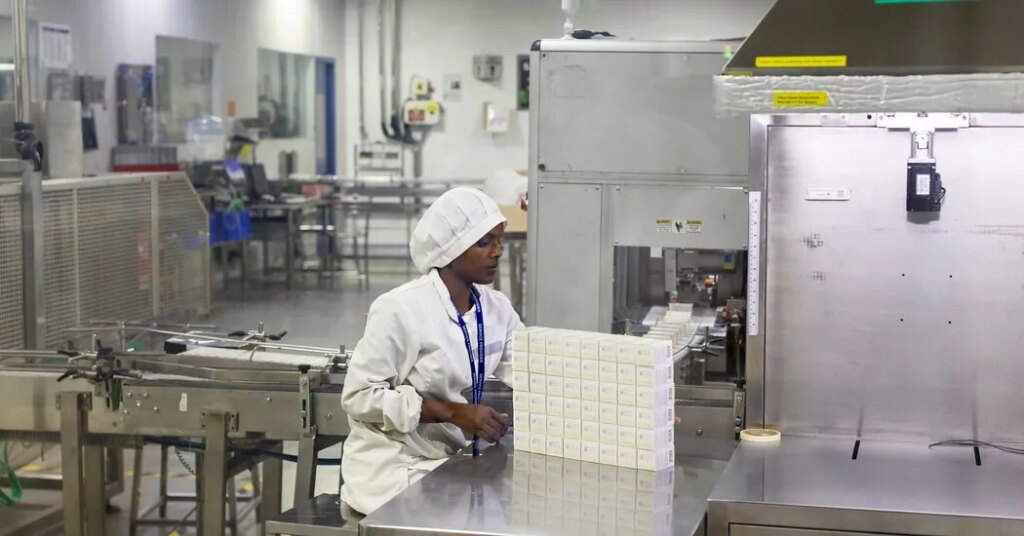
Inside the sprawling facility, about 1,900 Indian workers for Dr. Reddy’s Laboratories work around the clock to manufacture more than 100 generic drugs, including antihistamines, statins and antidepressants. Of the nearly one billion oral doses produced there each month, 75 percent go to patients in the United States.
The scale of India’s pharmaceutical industry has made it a cornerstone of the global drug supply. In a high-volume, low-margin business, India’s ability to make pills at a small fraction of what they would cost elsewhere has created an almost insurmountable hurdle for the United States, which is trying to bring that production home.
President Trump has said he wants to bring generic drug production back to America, using tariffs to pressure pharmaceutical companies.
In a July social media post, Mr. Trump said he planned to impose a 100 percent tariff on generic drugs starting in 2028, followed by a 200 percent tariff a year later, when his term will have expired. Generics account for 90 percent of drugs prescribed in the United States, and 40 percent of them are made in India.
When the United States imposed a new 100 percent tariff on certain pharmaceutical imports on Tuesday, it exempted generic drugs and many other products. Doctors and supply chain experts say taxing imported generics would raise costs, spur rationing and lead to shortages of crucial drugs.
Even a 200 percent tariff on generic drugs might not erase India’s advantage. Sudarshan Jain, secretary general of the Indian Pharmaceutical Alliance, estimates that most tablets and liquids made in India would cost at least four times as much to produce in the United States.
India got its start in generics in the 1970s by prioritizing affordable drugs for its huge and mostly poor population at a time when Western multinational drug companies did not. For decades, India refused to recognize drug patents, while its manufacturers patented processes they devised to reverse-engineer medicines sold in wealthier markets.
By the time India’s patent law was brought into accordance with World Trade Organization standards in 2005, its companies had become experts at processing complex drugs and producing them for much of Asia, Africa and Latin America. Around the same time, Americans started embracing generic drugs. By 2004, they started to account for more than half of prescriptions filled in the United States.
The greatest profits come from patented drugs, so “in the U.S., once it goes out of patent, you forget about it,” Mr. Jain said. “But in India, the entrepreneurs keep on working and developing it, and at these volumes, you get better at making it.”
That business is poised to grow. Over the next five to seven years, Mr. Jain said, 55 major patents worth $300 billion a year will expire in the United States, widening the pipeline for Indian manufacturers.
India’s advantage is not just expertise. Peter DeYoung, the American-born chief executive of Piramal Global Pharma in Mumbai, runs more than a dozen factories, including in Europe and the United States. In America, he said, labor is the highest cost “by a wide margin,” followed by energy and materials. In India, it’s the reverse: Materials are the greatest cost and workers the least.
Mennisha Paka, 23, supervises a line at the F.T.O. U-3 factory for Dr. Reddy’s Laboratories, packaging generic metoprolol, a beta blocker prescribed to heart patients. She earns $3,840 a year and uses part of her salary to pursue a bachelor’s degree in pharmaceutical chemistry. One of her subordinates, Susmita, who goes by one name, earns about $2,000 a year.
Both women make less than one-tenth the average salary of a worker in pharmaceutical manufacturing in the United States.
India has other advantages. Mr. DeYoung said factories and processes that took four years to set up in the United States, Europe or Israel — home to Teva Pharmaceutical Industries, the biggest generics maker — could be completed within a year in India. Customized equipment can be made in half the time it would take in Germany or Austria.
For years, relying so heavily on Indian factories had a downside: quality. A series of scandals beginning in the early 2000s tarnished the industry’s reputation. The most notorious offender, Ranbaxy, sold subpar drugs and lied to the U.S. Food and Drug Administration about its processes before going under more than a decade ago.
A book about the scandal has since become required reading for many industry managers. Its epilogue said that as recently as 2019, the F.D.A. still announced Indian factory inspections days in advance, giving operators time to conceal shoddy practices.
That is no longer the case, at least among big manufacturers. Dr. Reddy’s underwent a surprise inspection two weeks after Mr. Trump declared a tariff on generics. Piramal said its factory in Digwal, three hours west of Hyderabad, had undergone 415 inspections since it was built in 2012, including 49 from the F.D.A., with zero serious violations detected.
Piramal makes generics, but even more of its business is contract manufacturing for clients that hold drug patents. Keeping smaller factories in the United States makes it easier for some customers to keep tabs on production.
That geographic spread points to another problem with trying to produce all pharmaceuticals locally. Modern drug supply chains don’t divide neatly into things made in America and things imported from elsewhere.
One sealed barrel among thousands in Piramal’s main Digwal storeroom was made in India, shipped to Singapore and back, and bore the brand of a Japanese company with an American address.
Another drug, which Mr. DeYoung would describe only as a lifesaving medicine to treat central nervous system conditions, begins its journey in Digwal, then travels 8,000 miles by air to Piramal’s facility in Riverview, Mich.
Riverview, a quiet suburb of Detroit with broad lawns and white steeples, is a far cry from Digwal, where nearby villages still draw water from stone-lined wells. But specialized machines in Piramal’s Indian and American labs collaborate to turn the medicine into its final form.
There are good reasons to pair facilities in India with plants in their destination market, Mr. DeYoung said. Some drugs require especially dangerous chemicals, including some controlled by the Drug Enforcement Administration. Others, like sevoflurane, a generic anesthetic Piramal makes in both India and the United States, must remain available even if international supply chains break down completely.
Which raises a more fundamental question than whether tariffs can force drug manufacturing back to America.
“So what problem are you trying to solve?” Mr. DeYoung asked about the prospect of a tariff on imported generics. Is it to bring back pharmaceutical jobs to American workers? Is it to safeguard supplies of vital medicines?
Even as Indian firms wrestle with the Trump administration’s push to reduce its dependency on India, they are also grappling with their own reliance on another country for a critical part of the pharmaceutical supply chain.
Starting in the 1990s, China became the world’s dominant manufacturer of the active ingredients that most drugs require. India is now trying to reclaim that ability.
That, Mr. Jain said, creates an opportunity for the United States and India to work together, instead of pulling their pharmaceutical industries apart.
“Unless we work together with the U.S., we’ll be dependent on China” for ingredients, he said. That’s why, he added, it makes sense for American buyers “to stockpile from India” instead of making it in the United States “for six, seven or eight times the price.”
The post America Wants to Make More Generic Drugs. India Shows Why That’s Hard. appeared first on New York Times.