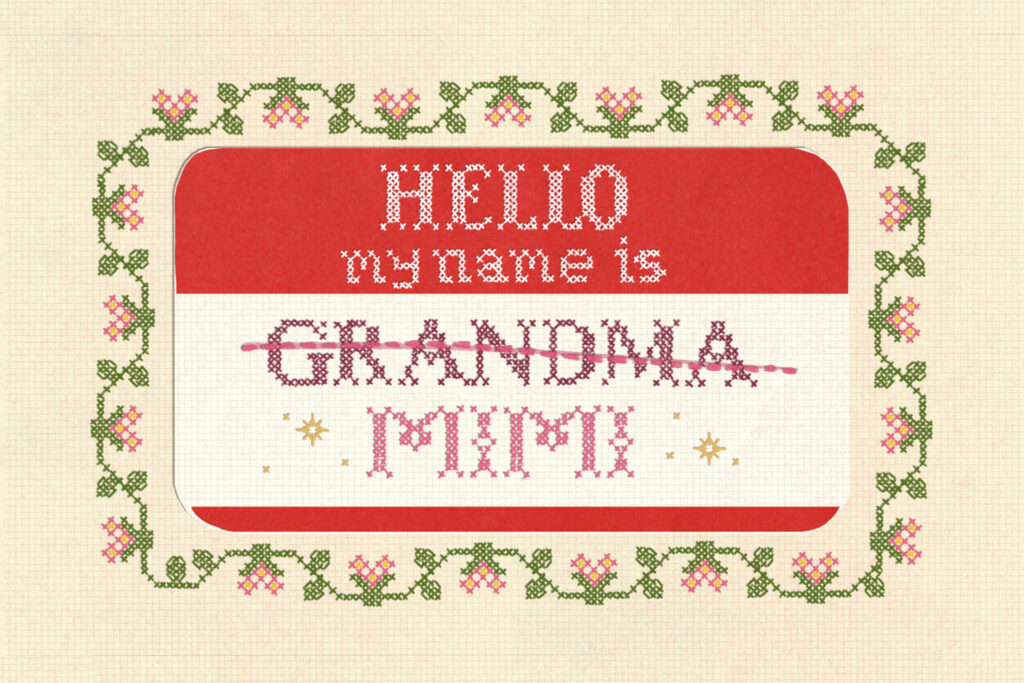
My first grandchild, Nolan, is due in early February. As I’ve been sharing the news with friends, I expected the first question to be, “Are you excited?” Instead, nearly everyone asks, “What’s your Grandma name going to be?”
Apparently, becoming a grandmother today comes with a branding decision.
I’d never considered what my future grandchildren would call me, and it feels like I’m choosing a new identity for this stage of life. “Grandma,” “Nana,” “Mimi,” “Gigi,” “Meemaw,” “Lovey,” “Lolly” or “Glama”? The possibilities seem endless, making the decision surprisingly daunting.
With just over four months to decide, the clock is ticking to find the perfect grandma name for me. And as I’ve been pondering, I started to wonder where this newfound interest in grandmotherly sobriquets came from.
Unpacking the trend
Cathy Livingstone, author of “The Best Grandmother Names Ever,” says the trend of choosing a creative name started with baby boomers. Before that, it was common to use Grandma followed by a first or last name or to choose another word that means grandmother, such as Nana or Gram.
When boomers started becoming grandmothers, “they wanted a moniker that aptly described them,” she says. “They were running corporations and marathons. They didn’t want a name that conjured up the woman with an apron and cotton-ball white hair.”
Celebrities have helped popularize the trend. Katie Couric has said that she chose “Gogo,” because she’s always on the go. Meanwhile, on Couric’s podcast, Kris Jenner shared that she goes by “Lovey.” And Goldie Hawn’s grandchildren call her “Glam-Ma,” according to her memoir.
Choosing fun names can be connected to our youth-oriented society, says Madonna Harrington Meyer, professor of sociology at Syracuse University and author of “Grandmothers at Work: Juggling Families and Jobs.” “It’s generally related to somebody who’s really trying to minimize any signs of aging in their life,” she says. “I don’t think that that’s wrong. I think that’s maybe just their style.”
What’s in a name?
Various factors may influence what a grandmother is called. Some people choose a name based on their heritage. For example, my sister picked “Nonna,” to honor our Italian ancestry, as did our mom, who went by “Nonnie.” Other common choices include “Yaya” (Greek), “Oma” (German), “Abuela” (Spanish), “Gogo” (Zulu) and “Ama” (Taiwanese).
Lynn Hardin of Frisco, Texas, chose “Unci” to honor her great-grandmother, who was 100 percent Lakota Sioux. “‘Unci’ means ‘grandmother earth’ in Lakota Sioux and stands for respect and wisdom,” she says. “Grandmothers are very respected in the Lakota Sioux culture. Honoring my heritage seemed to be the right thing to do.”
Some women pay homage to past generations by choosing the same name they called a beloved grandmother.
Corinna Windon of Wilmington, Delaware, chose “Mommom,” a title she believes is at least four generations deep. “I was very close to my mom’s mom and called her ‘Mommom,’ as did all her other grandchildren,” she says. “This name reminds me of the times spent with her and summers at the beach. Being a mommom now myself, I hope to instill memories for my grandchildren.”
Choosing the same name is a great way to honor the women who came before us, says Harrington Meyer. “It can become a beautiful story when it’s used generation after generation.”
Where you grew up could also play a part in your choice of names, according to a survey by YouGov. While “Grandma” is the most common choice across the country, people in the Northeast frequently choose “Nana.” In the Midwest, “Grandmother” is common, while in the South, it’s “Granny.” And for those living out West, “Gramma” is popular.
Then there are names that say something about the grandmother herself, and this is where rules go out the window. I posed the question, “What is your Grandma name?” on the Grown and Flown Parents Facebook page, which has more than 300,000 members in the empty-nest phase, and I received more than 500 responses. The most popular were “Gigi,” “Mimi” and “Nana.”
There were also some unique picks. For example, Emily Cathcart of Nashville chose “ChaCha” because it was fun and easy to say. “Long after you are dead and gone, you will be referred to by your grandmother name in family stories and memories. Make it a cool one,” she suggests.
In Harrington Meyer’s experience, grandmothers seem to care more than grandfathers. “In one family, they asked the grandpa, ‘What do you want to be called?’” she says. “His name was Henry and he said ‘Fred.’ Fred stuck, and he is Fred [to his grandkids].”
According to Livingstone, grandfather names tend to be less creative. “Typically, they’re Pops or PopPop,” she says.
Who gets to decide?
Just because you choose your name, doesn’t mean you get to keep it. Firstborn grandchildren sometimes get “naming rights,” according to Harrington Meyer. “There can be the name you prefer, but there’s also what the child is able to say,” she says. “Those are the best stories of all; somebody names them and then it sticks.”
Melissa Davis Haller of Cincinnati originally chose “Mimi,” when her grandson was old enough to talk, but he didn’t repeat it. She tried “Birdie” without luck, too. Then she gave up and told her grandson to use “Grandma” and “Grandpa.” “He immediately pronounced it ‘Gumma’ and ‘Beppah’ and that stuck,” she says.
Susan Scott of Brookfield, Wisconsin, assumed her grandchildren would call her and her husband Grandma and Grandpa like she had called her grandparents. But when the oldest grandchild could talk, she had other ideas. “She named us ‘Maney’ and ‘Bapa,’ so that’s who we are,” she says.
Your son or daughter may also have an opinion. For example, when Jeni Rogers of Naperville, Illinois, became a grandmother, her daughter-in-law christened her “Honey” after a character in her favorite movie, “Matilda.”
“Miss Honey was a teacher who was kind to the students and saved Matilda,” Rogers says. “I was a teacher for 38 years, so it was a compliment she asked me to take that name.”
Harrington Meyer’s only real guideline is to distinguish between grandparents. “If there are remarriages, some kids may have four sets of grandparents,” she says. “That’s a lot of names to keep squared. The children need to know who’s coming for dinner.”
Choosing a name should be fun and meaningful, Livingstone says. “Grandparents are so important,” she says. “You see them at class field trips and on the soccer fields with the grandkids. They’re such an asset and should be celebrated. Choosing their name is part of that celebration.”
As for me, I’m still thinking. Nana? Grandma Steffi? Mimi? I’m not sure. My secret wish is that Nolan will name me. It couldn’t get more special than that.
The post Gigi or Nana? The difficult process of picking a grandmother name. appeared first on Washington Post.