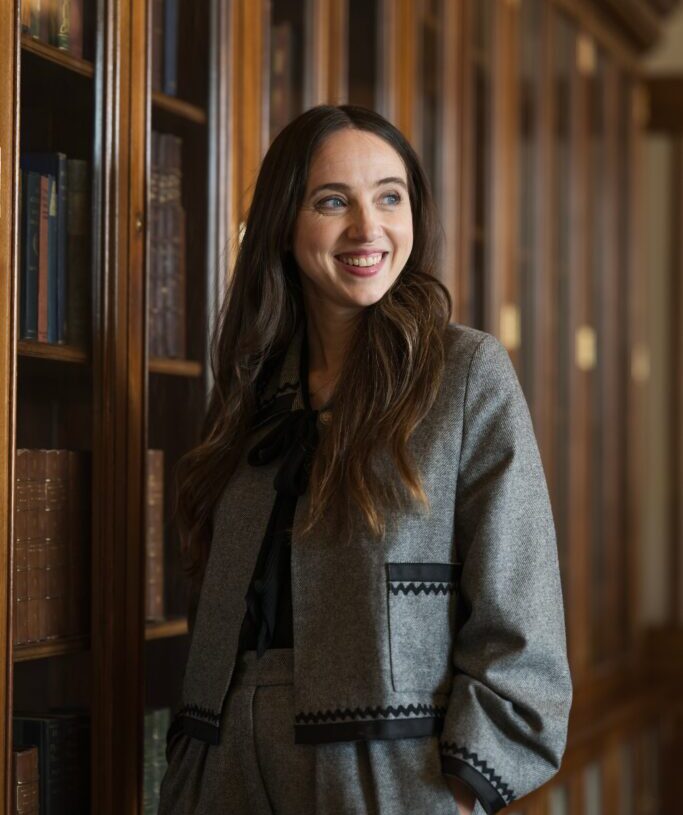
Zoe Kazan can only marvel at the treasures laid before her.
As the screenwriter and actress visits the Library of Congress on this mid-September afternoon, two weeks before her limited-series adaptation of John Steinbeck’s “East of Eden” hits Netflix, the curators have assembled a wealth of artifacts for Kazan to peruse.
The original Time magazine review of “East of Eden” catches Kazan’s eye, both for its ruthless dismantling of Steinbeck’s 1952 magnum opus and its pointed headline: “Gentlemen & Sluts.” “Wow, they really came for it!” she says with a laugh. “We should make T-shirts.” Sifting through production stills from the 1955 film adaptation — directed by her grandfather Elia Kazan — Kazan sweetly swoons over an image of actress Lois Smith, whom she would appear with off-Broadway a half-century later.
But it’s the sight of a weathered red slipcase — slightly sun-dyed, bent at the corners — that leads the 43-year-old to exclaim “I know what this is!” and to promptly unleash waterworks. Kazan owns an “East of Eden” first edition, but the original box has long proved elusive — until this moment. Kazan’s eyes well up. Her voice cracks. Running her fingers along the 74-year-old cardboard, she cradles the delicate case.
“I love that,” she says. “It’s so beautiful.”
Such is Kazan’s connection to “East of Eden.” When Netflix announced two years ago that she had been tapped to oversee this latest iteration, she took to social media with a telling acknowledgment: “This has been the work of my last four years and, in some ways, my life.”
Kazan, who proudly says that her first word was “book,” has long been a literary creature. She made her screenwriting debut with 2012’s “Ruby Sparks,” in which she played a love interest magically manifested by a struggling novelist (played by her real-life partner, Paul Dano). Kazan and Dano then collaborated on the screenplay for the contemplative 2018 drama “Wildlife,” adapted from Richard Ford’s novel.
Kazan was 15 when she first read “East of Eden.” She was captivated not just by the magnetic characters — the naively idealistic Adam Trask, the callous, complicated Cathy Ames, the approval-craving Cal Trask — but also Steinbeck’s authorial intent. The Los Angeles-raised daughter of screenwriters Robin Swicord and Nicholas Kazan, she also felt a kinship to the account of East Coast transplants in California’s Salinas Valley.
At that point, Kazan had never seen her grandfather’s film — the James Dean classic that earned four Oscar nominations — or discussed Steinbeck’s intergenerational epic with him. (Elia Kazan died in 2003, when she was 20.) So when her agent reached out two decades later about shepherding a new version to the screen, Kazan seized the opportunity without giving much thought to the legacy she would naturally confront. But as she considered the groundswell of pertinent themes — familial approval, individual agency, the weight of inheritance — Kazan realized there was no avoiding the thorny conversation.
“There’s the nature-versus-nurture thing of: Was I drawn to this book because I was the kind of person who was already thinking about inheritance and breaking cycles?” Kazan says. “My first reaction to all of that baggage was, ‘But my love for this book is separate from my grandfather’s relationship to it.’ But then I think there’s some other, more mature part of my brain that’s, like, ‘Yes, that can all be true — and then also there’s this very strange tie between me and this material.’”
The result, a seven-part series that started streaming Thursday, is a significant feat. Although the film tackled only the final portion of Steinbeck’s sprawling Cain and Abel allegory, Kazan adapted it all — tracking the parallel stories of Adam (played by Christopher Abbott) and Cathy (Florence Pugh) and their sons (Joseph Zada and Joe Anders) from 1862 to 1918. Characters excised from the film — such as Adam’s brooding half brother, Charles (Mike Faist), and the code-switching philosophizer Lee (Hoon Lee) — are richly depicted here. And the concept of timshel, a Hebrew word meaning “thou mayest,” is restored as “East of Eden’s” ideological core.
“Zoe was interested in the dirty, murky parts that make us all human,” Pugh says. “She wanted to make it feel like these people were real, and living in a real time.”
Kazan, who wrote every episode and shared show-running duties with Jeb Stuart (“Die Hard”), had her work cut out turning Steinbeck’s leisurely, lyrical tome into a propulsive on-screen story. One example: The series’ opening scene, when a bloodied Cathy crawls onto Adam and Charles’s porch, occurs more than 100 pages into the novel — after Steinbeck takes his time reveling in Californian scene setting and time-hopping reflection.
“I have nothing but love for my king, John Steinbeck, but I do think that the novel has quite a slow start,” Kazan says. “For a novel, that can be a beautiful thing. … As a dramatist, your job is very different.”
As Kazan points out, Adam — the ostensible protagonist — is a largely passive character defined by his choice not to move on after his wife, Cathy, walks out. So she focused on Pugh’s Cathy, the character long seen as the novel’s cruel antagonist, as the show’s “engine of plot.”
“She wasn’t wanting to create another simple female villain,” Pugh says. “She wanted to create something deeper and more meaningful than that, and allow for Cathy to be all sorts of things — not just one thing. She’s not just evil. She’s not just bad. She’s not just a monster. We’re showing a whole lifetime of Cathy.”
Unpacking Steinbeck’s view of Cathy can be unwieldy. In a letter to a family friend, he described her as a “total representative of Satan.” The “East of Eden” narrator flatly calls Cathy a “monster.” Yet that omniscient figure later muses that “it is easy to say she was bad, but there is little meaning unless we know why.” When Kazan combed through the letters Steinbeck wrote to his editor, she saw an author with evolving empathy for his novel’s purported villain.
“I do think at a deep, deep level, Steinbeck was a humanist and was trying to get us to look at ourselves and think about ourselves,” Kazan says. “I think sometimes that humanist impulse in the book comes out beautifully and fully in complex ways, and sometimes I think that the kind of misogyny and racism of a mid-century White male viewpoint overrides his intention toward humanism.”
That said, Kazan doesn’t shy away from Cathy’s despicable deeds. The character can be cold and calculated, vengeful and vindictive. She’s certainly not a feminist, in Kazan’s mind. But this “East of Eden” also reveals Cathy as a survivor driven to desperate measures by patriarchal malice. Her unresolved traumas linger. Her mental health issues go untreated. Her concerns aren’t heard. Thus, we witness — through Kazan’s nuanced writing and Pugh’s tortured performance — not a diabolical rise, but a tragic descent.
“Zoe gave me so much confidence in myself and in understanding my worth,” Pugh says. “I’m probably not damaged after shooting it because I had Zoe alongside me, helping me figure out who this woman is and joining in all of the pains that this woman goes through.”
Although Kazan is best known as an actress — her eclectic credits include “Revolutionary Road,” “It’s Complicated,” “Olive Kitteridge,” “The Big Sick” and “She Said” — she hasn’t performed since a Broadway revival of “Doubt” nearly three years ago. Recently hired by Netflix to tackle another imposing text, Larry McMurtry’s 1985 novel “Lonesome Dove,” Kazan can’t say when she’ll return to the screen or the stage.
Also, as a mother of two, she’s pickier about her projects nowadays. “I would love to act more,” she says. “It just really has to be worth my time.”
In other words: Kazan likes to approach her work as a choice, rather than an edict. Timshel. That’s what led her, after all, to wrestle with her lineage on “East of Eden.”
“I don’t want my family’s relationship to this material to supersede the actual characters,” she says. “At the same time, it’s my deep desire that anyone encountering my show will then walk away thinking about their families and their own relationships to the things that they are trying to change or break free from.
“So, in that way, it is right and good that I should be asking myself those questions.”
The post ‘East of Eden’ is a tale of familial legacy. To tell it, Zoe Kazan confronted her own. appeared first on Washington Post.