Two members of Congress are ramping up efforts to investigate the consequences of DDT pollution off the Southern California coast — an issue that has horrified scientists and policymakers since they learned that as many as half a million barrels of toxic waste had been dumped into the ocean after World War II.
A bill introduced this week in both the Senate and the U.S. House of Representatives lays out a long-awaited proposal on how to reckon with California’s poisoned marine environment. Officially named the “Ocean Protection and DDT Reduction Act,” the legislation has been years in the making and seeks to address many of the concerns raised by Californians and others around the world.
“I was shocked … I know firsthand how much our communities depend on a healthy ocean — from our fishermen and maritime workers to our tourism and coastal economies. We have a responsibility to protect these waters,” said U.S. Rep. Salud Carbajal (D-Santa Barbara,) who introduced the bill with U.S. Sen. Alex Padilla (D-Calif.) and cited The Times coverage of the issue. “Our hope is to move things forward in a way that is meaningful, in a way that’s done expeditiously, and in a way where we are able to achieve a real, meaningful solution to this problem.”
Public concern has been mounting since The Times first reported the little-known history of ocean dumping off the Southern California coast — and how the nation’s largest manufacturer of DDT had for years disposed of its waste at sea.
Although DDT, which is short for dichlorodiphenyltrichloroethane, was banned more than 50 years ago in the wake of Rachel Carson’s “Silent Spring,” the chemical is so powerful that it can take generations to break down. Scientists continue to trace significant amounts of this once-popular pesticide in present-day dolphins and coastal-feeding condors, and a recent study linked its presence to an aggressive cancer in California sea lions.
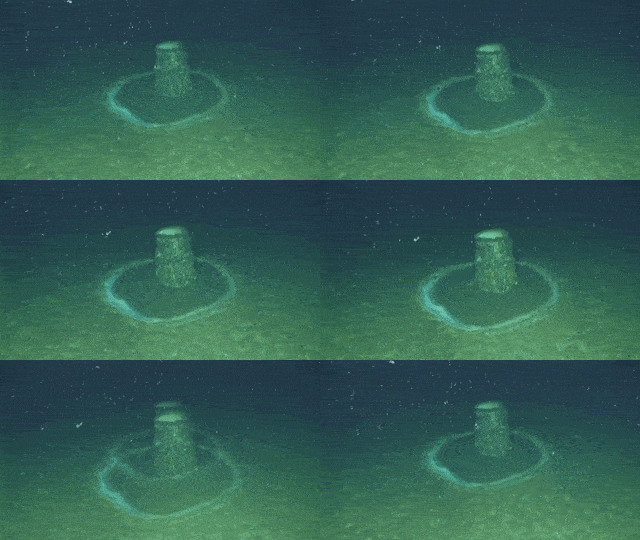
Dozens of ecotoxicologists and marine scientists are trying to fill key data gaps, and the findings so far have been one plot twist after another. A research team led by UC San Diego’s Scripps Institution of Oceanography had set sail to help map and identify as many barrels as possible on the seafloor — only to discover a multitude of discarded military explosives from the World War II era.
And in the process of digging up old records, the U.S. Environmental Protection Agency discoveredthat from the 1930s to the early 1970s, 13 other areas off the Southern California coast also had been approved for dumping of military explosives, radioactive waste and various refinery byproducts — including 3 million metric tons of petroleum waste.
Despite all the research, there has been no clear path forward on how to respond to the problem. (As one scientist put it, there is no Office of What Got Dumped into the Ocean More Than 50 Years Ago.)
The bill seeks to solve this lack of governmental leadership by designating the National Oceanic Atmospheric Administration (NOAA) as the main coordinating agency on this issue, with additional consultation from the Environmental Protection Agency, the Department of Defense and other relevant agencies.
Carbajal and Padilla also propose authorizing $6 million a year through 2034 to build out a program that will map the extent of the contamination on the seafloor and track how the chemical (and related chemicals) are spreading through the water and the food web.
The proposed legislation also calls on scientists to analyze and explore the possibility of cleaning up the contamination — potentially through bioremediation — and to “develop tools, technologies, and scientific approaches that can serve as a foundation to characterize the disposition and impact of waste disposal at other ocean locations.”
“Our communities deserve to know what’s in the water … and what it means for our health, our fisheries, and our future,” Padilla said. “By putting NOAA’s scientists and our leading research institutions to work mapping the contamination, tracking how it moves, and exploring cleanup through bioremediation, we can finally address this problem head-on.”
Carbajal and Padilla said they are building bipartisan support for the bill in both the House and the Senate.
David Valentine, whose research team at UC Santa Barbara first discovered the corroding barrels on the seafloor, said while California may be ground zero for this issue, the bill also would lead to advancements in science and policy that could then be applied to other dump sites along the nation’s coastline.
“Over the past few years, we’ve developed a really robust research community around the issue of deep ocean waste disposal and its impacts, and that community is primed and ready to work on this issue moving forward, both off California and elsewhere in the country,” Valentine said. “We were fortunate to have some support to get us started, but what we’ve really been lacking is both the continuity and a focused program to help coordinate all of the efforts. … And this bill really provides an opportunity for that community to coalesce around this issue in a longer-term way.”
Mark Gold, an environmental scientist who has spent more than 30 years pushing for DDT cleanup, said that the bill’s passage would be monumental. He hopes it finally would bring together all disparate data and knowledge collected from the deep ocean, as well as along the Palos Verdes Shelf — where DDT had been discharged for years via the sewer system — and the mouth of the Dominguez Channel, a long-identified DDT hot spot.
“The need to integrate all of that data, and to continue with what has been done in the last six years — it’s just so enormous to finally get to a place where decision-makers will have all the information they need to do what’s best to protect public health and the environment,” said Gold, who now serves as the director of the California Cooperative Oceanic Fisheries Investigations (CalCOFI) for Scripps Institution of Oceanography.
“This is one of the most tragic environmental stories in our nation’s history, and to ‘end the story,’ so to speak, before it has a conclusion is inappropriate,” Gold said. “So for Congress to make this sort of investment, at this level, in additional research and potential solutions is incredibly critical — and shows that this is a story that absolutely deserves an ending.”
The post New bill in Congress seeks to investigate toxic dump off California coast appeared first on Los Angeles Times.