Photographs by Maciek Nabrdalik
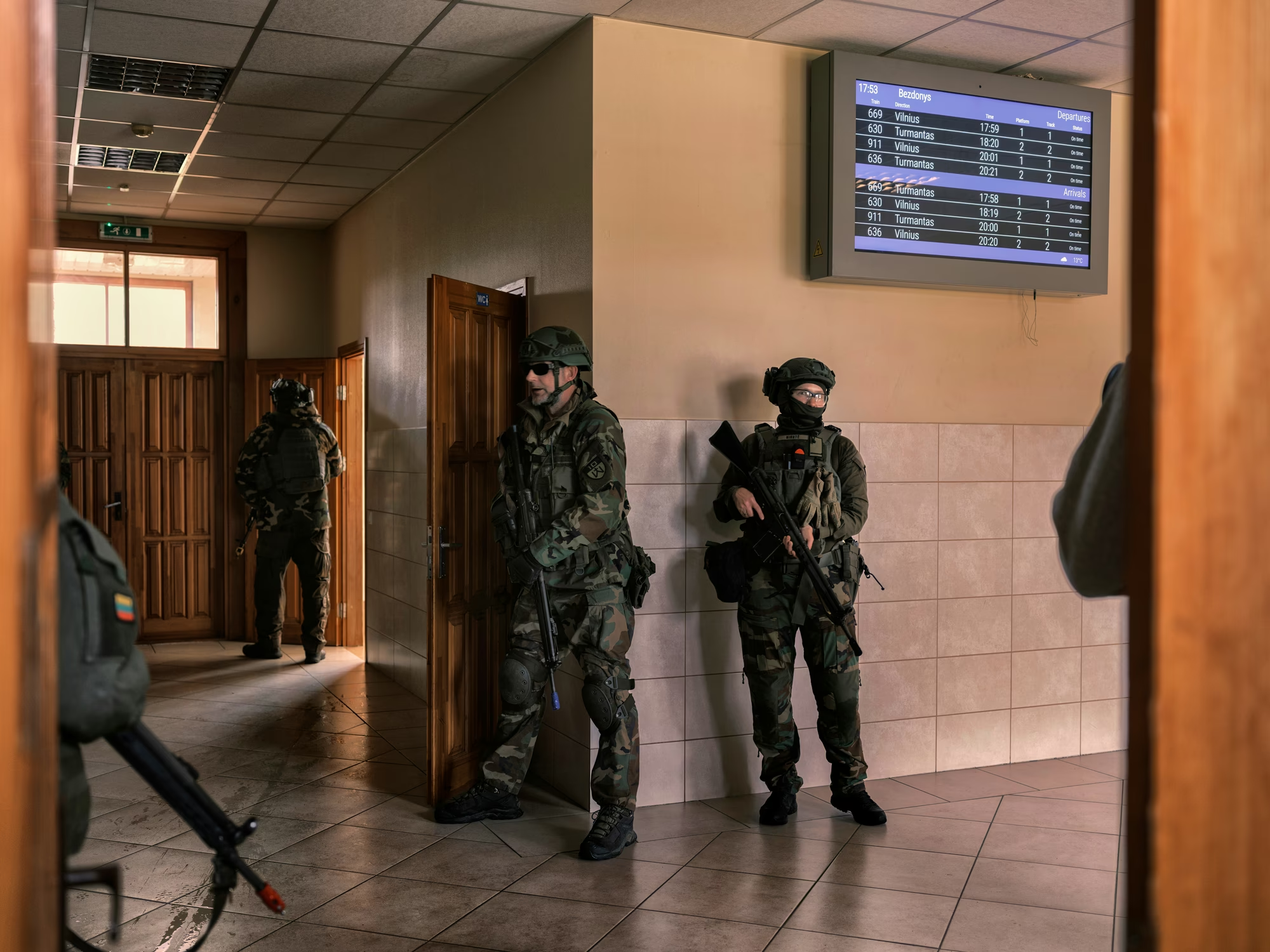
One evening this summer, in the village of Bezdonys, in eastern Lithuania, I watched as a platoon of riflemen arrived at a train station occupied by enemy forces. Some of the Lithuanians let out a burst of gunfire from across the tracks, pinning the adversary in place as the rest of the unit advanced on the station. As the firefight intensified, wounded riflemen were evacuated to makeshift medical tents. An enemy soldier lay slumped against the station’s yellow clapboard siding.
Military exercises are elaborate acts of make-believe. I was observing this one to understand how a large-scale attack on the most vulnerable part of the NATO alliance might play out—and to see how the Baltic states of Estonia, Latvia, and Lithuania think about their own defense. The raid in Bezdonys was part of a nationwide simulation and involved the Lithuanian Riflemen’s Union, a state-supported militia group that traces its history to the end of World War I. The Lithuanians I met wore camouflage fatigues and had no trouble accepting the scenario behind the exercise: that the enemy—Russia—had invaded their country, and that defensive forces had retreated to a city in the north. In their civilian lives, the riflemen are teachers and sales managers, economists and medical students. Now, suddenly, they were responsible for ambushing Russian outposts, killing enemy soldiers, and transmitting intelligence to the army.
“The enemy has to know,” General Raimundas Vaikšnoras told me, “that if they step one foot in our territory, we will strike back.” Vaikšnoras is Lithuania’s defense chief, and his distrust of Russia, a former occupying power, is not a notional concern. Ever since Russia’s invasions of other post-Soviet nations—Georgia in 2008; Ukraine in 2014 and 2022—conflict with Moscow has been front of mind for the people of the Baltic states. The three countries are small—Lithuania, the largest, is about the size of West Virginia—and grouped, one atop the other, on the shores of the Baltic Sea. They are also linked geopolitically by their common experience on Russia’s western borderlands, one of subjugation and dispossession. The Baltic states escaped some of that past after the fall of communism and the breakup of the Soviet Union, when they regained their sovereignty. And they took measures to solidify that status when they joined NATO, in 2004, attaching themselves to the American-led security order.
They have much to lose from what looks to be the unraveling of that order. Donald Trump has mused repeatedly about taking the United States out of NATO. On the campaign trail in 2024, he encouraged the Russians to do “whatever the hell they want” to NATO members delinquent in their defense spending. This year, he threatened to invade Greenland, a self-governing territory of Denmark, an alliance member. When European partners declined to join his war of choice against Iran, he disparaged NATO as a “paper tiger.”
[Read: Europe without America]
Even a small incursion by Russia into the Baltics could be catastrophic if NATO did not adequately respond, thereby breaking the promise of collective defense enshrined in Article 5 of the founding treaty—an attack on one is an attack on all. Over breakfast in Washington, D.C., earlier this year, I asked Jens Stoltenberg, a former NATO secretary-general, whether he was confident that Trump would help defend the Baltic states in the event of a Russian attack. He said, “We base our security on that,” a careful reply that stated an incontrovertible fact but did not answer the question.
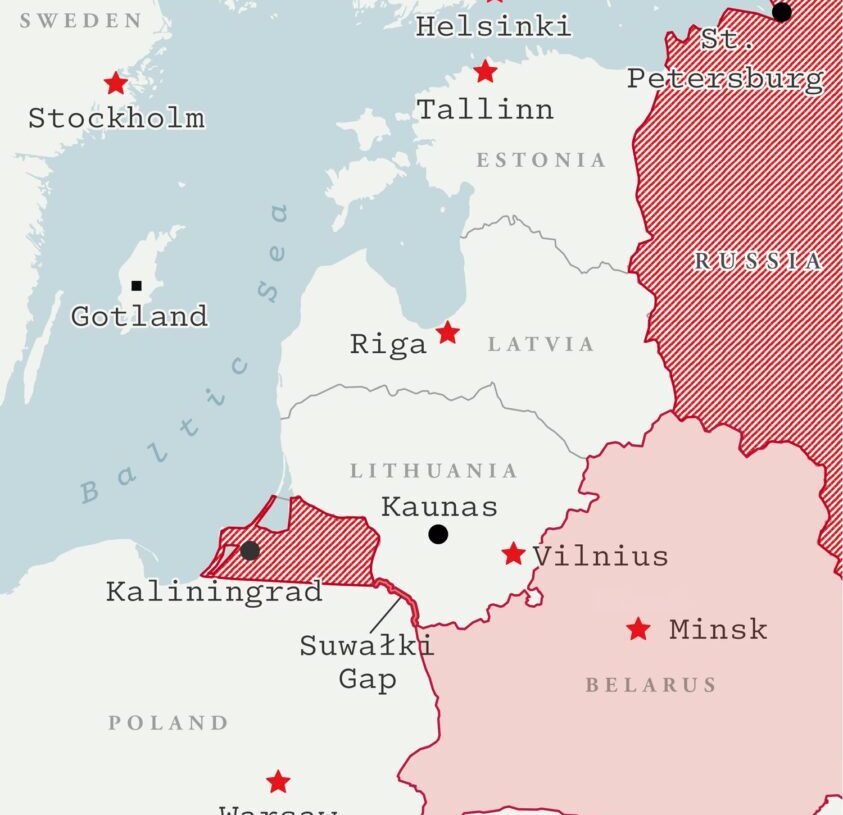
The threat of Russian expansionism may feel remote in the United States. But the idea that Russian soldiers might invade their countries doesn’t seem implausible to the 6 million people who live in the Baltic states. It has happened before. The Second World War brought Soviet and Nazi invasions, and the postwar Soviet occupation threatened to extinguish Lithuania entirely. (“Lithuania is beautiful without the Lithuanians,” a Politburo member once remarked.) In 1990, Lithuania became the first Soviet republic to declare its independence, and since then has transformed itself into a lively democracy with a high-tech economy. But it remains uniquely vulnerable: hemmed in to the east by the Russian satellite state of Belarus and to the west by the sea, and pinched to the south by the Russian exclave of Kaliningrad, home to Russia’s Baltic Fleet and a staging ground for ballistic missiles capable of reaching most of Europe. Nuclear weapons are likely stored there too. Lithuania spends more on defense as a share of its economic output than any other NATO country, and for years has urged the West to take Russian aggression more seriously. The possibility of war is lodged in its politics, its economy, and its psyche; the memory of occupation haunts its present and its view of the future.
[Read: Europeans have realized their error]
Whether Russia has imminent designs on the independent Baltic countries it once ruled is a matter of dispute, though the dispute centers mainly on the word imminent, not on Moscow’s desires. The Russian military is in poor condition in key respects. The cost of recruiting is high, armor stocks are dwindling, and corruption is endemic. But Russia has improved its performance in other areas, including its use of drones and glide bombs, and its agile infantry tactics. A recent American-led air exercise in Poland and the Baltic states, which massed fighter aircraft near Kaliningrad, seemed designed to warn Moscow of the costs of adventurism. Many analysts believe that any mobilization against the Baltics would come only after the end of hostilities in Ukraine, where almost all capable Russian ground forces are currently engaged. Ukraine, Vaikšnoras noted hopefully, is “keeping Russians away.” Others see Russian President Vladimir Putin’s incentives differently, fearing that he might wish to act sooner, exploiting the interval in which the U.S. commitment to Europe seems to be faltering but Europe’s rearmament, after decades of disinvestment, is incomplete. Russian coordination with China—timing an attack in Europe to coincide with a move by Beijing against Taiwan—could be disastrous. Some U.S. and European officials I spoke with believe that the high burn rate of American munitions in Iran may increase Russia’s appetite to test NATO with a limited ground attack in the Baltics. The aim would be a fait accompli, taking a small piece of territory so quickly that the defenders decide the cost of reversal is too high. Putin once boasted that Russian forces could seize the Baltic capitals in two days. A Putin ally not long ago described Latvia, Lithuania’s neighbor to the north, as a “nonexistent country.”
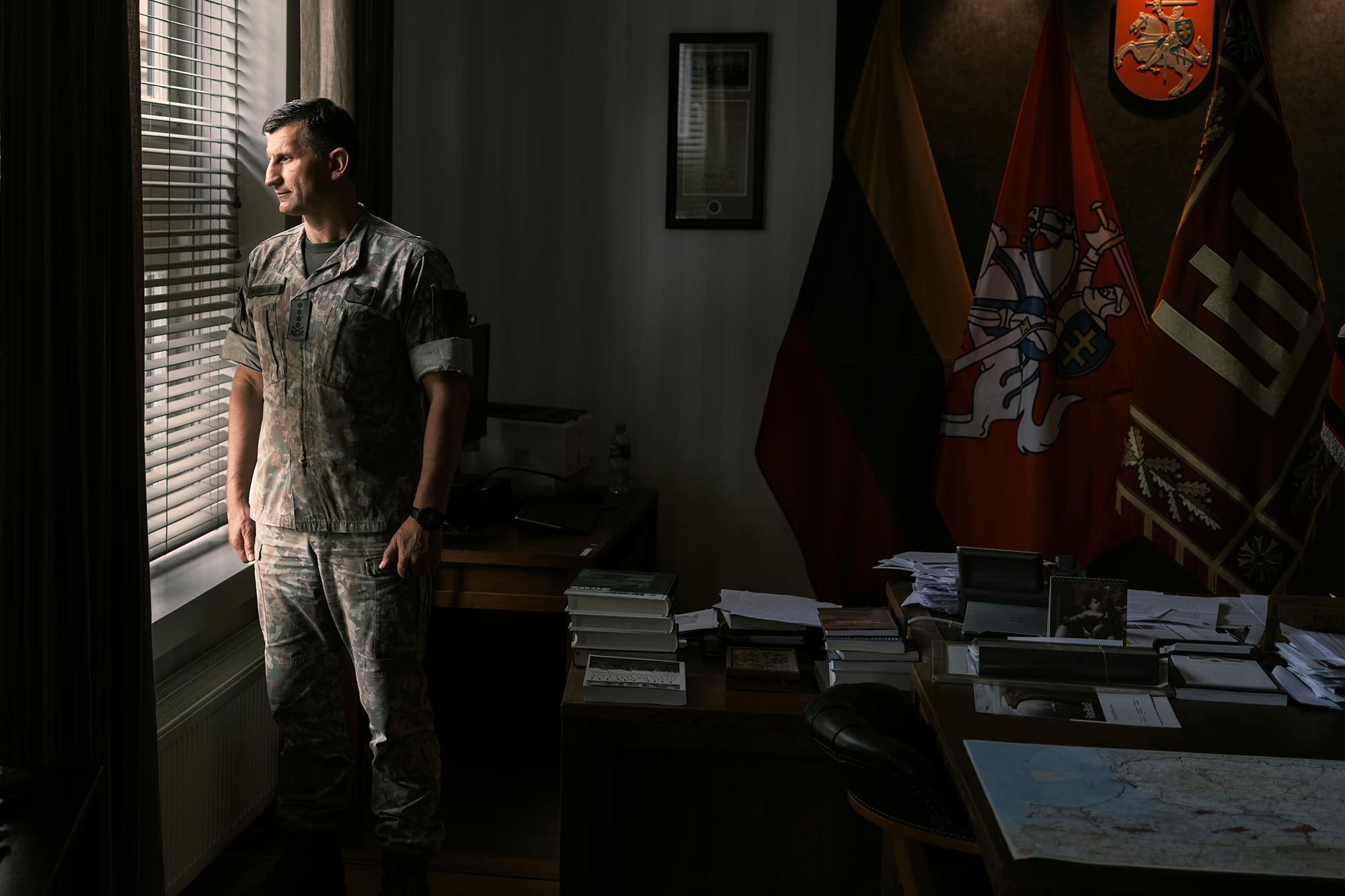
For the Baltic nations, “wait and see” is not a strategy. Distrust of Russian intentions has given rise to a low-grade but pervasive dread that hangs over daily life and has an impact on all institutions. Cities constantly hone their evacuation plans. Hospitals can shift at once to a wartime footing. After Russia’s 2022 invasion of Ukraine, membership in the Lithuanian Riflemen’s Union doubled, and now stands at about 20,000. When I visited Vaikšnoras, he brought me to an alcove behind his office where his helmet, rucksack, and body armor were hanging on a small wooden stand. It’s his job to imagine the worst. But as I learned during a month spent talking with political and military leaders, it’s also true that, in a struggle for survival, the Baltic states possess advantages. They are ready to commit their whole societies to the fight. What they no longer know is whether the United States will be by their side—and in Russian eyes, uncertainty may seem like an invitation.
THE FIRST DAY
What would a Russian attack on the Baltic states look like? It could come in the form of outright invasion, designed to control all three countries and restore what Russia has declared to be its rightful sphere of influence. It could come in the form of “hybrid war,” which the Baltic states have gotten a taste of already: think cyberintrusions, assassination attempts, arson, damage to undersea infrastructure, interference with GPS frequencies, and a deliberately heightened volume of asylum flows—transporting desperate migrants from the Middle East and Africa to the border of European Union countries, as Belarus has done since 2021. Russia could also stir up unrest among the Russian-speaking minority who still live in the Baltic states—a scenario that figures in If Russia Wins, a best-selling book published last year by the academic analyst Carlo Masala. Short of invading all three countries, Russia could attempt to close the Suwałki Gap—the small patch of border that Lithuania shares with Poland, stretching for roughly 40 miles between Kaliningrad and Belarus. This corridor is the only friendly overland route between the Baltic states and the rest of NATO Europe—an essential lifeline.
[Read: Russia’s hybrid-war strategy in Europe]
Despite the shortcomings revealed by its war in Ukraine, Russia would be a formidable adversary. It is willing to send soldiers to their deaths by the hundreds of thousands, and it possesses nuclear weapons. Baltic leaders do not make the mistake of thinking that Russia will behave the way they want it to. As former U.S. Defense Secretary James Mattis has cautioned, about all military conflict, “The enemy gets a vote.” That said, it would be hard to hide large-scale Russian preparations for invasion. Baltic intelligence officers are so focused on every permutation of the Russian threat that their mindset was summarized to me this way by a European expert in Baltic security: “If a seagull shits in the harbor, we know what it had for breakfast, we know where it nests, and we know when it last went to Russia.” When I visited Vaikšnoras, I noticed on his desk a map of a new training area, planned for the southwestern part of the country, right near the Suwałki Gap. If enemy troops start massing on Russian or Belarusian territory, Lithuanian troops will assemble opposite them—force-shadowing, as it is called.
The Baltic states can’t trade space for time—a classic defensive strategy that involves yielding territory in order to exhaust the enemy, then waiting until a counterattack becomes feasible. Vilnius, the capital, home to 600,000 people, is a mere 20 miles from Belarus. In the early days of an invasion, it would quickly be threatened by the Russian army. The Baltic states need to hold off the invaders for as long as possible, hoping that allied help will arrive—whether in the form of ground forces or, even more useful, airpower—before the situation becomes irretrievable.
Lithuania’s military, though the largest among the Baltic states, is nonetheless modest: some 60,000 men and women in active and reserve units. In an emergency, and with the assistance of well-trained volunteer groups such as the Riflemen, the number could swell to more than 80,000—still small compared with any potential Russian force. To help contain the enemy forces and keep them as close to the border as possible, the Baltic states are building a defensive line—digging anti-tank ditches and erecting concrete obstacles called “dragon’s teeth” because of their hulking triangular shape.
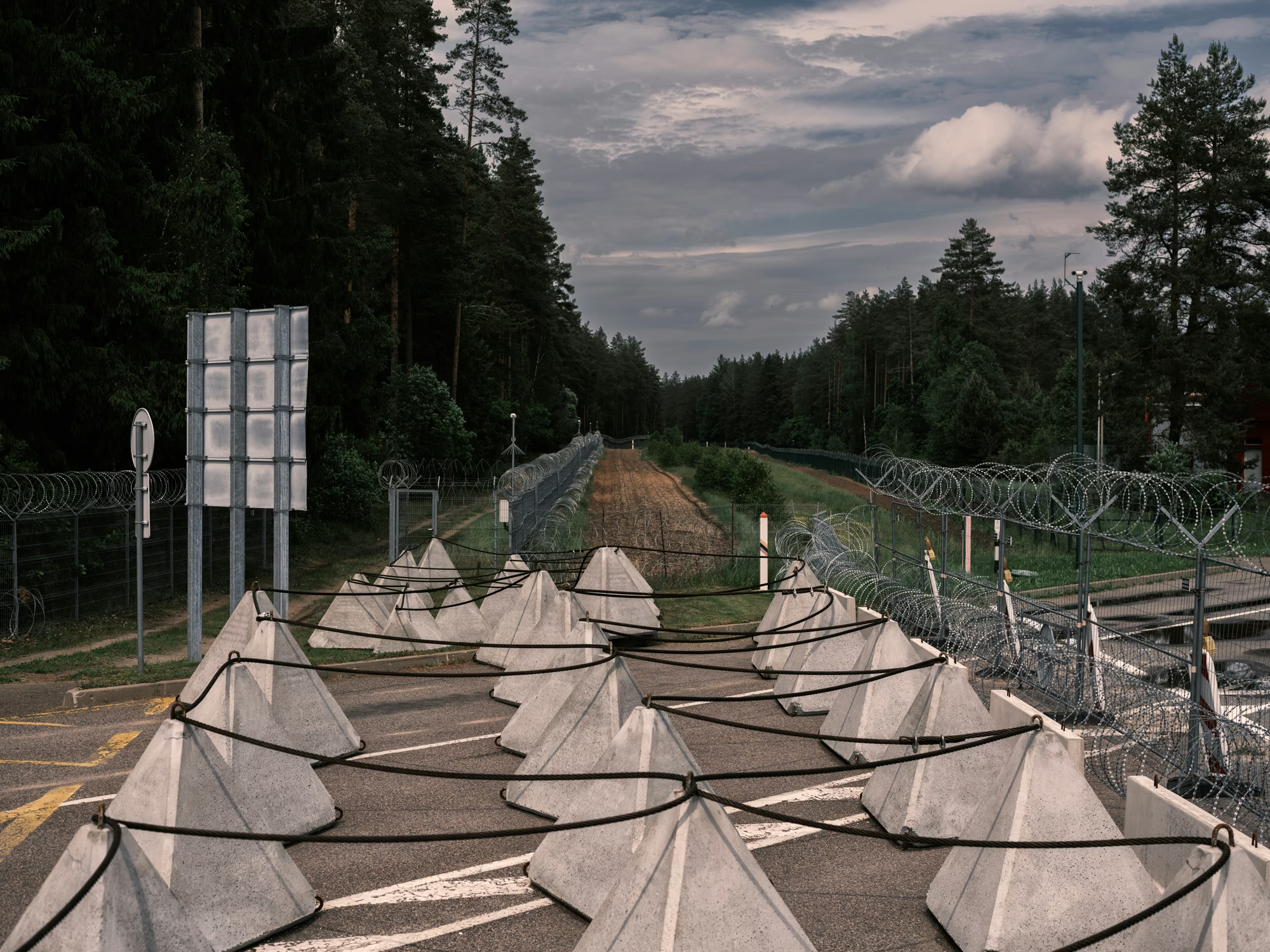
Modern technology could make a big difference. The plan is to saturate the border with infrared cameras and acoustic sensors, a network modeled on a Ukrainian system called Sky Fortress. Data gathered by this equipment would be shared with allies and analyzed by artificial intelligence to help determine the best way to neutralize incoming threats. Border areas could also be heavily mined. All three Baltic states, along with Poland and Finland, have withdrawn from the 1997 Ottawa Treaty, aimed at eliminating antipersonnel land mines, which can kill or maim civilians long after conflicts have ended. The move caused some disquiet in allied capitals. The reply from the Baltics was, What choice do we have?
One afternoon, two soldiers picked me up outside the ministry of defense in a military off-roader, and we drove east to the Belarusian border. The terrain is flat, seemingly favorable to an attacker. But it’s also full of spongy bogs, which serve as natural choke points. Last year, four American soldiers died during a training mission in Lithuania when their 70-ton armored truck sank in a wetland. Lithuania is re-creating swamps and reforesting parts of the border to force the enemy into predictable routes. Man-made obstacles are layered on top of natural barriers to channel (or, in military parlance, canalize) the enemy into narrow zones.
The dragon’s teeth rise to about chest height, and they’re linked by a tangle of metal cords. The fortifications are perhaps the most conspicuous part of Baltic war planning. Rather than destroying a tank outright, the dragon’s teeth catch a vehicle’s underside, where its armor is thinner, and lift the hull off the ground. This leaves the vehicle stranded and vulnerable to artillery and anti-tank missiles. The military has bottleneck coordinates already plotted, anticipating that the enemy will need to slow at specific points.
A breach attempt at a fortified point would create extraordinary violence: tanks caught on dragon’s teeth, mines detonating, artillery landing on the stalled convoy, drones circling overhead to hit anything left moving. Meanwhile, the Baltic states would be striking deep in enemy territory. All three Baltic countries have ordered missile launchers called HIMARS, and their most powerful precision-strike missiles have a range of about 190 miles. That’s almost exactly the distance from Tallinn, the capital of Estonia, to the Russian city of St. Petersburg.
THE FIRST 72 HOURS
Given the likely warning signs, political and military consultations would begin within NATO before Russian troops cross any border. When the Baltic states joined the alliance, NATO leaders initially resisted developing plans for their defense so as not to provoke conflict with the Kremlin. Then, in 2008, Russia invaded Georgia. That year, a senior Russian official and close associate of Putin’s publicly described the Baltic states, along with Crimea and other parts of Ukraine, as “traditional territory of the Russian nation.” In response, an existing NATO playbook for the defense of Poland was extended to the Baltics. But only meager forces were pre-positioned, and reinforcement timelines were inexact. Implicitly, the strategy was to cede territory in hopes of later taking it back. Widespread Russian atrocities in Ukraine following the 2022 invasion made that prospect unacceptable, and Baltic leaders pressed for changes. A year later, the alliance adopted new regional defense plans aimed at containing and countering an incursion, rather than rolling it back.
The main conference chamber at NATO headquarters, in Brussels, is known as Room 1—an amphitheater with an oval table in the middle. This is where ambassadors would gather in the event of an attack to consider a bid by the Baltic states for a declaration under Article 5—the necessary first step toward a collective response. The ambassadors make up the North Atlantic Council, the alliance’s main political decision-making body. They would seek options from NATO’s military committee, composed of the member states’ national-defense representatives. Remigijus Baltrėnas, a Lithuanian general, currently leads NATO’s military staff, although NATO doesn’t have any forces of its own; everything is provided by member countries. When I asked Baltrėnas if he believed that the alliance would come to the aid of the Baltic states, he said, “I’m convinced, practically, that if it will be needed, nations will be able to push aside their national ambitions, their national restrictions, and agree for the cohesion and defense of the alliance, to move forward with whatever is necessary.” But as the clauses and qualifications in his gnarly statement suggest, it would be, as he put it, a “painful process.” Different alliance members will view the risk of escalation differently. Some may even have different interpretations of the facts.
A new color-coded alert system dictates what degree of mobilization is called for: yellow, amber, and red, with the last meaning that an attack is imminent or has already started. The Supreme Allied Commander Europe, who leads all NATO military operations, has the authority to rush certain forces to the region before the member countries reach a consensus. An American has held that job since the alliance’s founding, in 1949. Today, it belongs to Alexus G. Grynkewich, an Air Force general. He can call upon tens of thousands of troops supplied by member countries; their duty is to be mission-ready and able to deploy within 10 days of activation.
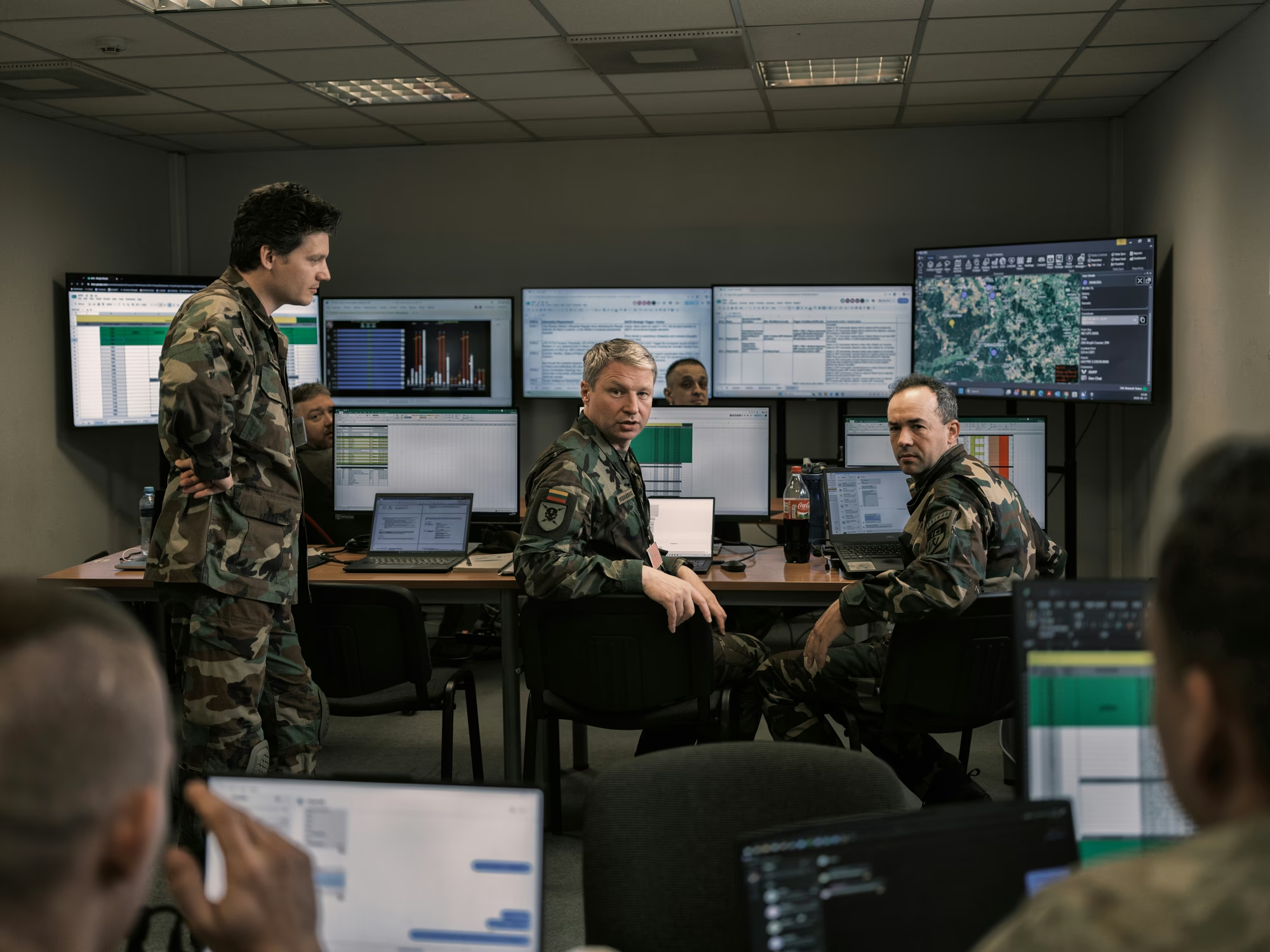
The U.S. military has been training Lithuanian troops and other armed forces in the Baltics for years. The Riflemen’s exercise I witnessed in Lithuania took place at the conclusion of a nine-week commando course run by the 1st Battalion of the Army’s 12th Cavalry Regiment, deployed from Fort Hood, Texas. But the American battalion was rotating out of the country the next day—and there would be no “heel to toe” replacement, as there had been since 2019.
That may seem like a small thing, but it occasions nervousness about a larger one. Deterrence is about signaling, and the Baltic nations need Russia to believe that Washington would treat an attack on their territory as an attack on all NATO members. In the past, the U.S. has spoken loudly in support of the Baltic countries. On a trip to Vilnius in 2002, President George W. Bush vowed that “anyone who would choose Lithuania as an enemy has also made an enemy of the United States of America.” Those words are engraved on a plaque outside the entrance of city hall. Do they remain true more than two decades later?
NATO could be drawn into a conflict regardless. Each of the Baltic states hosts allied forces, initially assembled in the years after Russia’s annexation of Crimea in 2014 and then expanded after the invasion in 2022. Multinational forces were originally intended as trip wires that would compel a larger NATO force to intervene. Now their mission is contributing to a credible defense from the very start of an invasion. Kris Reeves, a Canadian colonel who until recently commanded multinational forces in Latvia, told me, “I can fight tonight and tell Ottawa tomorrow.” The brigade in Lithuania is expanding to include 5,000 Germans and the latest tanks for added firepower and mobility. About 20 countries contribute to military forces in the three Baltic states, led by Germany, Canada, and Britain.
Žilvinas Gaubys, a brigadier general who heads Lithuania’s training-and-doctrine command, told me that the military has considered a scenario in which help from Washington is delayed or does not arrive—indeed, war games have been conducted that consider this premise. Military planners, the general said, must test “the most difficult scenarios.” According to established war plans, American forces stationed in Poland or Germany should be activated from the “first minute” of an invasion, Gaubys explained. But what happens if that minute goes by and the Americans don’t come? The presence of other international forces offers a measure of reassurance. So, too, according to Baltic officials, does the progress made by NATO’s European members in acquiring certain capabilities, such as aerial refueling, that the U.S. once mostly provided. But there would be no easy replacement for American satellite intelligence, or for American missiles and hypersonics capable of reaching far behind the front line. Loss of American support would diminish what the Baltic states can see and what they can strike.
NATO planners know that, early on, Russia would rely not only on physical force but also on cyberwarfare to disable critical infrastructure in the Baltic states—the energy, transport, water, and communications systems that enable their societies to function. The vulnerability, however, goes both ways. When it comes to cyberoperations, Estonia is a global leader. It made cybercapabilities a priority after a sweeping digital assault brought down government and commercial servers in 2007—a surprise move by Russia or Russian sympathizers to protest the relocation of a Soviet-era statue. In response, Estonia established a dedicated cybercommand within its armed forces, as well as a cyberunit within the Estonian Defence League, a volunteer reserve team drawing on the country’s immense civilian IT talent pool. One way reservists contribute is by looking inside successful Ukrainian technology—the Baltic states understand how Ukraine’s innovations are transforming the nature of warfare.
[Read: Lessons from the world’s most tech-savvy government]
Estonia’s cybercommand is led by a taciturn colonel named René Innos. When I met him over the summer, in Tallinn, he was wearing combat fatigues and black boots but had the tired and under-exercised look of someone who spends most of his time looking at a computer screen. Part of his job, he said, is defensive: Every year, he sees billions of “knocks on the door” by Russian hackers looking to penetrate Estonian networks. But the cybercommand is capable of offensive operations too, and it would be an invisible but major part of any war. One objective, Innos said, would be to disrupt the “kill chain”—the communications links that connect target acquisition and target destruction. Another objective would be simply sowing confusion. The enemy, of course, is renowned for its own digital expertise. Both sides would be asking, What is the next new trick?
THE FIRST WEEK
The conflict would soon begin to stabilize—not to ease, necessarily, but to unfold along more predictable lines. Both sides would be using a dense network of drones, sensors, and mines, making a surprise breakthrough on the front difficult to achieve. Russian infantry and armored vehicles would be detected by drone reconnaissance and then destroyed before they could generate momentum and push past defensive fortifications. Many of the defenders wouldn’t be firing machine guns or driving tanks. They’d be operating small quadcopters known as FPV drones, because of the first-person view they give remote pilots. FPV drones mostly function as one-way strike weapons, though the same airframes can fly reconnaissance. One Lithuanian colonel estimates that 80 to 90 percent of Russian casualties could be inflicted by FPV drones.
A visit to a training area in the southwestern part of Lithuania, about 30 miles from the border with Kaliningrad, gave me a sense of the country’s growing drone capabilities. Trainees were sitting behind a pair of laptops placed on a folding table in a tent. A Monster Energy drink was open on the table. The primary pilot used simple mouse clicks to direct an airborne vehicle—an Estonian-made reconnaissance drone with a range of about 30 miles. Sitting alongside, his co-pilot operated the camera system using a joystick resembling a PlayStation controller.
I had come to the training area from Kaunas, Lithuania’s second-largest city, where a military-drone laboratory occupies space in a glass-sheathed university building. The army is using the facility to turn soldiers into engineers. FPV drones are cheap—they can cost only a few hundred dollars apiece—but also full of bugs. Being able to replace a battery in the field could save money and lives. Inside the lab, an airy space with soldering irons and fume extractors, soldiers in army fatigues were bent over worktables. A reservist in jeans and a T-shirt stood at a whiteboard, delivering a lesson about the battery’s power connector and protective casing. Nearby, university students were completing an academic 3-D-printing project, unconnected with warfare. They appeared unbothered by the military preparations, which are difficult to keep neatly apart from civilian life. Schools operated by the ministry of defense are teaching children as young as 10 how to assemble, program, and fly drones.
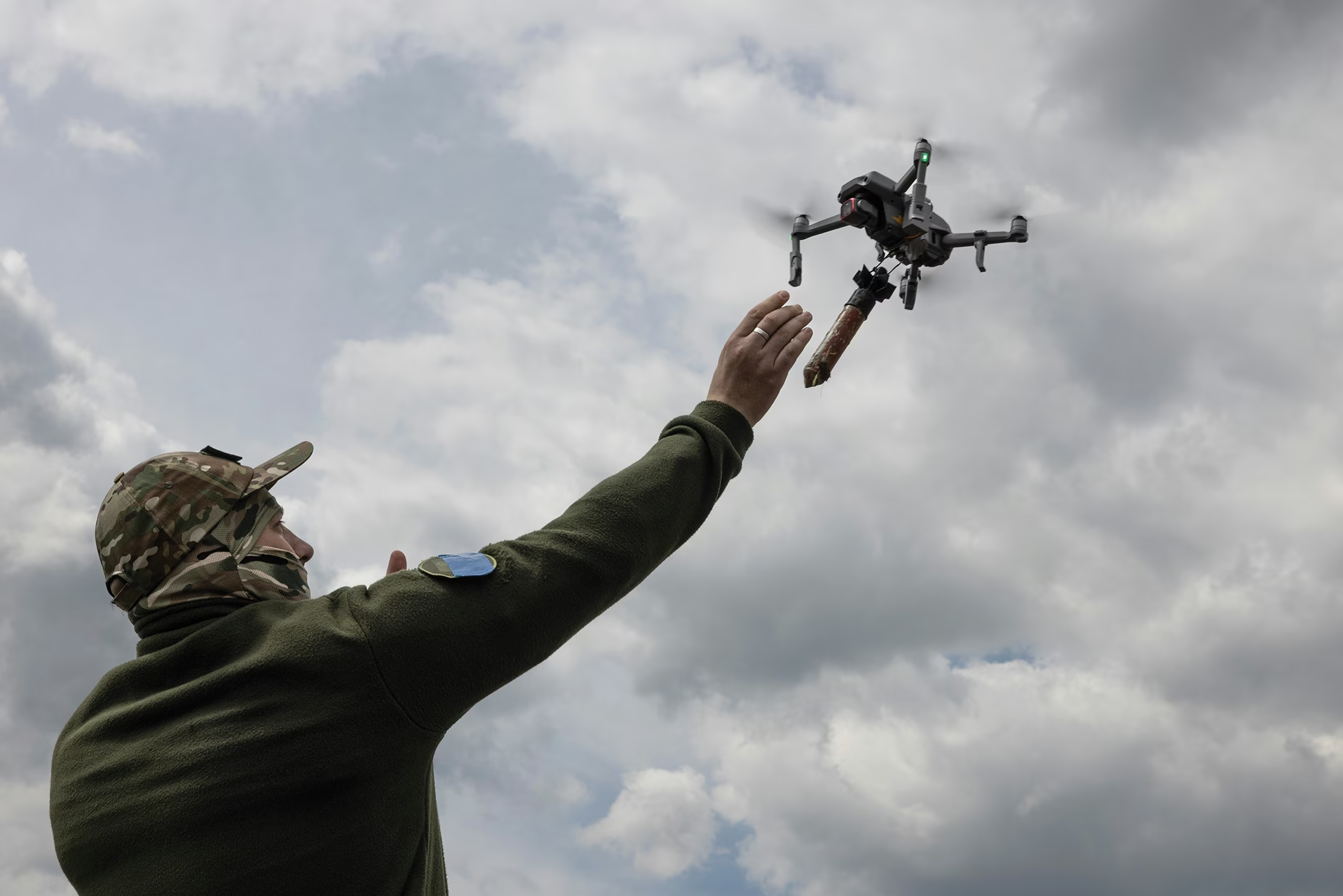
I was in the company of Arnoldas Sadauskas, a major in the Lithuanian armed forces. Earlier, I had seen in the back of his van a pile of torpedo-shaped warheads with propellers, which he showed me while casually lighting a cigarette. The most important lesson to learn, Sadauskas said, is the need for improvisation. He brought up Ukraine, as Baltic commanders often do. Its armed forces no longer wait for foreign companies to provide state-of-the-art equipment. Ukraine builds its own, and constantly changes the technical composition to elude electronic countermeasures. The takeaway—that technical advances can make up for a relative disadvantage in troop strength—is now dogma in Baltic defense thinking. Officers from Estonia, Latvia, and Lithuania make frequent trips to Ukraine. I asked Sadauskas if he was adapting lessons from Americans too. He said, “I don’t know what they have to teach me.”
In a sustained conflict, the Baltic states would need private industry to replenish weapons stocks and modify technology as battlefield dynamics change. Because of their size, the Baltic states don’t build heavy platforms, such as battle tanks and self-propelled artillery. Their advantage lies in niche areas, including electronics, optics, and ammunition components. The field of photonics, devoted to generating and controlling light, is especially strong in Vilnius. Julius Skruibis, the chief technology officer of Aktyvus Photonics, told me that the city is home to no fewer than 60 companies active in this area.
Aktyvus Photonics is in a tech hub on the outskirts of Vilnius, and I met Skruibis at the company’s offices. He gave me a pair of sunglasses, and with our eyes shielded and shoes wrapped in plastic coverings, we entered an antiseptic space where engineers in blue lab coats were experimenting with laser designators—highly concentrated light sources used to “light up” military targets. These laser beams guide munitions to their destinations.
The company has developed a handheld designator for the Ukrainian armed forces. In my hand, it felt like a state-of-the-art film camera, smooth and compact. The designator has a range of six miles. The drawback is that a soldier using one from a ground position, kneeling and pointing it at a target, risks exposure to the enemy. The company’s newest designator, not much bigger than a Duracell nine-volt battery, can be lifted by a small drone, and is now the biggest-selling Aktyvus product. Keeping the designator steady is the challenge; it’s buffeted both by wind and by vibrations from the drone. Digital stabilization is able to remove imperfections in the video feed, but there’s as yet no analogue for adjusting the beam of light. The company is working intensively on stabilization technology to hold the designator in place. Skruibis was frank about the kind of accuracy he’s seeking: He placed an index finger on his forehead, right between his eyes.
THE FIRST MONTH
The consequences of any conflict in the Baltic states will quickly expand outward. Within a month of the war launched by the U.S. and Israel against Iran in February, it had grown to involve more than a dozen other countries, closed the Strait of Hormuz, and sent global oil prices to their highest levels in years. Some ramifications of a Baltic conflict are unpredictable, but one is not: The Baltic Sea would become a contested strategic space.
One of the keys to controlling the Baltic Sea is Gotland, a Swedish island about 80 miles from the Baltic states. Its sandy beaches and limestone cliffs make it a tourist jewel. It is also vital to establishing air and naval dominance over the entire region. Several years ago, Russian state television hosted a reserve officer and pro-Kremlin commentator who explained how Russian forces could commandeer Gotland, which is about the size of Long Island, and leverage it as a base while Moscow set about conquering the Baltic states. Estonia, Latvia, and Lithuania have no combat aircraft of their own, and only gunboat navies. Lithuania’s largest ship is a minelayer that came used from Norway.
Sweden and Finland joined NATO in the aftermath of Russia’s 2022 invasion of Ukraine, casting aside a long tradition of neutrality and military nonalignment. One day this summer, I met Sweden’s defense chief, Michael Claesson, on the deck of the Carlskrona, which at 350 feet has the distinction of being the longest ship in the Swedish navy. It packs little firepower but bristles with masts, antennas, radar arrays, and communications equipment. It was docked in the harbor at Visby, Gotland’s capital. The fortification of Gotland, Claesson explained, would allow NATO to project air and maritime superiority in the broader Baltic Sea region. Kaliningrad is to the southeast. Rockets and long-range missiles launched from Gotland could easily strike Russian supply lines and other infrastructure supporting military operations in the Baltics. The island is an ideal staging ground for fighter jets: close enough to high-value Russian targets but far enough away to be untouchable by short-range drones launched from Russian terrain. That enviable location has earned the island its description as an “unsinkable aircraft carrier.”
Hostilities would convulse the entire maritime zone, one of the busiest in the world for commerce. Trade and civilian traffic in the Baltic would be suspended, with priority given to reinforcement and evacuation efforts. Moscow is not without options, even if the Baltic Sea, ringed almost entirely by Western allies, has come to be seen as a “NATO lake.” Russia still has access to Baltic waters from ports at St. Petersburg and Kaliningrad. It could provide military escorts for its merchant fleet and target undersea cables used for power and communication. Missiles from Kaliningrad could menace maritime operations and hold regional economies hostage.
In some ways, Gotland is to NATO what Kaliningrad is to Russia—a forward outpost that helps control access to a vital theater of operations. Which is why the island itself is vulnerable to attack, and why war could spread quickly to Sweden. The Swedish armed forces disbanded the island’s last defensive regiment in 2005 and began restoring its defenses only after Russia’s annexation of Crimea. In 2022, as Russian troops massed on Ukraine’s border, Sweden dispatched additional units to Gotland. Armored vehicles clambered down Visby’s medieval streets. The government in Stockholm is building new barracks and other facilities, and Sweden’s military has conducted joint exercises involving U.S. Marines. Bolstering the garrison on Gotland remains a work in progress, and a visitor may well be more aware of archaeological activity (the island has been settled, sparsely, for millennia) than of a humming military presence. Ewa Skoog Haslum, a vice admiral and Sweden’s chief of joint operations, was blunt about her view when we spoke: “We have too few forces on Gotland.” Moscow is definitely aware of Gotland’s strategic value. Russia’s ambassador to Sweden recently accused the government in Stockholm of “provocative steps” on Gotland, vowing that Moscow would “take all of this into account in our military-political planning.”
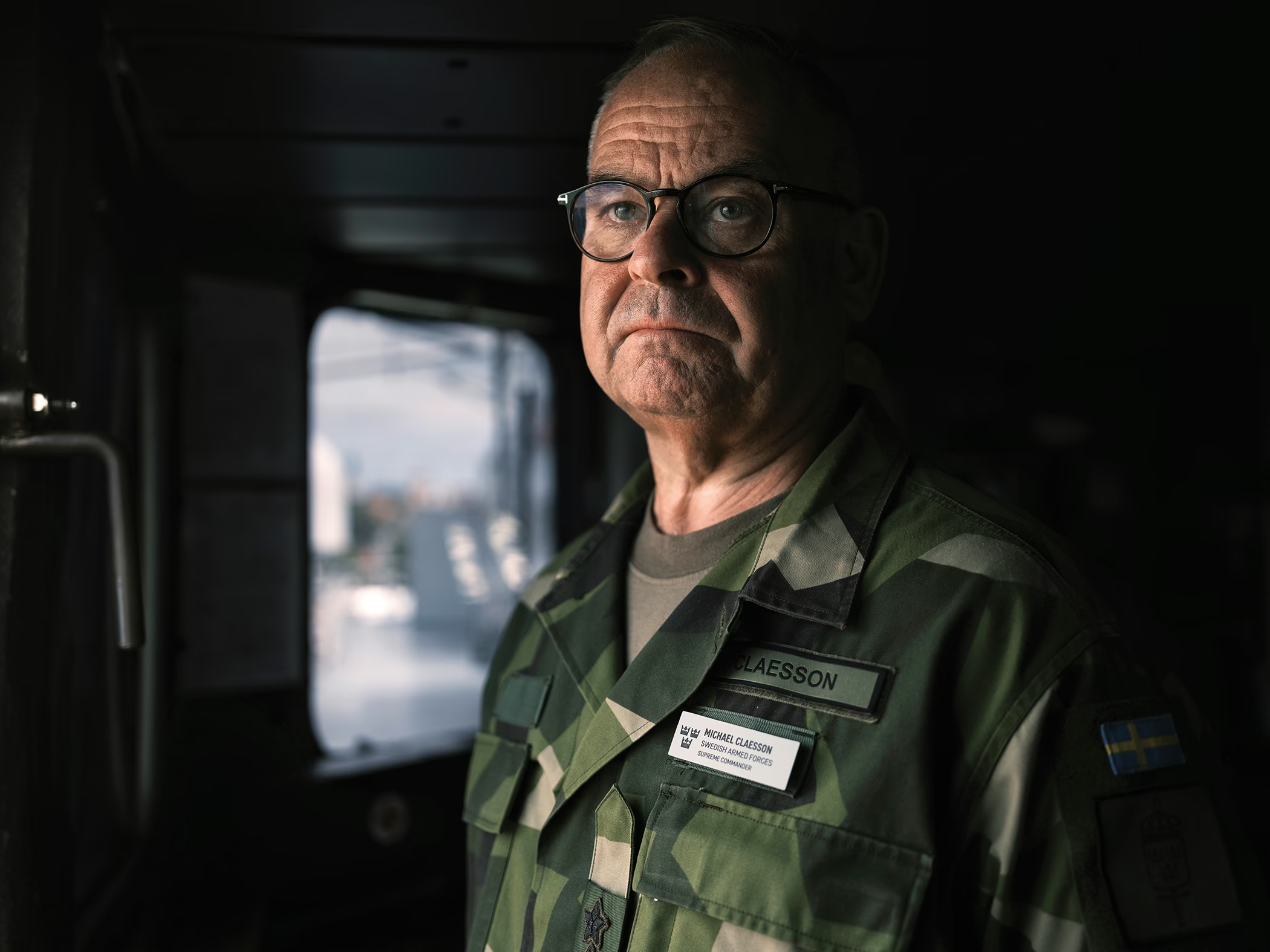
Although NATO forces have trained on Gotland, offensive weapons aren’t currently stored there. I asked Claesson how long it would take to turn Gotland into a platform for serious offensive operations. “Days,” he said, holding up a few fingers. “Days on one hand.”
ENDGAME
Men in hooded suits, gas masks, and orange boots lifted bodies from wheeled gurneys and placed them on folding tables: yet another training exercise, this one taking place in a barracks belonging to the Vitkus Engineer Battalion, in Kaunas. The battalion builds defensive fortifications, clears land mines, and removes chemical and biological hazards. The premise of the training exercise was that the enemy had used chemical weapons against civilians. Victims had to be cut out of their clothes and doused with soapy water. Medics triaged cases while a decontamination team rushed people through washing stations. The equipment came from the Defense Threat Reduction Agency, the part of the U.S. Department of Defense responsible for countering weapons of mass destruction.
The longer a war persists, and the deeper into civilian society it penetrates, the more resources the engineer battalion will require. Its commander told me that its motto is “First in, last out.” The battalion is still finding and disposing of mines and other unexploded ordnance from both world wars. It is named for Juozas Vitkus, a colonel in the country’s interwar army who helped train members of the Lithuanian Riflemen’s Union. He was killed by Soviet troops in 1946.
The Lithuanians I met in military barracks, on training fields, and at government offices all wanted to make sure I witnessed the many ways in which the United States is still participating in their defense—presumably, they want to believe, with every intention of assisting in a potential war with Russia. Strategic culture in the Baltics is indebted to American guidance. Many generals have studied and trained in the United States. When I met with Vaikšnoras, the Lithuanian defense chief, I noticed a photograph of his graduating class at the U.S. Army War College, where he received a master’s degree in 2013. Ties between the two militaries remain close. And although many nations, including NATO allies, are skittish about having nuclear weapons based on their soil, Lithuania is revising its constitution to permit such staging. But the American commitment to NATO—to countries such as Poland and Germany, never mind the Baltic states—is no longer a given. As I watched U.S. Army personnel give pointers to Lithuanian troops, I wondered if they might be among the last American military representatives engaged in Europe in this way.
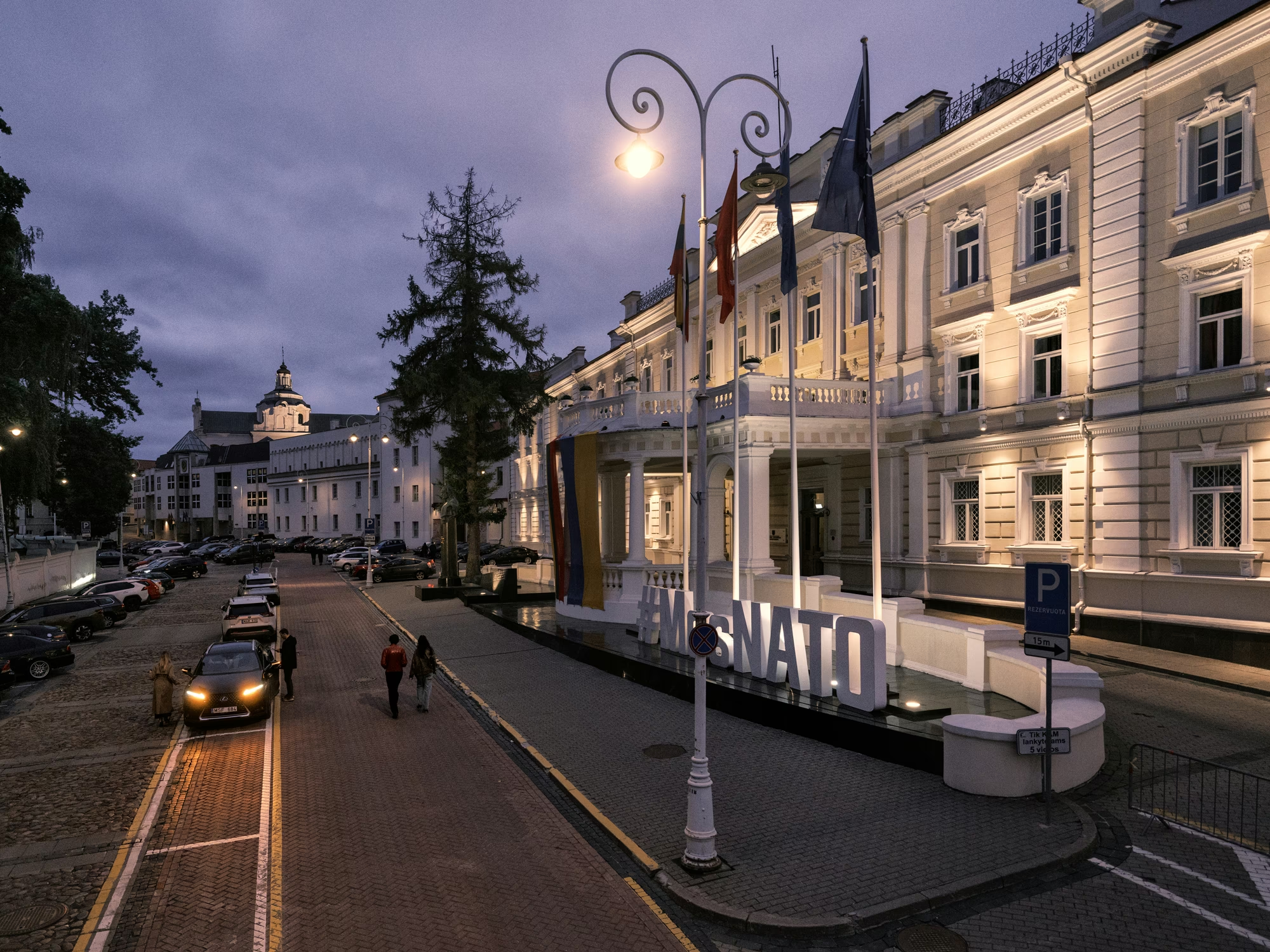
These days, the truly inescapable sight in Lithuania is not the Stars and Stripes but the blue-and-yellow flag of Ukraine. It flies outside government ministries. It is draped inside hipster coffee shops. Near the Neris River, which cuts through the capital, I saw a bird feeder painted in blue and yellow. Don’t mistake this for a mere token of solidarity. It is a badge acknowledging Ukraine’s contribution to the defense of Europe.
The Baltics are sometimes described as the Cassandra of European states—doomed for their prescience. But the metaphor is not quite right. Vilnius isn’t Troy, and it wasn’t sacked when Lithuania’s warnings about Russian expansionism were vindicated in 2022. For now, Ukraine is absorbing the Russian onslaught, and giving survival lessons to other vulnerable democracies. One counterpoint to a weakening American military presence in Europe has been an acceleration of visits by European military leaders to Ukraine. My interview with General Gaubys had to be cut short because he was scheduled for a trip to the Ukrainian battlefield.
Questions about the future of the American-led order are unavoidable in Estonia, Latvia, and Lithuania. The doubts provoked by Trump about the principle of collective defense will not easily be assuaged or argued away. But I also encountered something else: the emergence of a new order, in which Ukraine matters as much to the security of Europe as the United States does. Baltic soldiers are in Ukraine every day, embedding with officers close to the front line, helping where they can, but most of all learning, adopting their tactics, and preparing their own defense. They believe that war with Russia is coming. They would prefer to have American backing when it does. But they’ll fight without the United States if they need to.
This article appears in the November 2026 print edition with the headline “The Next Front.”
The post The Next Front appeared first on The Atlantic.