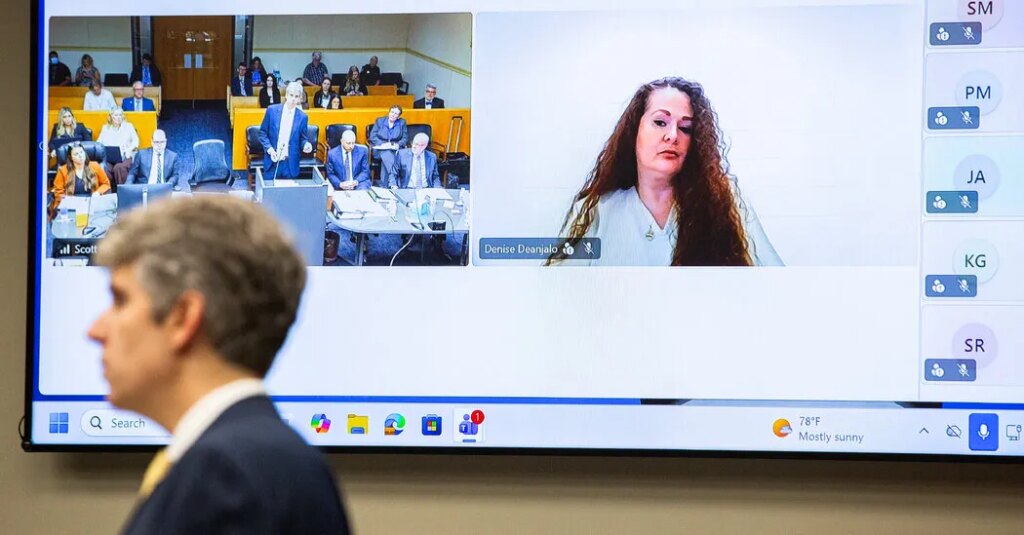
A Tennessee woman convicted of murder survived two doses of lethal injection on Wednesday night before state officials suspended the execution and had her taken to a hospital for medical care, her lawyers said.
It was the second botched execution in the state this year.
The apparent failure came after dueling court rulings delayed the execution of the woman, Christa Pike, by about nine hours. The state had raced to go ahead with the execution before the day ended and to avoid having to reschedule.
In a pair of emergency legal filings, Ms. Pike’s lawyers said that while two syringes of pentobarbital, the lethal drug, had been administered, Ms. Pike had not lost consciousness. She still had a heartbeat, they said, and was audibly snoring.
It was not immediately clear what went wrong with the administration of the drugs, or what Ms. Pike’s medical condition was. In a statement late Wednesday, her lawyers said that she was at a nearby hospital but that they did not know her condition. Tennessee officials confirmed to a federal judge late Wednesday that Ms. Pike was receiving medical care.
“This event is the worst we’ve seen and unlike any other botched execution in the modern era,” said Robin Maher, the executive director of the Death Penalty Information Center. “There is no precedent.”
At a news conference after the execution attempt, members of the media who served as witnesses described Ms. Pike as somewhat alert, at one point singing with her spiritual adviser. They were brought into the witness room outside the execution chamber just before 6:30 p.m. Shortly after, the curtains separating the execution chamber from the witnesses were opened to show Ms. Pike, strapped to a gurney, they said.
“I’m going to leave this world the way I spent most of my life,” she said. “And that is with love.”
At one point, they said, she described a burning spot in her arm that felt like it was going to burst. She asked if that was normal. The curtains briefly closed, then reopened.
The curtains were then closed again for nearly an hour, reporters said, adding that they could hear breathing and steady snoring. Just before 9 p.m., reporters were told to leave for the news conference.
Emergency vehicles arrived at the prison as the witnesses were addressing the news conference and left about 15 minutes later.
Officials at the prison, the Riverbend Maximum Security Institution in Nashville, did not address reporters afterward. In a statement, the Tennessee Department of Correction said it “had followed every step of the state’s lawful, established execution protocol approved by the attorney general’s office.”
“The lethal injection chemical in the protocol has consistently been effective,” the department said.
It was the second time this year that Tennessee failed to administer the lethal drugs. In May, the state called off one of four planned executions because medical staff could not find a vein while administering a lethal drug.
Ms. Pike’s lawyers had argued the procedure could be torturous for her because she has small veins, a history of sexual trauma and other medical conditions.
“We take no pleasure in being right, but the concerns raised by Ms. Pike proved to be true: difficult vein access, blown veins, degraded pentobarbital, no emergency medical care available when things inevitably go wrong, all under a protocol that remains veiled in secrecy,” they said in a joint statement after the execution attempt.
Ms. Pike, 50, who was convicted of murdering her classmate in 1995, would have been the first woman to be executed in the state in over 200 years.
The attempted execution came hours after the U.S. Supreme Court allowed the state to proceed, overturning a pause imposed by a lower court earlier in the day.
The lower court briefly paused the execution, saying more time was needed to consider the case. Her lawyers had argued that Ms. Pike’s initial legal defense did not adequately present her history of child sexual abuse and neglect.
The three liberal justices on the Supreme Court dissented from the order allowing the execution to proceed, with Justice Sonia Sotomayor writing that the majority “unnecessarily prevents” the appeals court from fully considering Ms. Pike’s argument.
“I see no reason to short-circuit the ordinary process of appellate review, particularly in light of the grave consequences of an erroneous decision,” Justice Sotomayor wrote. She was joined by Justices Elena Kagan and Ketanji Brown Jackson.
Justice Sotomayor added that “Tennessee’s desire to expedite Pike’s execution by a few days or even weeks cannot outweigh” Ms. Pike’s interest in protecting her own life.
In January 1995, Ms. Pike, her boyfriend at the time and a friend lured 19-year-old Colleen Slemmer into the woods on the University of Tennessee campus, taunting and torturing her. They beat her with asphalt rocks and slashed her with a box carver. Ms. Pike, who was 18 then, took a piece of Ms. Slemmer’s skull with her, which she showed to at least one other person.
Tadaryl Shipp, Ms. Pike’s boyfriend, testified to carving a pentagram into Ms. Slemmer’s chest, a gesture that sparked fears of Satan worship. Because Tennessee law applies the death penalty only to people 18 and older at the time of the crime, Mr. Shipp, at 17, was sentenced to life in prison. He was denied parole last year.
Ms. Slemmer’s family remained firmly in support of Ms. Pike’s execution and raised funds to cover the drive from their home outside of Jacksonville, Fla., to Nashville to witness the execution. May Martinez, Ms. Slemmer’s mother, was adamant that Ms. Pike could not atone for the death of her daughter and should be executed.
The lone woman on Tennessee’s death row, Ms. Pike has expressed remorse for her crime. She was diagnosed and treated while in prison for bipolar disorder and post-traumatic stress disorder, something which her lawyers said had contributed to her violence. Women who were incarcerated alongside Ms. Pike said she was a supportive and kind presence.
In the grassy fields outside the prison, where protesters gathered both in favor of and against the death penalty, there was confusion and disbelief over the lower court’s last-minute intervention on Wednesday. Some people walked away, frustrated that another legal hurdle had temporarily delayed the execution.
Tennessee is among a small number of states that have pushed forward with executions in recent years. This month, Alabama executed a man using lethal injection just months after the Supreme Court blocked his execution by nitrogen gas.
Both states, along with Oklahoma, held executions on the same day in August. It was the first time in more than a decade that three people were executed on the same day.
Seamus Hughes contributed research.
The post Tennessee Fails to Execute Woman After 2 Doses of Lethal Injection appeared first on New York Times.