Seemingly overnight, Alexander Calder’s giant sculpture “Mountains and Clouds” became all mountains and no clouds.
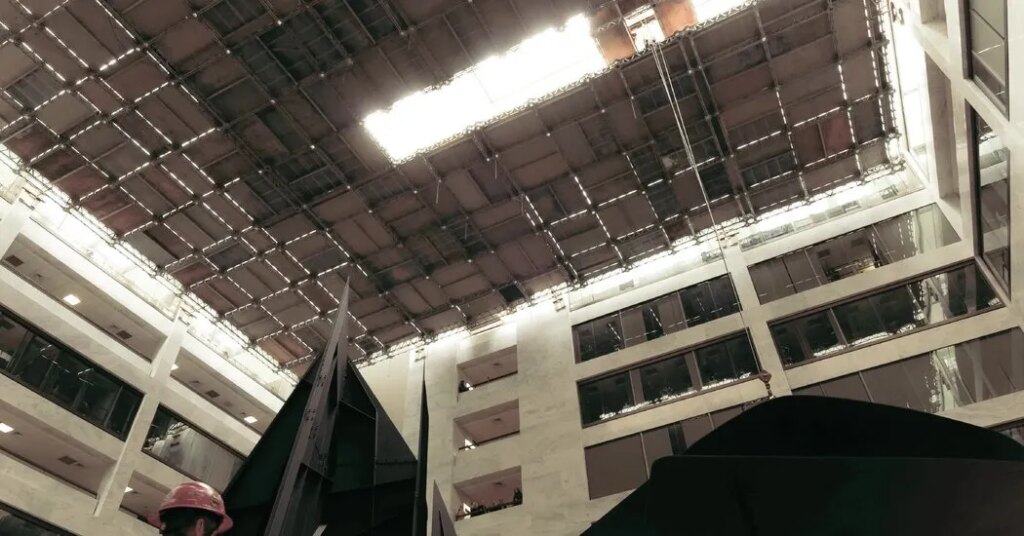
In 2014, the celebrated artist’s 51-foot steel triangular slopes nestled beneath a blanket of matching black aluminum clouds that hung from the skylights in the marble atrium of the Hart Senate Office Building.
Then safety concerns were raised by officials on Capitol Hill over the structural integrity of the work — Calder’s last before his death in 1976 — following a 2011 earthquake, and the clouds were lowered. The mountains languished in Washington for 12 years, marred by an empty ceiling above, and far from Calder’s original vision for the sculpture.
“It was a mutilation of his final masterpiece,” said Christian Quilici, an independent consultant who had long advocated for the work, which combined a separate mobile (the clouds) with a stabile, or standing sculpture (the mountains). “They took them down under the cover of night. They didn’t tell anybody. They chopped them up.”
This past Saturday, on a crisp autumn day in Washington, a group of contractors hoisted four newly created chunks of clouds made of carbon fiber composite to the top of the Hart building, as part of a $12 million renovation to the sculpture, made possible by two private donors. The black, curved slabs, no more than three inches thick, seemingly floated over the steel mountains — five triangles and two curved arcs — fastened to the floor of the atrium.
The Calder got its clouds back.
“They are kind of sublime,” said Harry Cooper, the curator of modern art at the National Gallery of Art, which has a Calder collection. Staring up at the atrium, he added: “There’s an awareness of the natural world, but it’s in his great vocabulary.”
Throughout 50 years, lawmakers have toiled to bring Calder’s vision to the Hart building, home to the offices of about half of the country’s senators. Calder, best known for infusing kinetic movement into his works, won a commission to fill the Hart atrium in 1976, while the building was under construction. His design included the stabile, to be paired with a mobile, a moving medium that he invented, hanging from the atrium’s ceiling and intended to gently rotate with the assistance of a motor.
The piece was the only one created by Calder to have a separate stabile and a mobile. Set against Hart’s white marble walls and filling nearly the entire nine-story atrium, it was the kind of avant-garde, modern sculpture that defined Calder’s final works.
“I think what excited him was space, and I think he was probably responding to the dimensions of the atrium,” Mr. Cooper said. “It’s abstract, formal, and he was given a great space.”
On Nov. 10 of that year, Calder spent a morning in Washington wielding a crimping tool to adjust his small maquette of the piece, deciding its size and position in the atrium. By the next morning, back in New York, he was dead of a heart attack, at age 78.
The Calder estate allowed the sculpture to be built anyway, making it the only posthumously produced work created by Calder with the backing of his family. But funding woes effectively waylaid the project. It went up a decade later in 1986, thanks to $650,000 raised by Senator Nicholas F. Brady, Republican of New Jersey, through the Capitol Art Foundation, which covered construction, installation and artist fees. Mr. Brady said the sculpture was fit for Capitol Hill, where “senators have egos as big as mountains and have their heads in the c louds.”
Almost from the beginning, the sculpture was mired in structural challenges. The motor moving the clouds never quite allowed the piece to gently drift as Calder had hoped. By 1992, the clouds had stopped moving altogether, and they remained still until the piece was halved in 2014.
Left unfinished, the piece couldn’t be considered a Calder sculpture in the eyes of Alexander S. C. Rower, known as Sandy, Calder’s grandson and the president of the Calder Foundation. The back-and-forth between the mountains and clouds had been lost — and would have to be reimagined.
“In order for it to be a Calder, the clouds have to be there and they have to move,” Mr. Rower said in an interview.
In its new construction, the carbon fiber composite clouds are about half the thickness of the original aluminum panels. Daniel Sesil, the lead engineer on the project, said carbon fiber would be a stronger and safer material to hang above people walking below.
Sesil also said that a new motor had been constructed to initiate smoother, gentler movements among the clouds. In October the motor will be installed; by November, the foundation said, the clouds should be moving and drifting, for the first time, as Calder intended.
The restoration cost $12 million, according to the Calder Foundation, or about 18 times the amount to create the original structure. The foundation found two willing donors in Jon Shirley, the former president and chief operating officer of Microsoft, and Kim Shirley, a retired attorney who, along with her husband, serves as a trustee at the Seattle Art Museum. Mr. Shirley first saw Calder’s work in a book for his high school humanities class, and the rest was history. His wife, too, caught the Calder bug. (The Shirleys have their own collection of roughly 50 Calder pieces.)
“The first time I saw the scale of it I thought, ‘God, it’s just gigantic.’ How could he have conceived of doing that inside the atrium of a building?” Mr. Shirley said.
“It didn’t look like what you would think a Calder would be because it looked incomplete,” said Ms. Shirley, who first saw the piece after the clouds were stripped from it. “Now that you see it together, you realize how incomplete it was and, really, fundamentally so disappointing.”
The project had its fair share of snags. For years, the Architect of the Capitol lagged in executing the project. The restoration needed a sign-off from the Senate Commission on Art, comprising leaders from both parties. Lawmakers also changed the law in 2017 to allow Senate officials to accept cash donations for art restoration and conservation.
Former Senator Roy Blunt, Republican of Missouri, recalled in an interview last week that at one point, Senator Chris Murphy, Democrat of Connecticut, asked for his help in rehanging the clouds.
“I’m thinking, ‘Well, that sounds pretty powerful if you can rehang the clouds,’” Mr. Blunt said, chuckling. He quickly backed the effort.
Then came the dilemma over the sculpture’s signature Calder Black paint, a light-absorbing matte black hue no longer in distribution. Before she was elected to the Senate in 2024, Angela Alsobrooks of Maryland, then a county executive, learned of the problem and connected the Calder Foundation to the U.S. Army Research Laboratory based in Prince George’s County, Md. Leaders there said they could recreate the shade.
It was a persnickety detail, but vital to the project. Mr. Rower said his grandfather had a vision, and he wanted to honor it.
“My grandfather died 50 years ago this year, and his art still inspires people,” he said, adding, “Even if you don’t go deep, it still inspires you to have an expression that’s something more, something enriching.”
Senator Murphy, who long admired Calder and championed the project, said the sculpture reflected the idea that the Senate could tackle mountainous projects.
Senator Amy Klobuchar, who aided the effort while serving as Rules Committee chair, said: “You can’t have the mountain without the clouds, right?”
Senator James Lankford, Republican of Oklahoma, another lawmaker with a hand in helping the project, said the mountains and clouds served as a reminder of home for legislators while they worked in Washington.
Ms. Shirley said she looked up at the black slabs and saw “a sense of balance and completion.”
“It’s in the hardness of the mountains and then the soft lyrical nature of the clouds,” she said.
The post Calder’s Clouds Return to Senate Office After a Mountain of Problems appeared first on New York Times.