ChatGPT hit the internet in November 2022 during Keon Davis’s junior year at the University of Wisconsin at Madison. He used it and grew over-reliant, but it also worried him. Davis, who was studying marketing, soon watched it automate tasks he handled in a summer internship, like crafting outreach emails and doing consumer research.
Seeing how easily he might be replaced was one reason he changed direction a few months before graduating in May 2024. Instead of pursuing marketing jobs, he signed up for Teach for America. He’s in his third year in front of a third-grade classroom at a charter school in New York City.
He’s enjoying the work, which requires building trust with students, understanding their individual needs and helping them believe in themselves. “Stuff like that cannot be automated,” he said.
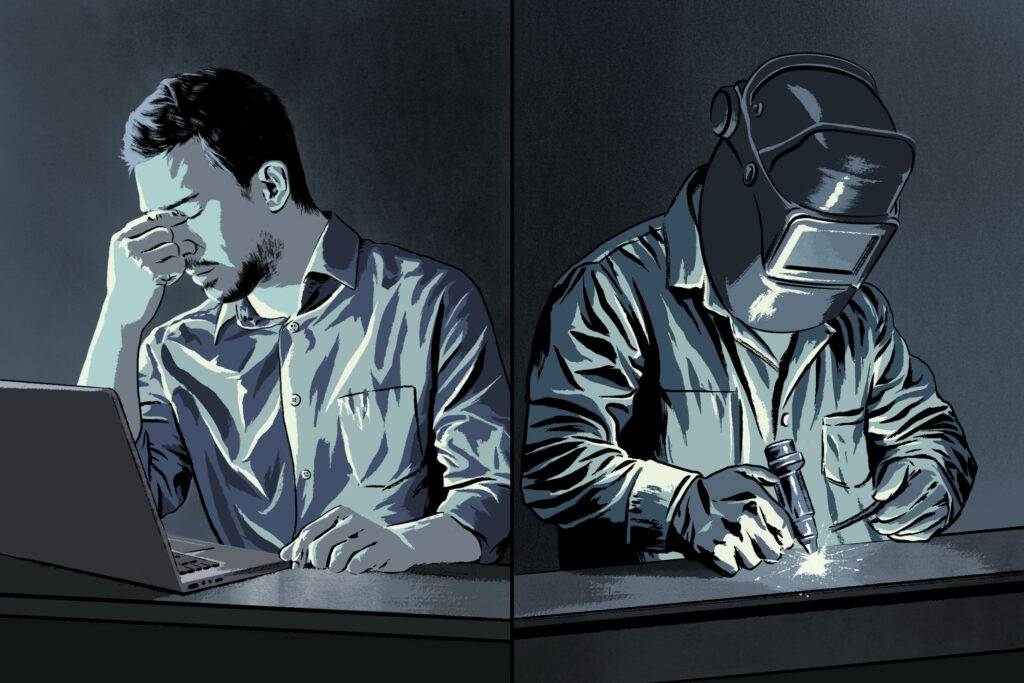
As artificial intelligence threatens to upend the white-collar job market, some young workers and recent graduates like Davis are reconsidering their career paths. They are, in some cases, leaving computer science studies for other college majors, or exploring a hands-on trade like electrical work, or a human-facing career, such as nursing or teaching.
Related: Interested in innovations in higher education? Subscribe to our free biweekly higher education newsletter.
Researchers have produced scant information on how many workers or students are retooling because of AI, but a recent survey gives clues. In a Pew Research Center poll released in August, 73 percent of adults under the age of 30 said AI would lead to fewer jobs, up from 61 percent two years ago.
Younger workers aren’t wrong to worry. From November 2022 to June 2026, those ages 22 to 25 in the most AI-exposed jobs, such as customer service representatives and software developers, saw a 19 percent decline in employment compared with those in the least-exposed jobs, like nurses’ aides and maintenance and repair workers, according to the Stanford Digital Economy Lab. That gap held even after controlling for industry- or firm-specific factors that might otherwise explain it, like changes in interest rates that hit some companies harder.
Still, some economists question whether many of the layoffs that companies blame on AI are efforts to downsize after over-hiring during the coronavirus pandemic.
Meanwhile, enrollment in computer science programs is falling while it’s rising in the health professions, according to the National Student Clearinghouse, a nonprofit education group, though AI isn’t solely responsible.
And applications to some teaching programs are up significantly. At Teach for America, enrollment increased 43 percent from 2022 to 2025. Teachers of Tomorrow, an alternative teacher training program, saw a 30 percent jump in applications in 2026 compared with 2025, said CEO Heath Morrison. Many incoming participants say they feared AI would eliminate their previous jobs and saw teaching as less vulnerable, he added.
The number of those 24 and younger enrolled in registered apprenticeships, which combine classroom learning with on-the-job experience, rose 20 percent from 2022 to 2024, federal data shows.
Those who promote the trades make a strong case for apprenticeships and other routes into hands-on jobs. The demand to build data centers, solar installations and new housing — along with the wave of retiring older blue-collar tradespeople — is fueling ever more need for skilled labor. Job growth for electricians, HVAC mechanics and installers, and roofers is double or triple the average for all professions, according to the U.S. Bureau of Labor Statistics. Growth for carpenters and auto repair technicians is above average, too.
All of that combined with fears about AI-related layoffs helps trade schools make their pitch to white-collar workers. One nonprofit foundation promoting the trades calls them “AI-proof six-figure jobs.”
Dennis Wilke is president of Rosedale Technical College in Pittsburgh, a nonprofit organization that trains people to become auto repair technicians, carpenters, electricians and more. Enrollment has grown 50 percent in two years, and the number of people calling to express interest is up 80 percent, he said. Many applicants from white-collar backgrounds tell him they’re changing course because they’re worried about AI.
Kevin Brough, 34, is one of them. After graduating from college with a computer engineering degree in 2015, he worked for logistics and commercial insurance firms as a software developer until he was laid off in May 2024. He’s unsure whether the layoff was related to AI. But a few months later, he watched a talk by a former Google CEO about the growing power of AI tools, and Brough could see how good they were becoming at coding.
So in the summer of 2025, he enrolled in Rosedale’s automotive technology program. Before then, he had never spent time under a car. But he will graduate this November, and he’s heard from employers at career fairs that he will have no trouble finding a job. He spends his days snaking hands into narrow spaces, rotating and tightening parts by feel — not the sort of tasks he thinks a robot could do, at least not in the next 20 years.
“I never thought I’d be changing from software development, but here I am,” said Brough.
There are also trade-offs in pursuing a more AI-proof career. Blue-collar work is more physically demanding. Meagan Acevedo, a 33-year-old from New York City, graduated from Pace University in 2019 with a degree in human resource management. She spent nine years in retail, working in the field through college and after graduating.
But in her last two jobs, at a vitamin store and then an online watch retailer, she saw her tasks get whittled away, first by self-checkouts and then AI-powered chatbots. In both cases, the companies downsized and she was laid off.
Looking to insulate herself from automation, Acevedo started an apprenticeship with a union, UEWA Local 363-A, training to become an industrial construction electrician. She’s in her second year of a six-year apprenticeship and makes about $23 an hour plus full benefits including employer-funded health insurance and a pension. Median pay for electricians in the New York City area is $38 an hour, though the rate on public works projects ranges from $64 to $126 an hour under the state’s prevailing wage law.
Acevedo has to be at her jobsite by 5:30 a.m., which means getting up at 3 a.m. And she’s lifting 75-pound spools of wire and pieces of equipment. “I’ll be honest, all of it was kind of rough,” she said of getting used to the physical toll.
A few schools have scrambled to help students adapt. Starting this fall, Purdue University has an “AI working competency” graduation mandate requiring that most undergraduates demonstrate mastery of the latest AI tools relevant to their majors. Others, like the Massachusetts Institute of Technology and the University at Buffalo, now offer degrees designed to prepare students to use AI, either as stand-alone majors or in combination with other disciplines.
As for workers, some experts say they shouldn’t be left on their own to deal with AI-driven job losses. Former Biden official Jacob Leibenluft argued in a March paper that a familiar dynamic — gains for the economy as a whole but swaths of workers losing their jobs — is just what played out with free trade. He and others want a new federally funded program that retrains and compensates workers affected by AI layoffs.
In January, AFL-CIO President Liz Shuler warned an elite World Economic Forum audience that companies using AI to “de-skill, dehumanize, replace workers, you know, put people out on the street with no path forward” would trigger “a revolution.”
The biggest AI companies have since floated their own worker-protection proposals. This year, OpenAI called for stronger federal safety net programs, portable health insurance and retirement benefits, and more. Anthropic’s CEO proposed wage insurance for AI-related layoffs, tax incentives for employers who retain workers, training grants and job placement help.
Little of that is on the table in Washington. In June, the Trump administration announced a $50 million grant program for retraining displaced workers generally — not those specifically displaced by AI.
Two U.S. senators have pushed for more. Democrat Mark Kelly (Arizona) proposed a federal trust fund, financed by AI company revenue, for reskilling programs and expanded benefits. Sen. Bernie Sanders (I-Vermont) proposed an excise tax on companies using AI to push people out of jobs, with proceeds going to displaced workers. Both remain proposals, not bills.
Absent government initiatives, retraining is mostly unfolding one person at a time, as workers make their best bet and hope they guess right. For Acevedo, that has meant accepting the early start to her workday as an electrician apprentice and the physical demands as a trade-off for a paycheck she believes will still be there in 20 years.
“I feel like I can see where my career is going,” she said.
This story about AI-proof jobs was produced by The Hechinger Report, a nonprofit, independent news organization focused on inequality and innovation in education.
The post Fearing AI, workers go back to school seeking jobs that still need a human touch appeared first on Washington Post.