Political advertisements created with artificial intelligence are proliferating throughout this year’s midterm election races, transforming the way campaigns seek to energize voters.
Take the razor’s-edge race for U.S. Senate in Ohio, where incumbent Republican Sen. Jon Husted is defending his seat against Democrat Sherrod Brown, who’s fighting to return to Washington, D.C., two years after losing his last reelection bid.
A Republican super PAC released an ad in April showing an artificial — but extremely human-looking — depiction of Brown as an unwelcome guest at the tail end of a birthday party, stabbing at a half-finished sheet cake and slipping a noisemaker into his pocket.
“Ugh, he just won’t leave,” a woman tells her husband as the two stand at a kitchen counter looking at the fake Brown seated at a table. Then, a narrator intones, “Party’s over, Sherrod.”
Critics have used the term “slopaganda” — a portmanteau of “AI slop” and “propaganda” — to describe various forms of synthetic political messaging. But recent advances in AI give campaigns the tools to make compelling, lifelike ads such as the anti-Brown spot quickly and inexpensively — and that’s leading even seasoned political observers to take note.
“Watching that ad, I think, oh yeah, you could do a lot with a candidate that you’re running against, if you can put it into that simplistic package, and show the candidate in a circumstance that makes your message clear,” said Michael Franz, who has studied political advertising since 2000 and is co-director of the Wesleyan Media Project, which tracks and analyzes election ads.
Brown’s campaign spokesperson, Lauren Chou, said “special interest allies” of Husted’s were “literally resorting to false advertisements with fake images.” Husted’s campaign declined to comment on “ads from outside groups.”
In a Sept. 4 report, the team at the Wesleyan Media Project tallied 164 AI-generated and AI-enhanced ads this midterm cycle, fueled by nearly $80 million in spending by candidates and outside groups to broadcast the ads during television breaks and on online platforms. Franz estimates that the number of ads using AI is now approaching 180.
The technology can be used as cartoonish satire, or misleading “deepfake” material that seeks to fool viewers about what they’re looking at.
Political spinmeisters have used AI to dress candidates in superhero costumes, show a rifle-wielding Donald Trump in a foxhole, depict entire societies as Lego figurines, and also to put words in opponents’ mouths.
GOP embraces AI advertising, Democrats are more wary
Republicans are embracing AI ads to a far greater extent than Democrats. Eighty percent of the ads tallied in the Wesleyan Media Project analysis came from GOP candidates and groups supporting them.
That may in part be due to the nationwide backlash against AI and the data centers popping up to support the technology, which Democrats have sought to capitalize on, in contrast to Trump’s support for data center construction and AI development.
Brown, for example, has made frustration with new data centers a theme in his campaign, attacking Husted as a “point guy” for data center construction. Husted’s campaign pushed back by pointing to a proposal from the senator concerning data center energy use, which some Democrats in turn have argued does not go far enough. “Data centers are, and should remain, a local decision,” Husted campaign spokesperson Amy Natoce said in an email.
But Franz said the anti-Brown ad made him think that Democrats, too, may ultimately see AI-generated media as too compelling to ignore on the campaign trail, despite the potential backlash surrounding its use.
“Persuasion is often tied to the emotional punch in an ad,” he said. “You can do that in creative ways with AI.”
Texas Democratic Senate nominee James Talarico is another prime target of AI ads.
With polls showing Talarico running a highly competitive race against GOP nominee Ken Paxton in a traditionally red state, conservative political action committees and Paxton have been hitting him with spots that play up culture war issues.
In one of them, the National Republican Senatorial Committee depicted a lifelike but artificial version of Talarico, a state representative, reading his old tweets aloud.
The ad, which a narrator calls “a dramatic reading,” includes the artificial Talarico adding his own made-up commentary to the old tweets, such as “this one is touching.” A faint “AI generated” watermark appears in the corner of the ad.
Earlier this month, Paxton, the Texas attorney general, launched a spotdepicting a fake, but realistic-looking Talarico defacing a Bible with a crayon drawing of himself while the AI character refers to several out-of-context quotes from the candidate about gender and religion. “Certain video content depicted in this advertising was generated by artificial intelligence,” the ad briefly disclaims in small text on the bottom of the screen.
“They don’t have any real attacks, so they’re firing up their data centers and making up fake ones,” Talarico, a Presbyterian seminarian, said in remarks posted on Instagram a few days later. “Even the most advanced AI couldn’t come up with Ken Paxton’s actual scandals.”
An AI ad put words in a candidate’s mouth. Was it a crime?
From a legal perspective, AI ads are uncharted territory. There is no federal law governing their use on the campaign trail. While states have a patchwork of regulations, those are now being tested in real time.
In Texas, Democratic state Rep. Vikki Goodwin recently filed a police report alleging that her opponent in the race for lieutenant governor, incumbent Republican Dan Patrick, violated a 2019 Texas law against misleading “deepfakes” close to Election Day.
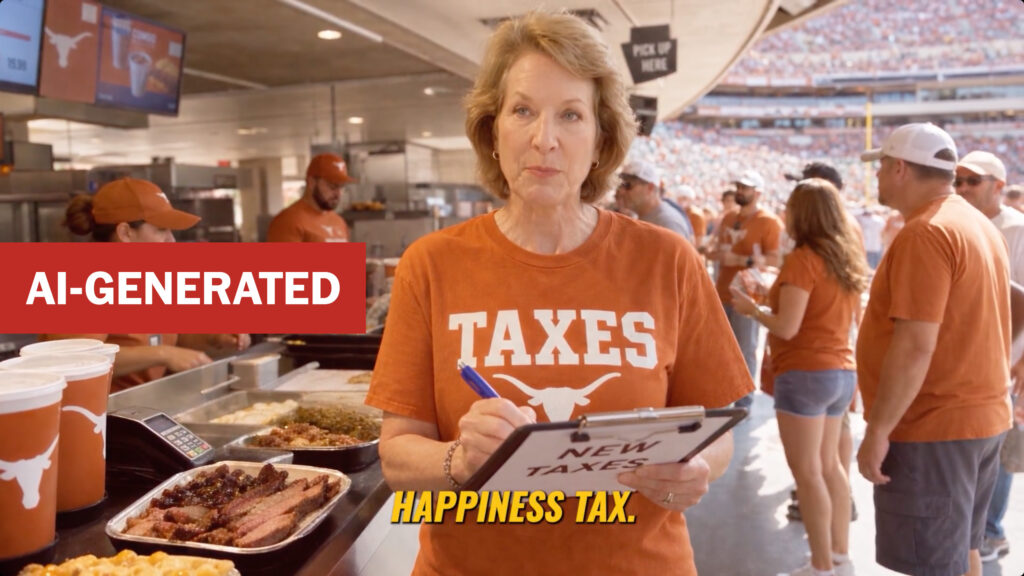
Patrick’s campaign posted a videoon social media depicting a convincing but fake Goodwin appearing at a University of Texas football game, cheering on taxes. “Soda tax, brisket tax, happiness tax!” the AI Goodwin says, before the frame widens to show an oddly shaped football field.
Texas law prohibits creating and causing the distribution of any “deepfake” video — defined as that which deceptively “appears to depict a real person performing an action that did not occur in reality” — with the intent to injure a candidate or influence an election result. The statute applies to videos published or distributed within 30 days of an election. Goodwin filed her report on Sept. 19; Texas’s early voting period begins Oct. 19.
“This outrageous behavior by an elected official is criminal, and Dan Patrick must be held accountable,” Goodwin wrote in an affidavit that her campaign shared with The Washington Post.
A Patrick campaign spokesperson, Allen Blakemore, defended the videos to the New York Times as parodies and said none had been published within 30 days of the election.
Notably, the ads appear to have been removed from Patrick’s X account. (One is viewable via the Internet Archive.) Last week, Goodwin wrote to X owner Elon Musk, asking him to provide the posts to law enforcement, and calling them “evidence of a crime,” according to a copy of the letter provided by her campaign.
“Removing the deepfakes seems like admission of guilt,” Sophia Mirto, Goodwin’s communications director, told The Post. “Why take it down if you did nothing wrong?”
Apart from the legal and regulatory debates AI is stirring up, there is a more basic question for candidates and voters that is being tested this fall. Are AI ads even effective?
Those airing the ads are betting that the issues they surface are striking enough to stick with voters — enough to overpower any skepticism voters may have about the technology.
If the ads are demonstrated as effective, this campaign cycle could usher in a new era of “slopaganda.”
The post Secret weapon or ‘slopaganda’? How AI is revolutionizing campaign advertising. appeared first on Washington Post.