SEASONS OF FURY: Four Families and the Rise of Islamophobia in America, by Rozina Ali
There is a cherished myth about 9/11, one evident during the recent 25th-anniversary commemorations, according to which the attacks united the country. Like many myths, it contains grains of truth. The early “war on terror” registered levels of political consensus not since repeated. But the myth obscures the millions of people whom the consensus not only excluded but targeted.
A more recent myth says that after the occupations of Afghanistan and Iraq failed, the wars came home. There are grains of truth here, too. Black Lives Matter protesters in Ferguson, Mo., faced police officers wielding military equipment developed for those occupations overseas. But like the first myth, this second one obscures how, from the very first moments after 9/11, the war was already at home. Federal agents and vigilantes fanned out in search of post-9/11 threats. They found them in Muslim communities.
Rozina Ali’s unforgettable new book, “Seasons of Fury: Four Families and the Rise of Islamophobia in America,” takes an overdue hammer to these myths. A thorough, subtle reporter and a contributing writer for The New York Times Magazine, Ali presents a disparate record of American Muslim life as she follows a Michigan-born civil rights lawyer; working-class Pakistani immigrants in Queens; a suburban Palestinian family; and a Republican mayor in Basking Ridge, N.J. Through their varied experiences, Ali details what it is to survive state persecution draped in the legitimacy of counterterrorism. Often their ordeals were greeted with silence by neighbors, and sometimes with approval.
President George W. Bush might have said that Islam was not the enemy, but his words provided no comfort to those living under the threat of the surveillance, sanctions, detention and deportation apparatus that he built or expanded. “Parents who once lived under oppressive regimes in Syria and Egypt now repeated a familiar refrain to their kids in the United States,” Ali writes: “The walls have ears.”
The overwhelming majority of Muslims targeted by law enforcement and immigration authorities over the past 25 years had no connection to 9/11, Al Qaeda or political violence. In the post-9/11 atmosphere of collective suspicion, it did not matter. Within two months of the attacks, at least 1,182 people had been rounded up and detained, and many had been deported. The next year, the Justice Department required “special registration” for immigrants from predominantly Muslim countries, eventually creating a database of more than 80,000 people. Registrants, Ali writes, feared they would be jailed and deported whether they complied or not.
Not many genuine terrorist plots emerged from American Muslims. Mostly prosecutors went after the webs of association emanating from newly criminalized organizations, often those supporting Palestinians. In some cases, the F.B.I. and other law enforcement agencies manufactured threats. As Ali reports, one paid informant, Osama El Dawoody, manipulated a 21-year-old Pakistani immigrant from Queens, Matin Siraj, into a concocted plot to bomb Herald Square, in Midtown Manhattan, in 2004. Siraj, who thought the scheme was just talk, backed away as El Dawoody’s entreaties intensified. He was nevertheless arrested, tried and convicted on four counts of conspiracy to destroy property. One of the many triumphs of “Seasons of Fury” is Ali’s account of the Siraj family, which she follows as Matin ages in prison and his parents and sister are arrested by ICE agents while coping with the injustice of his incarceration.
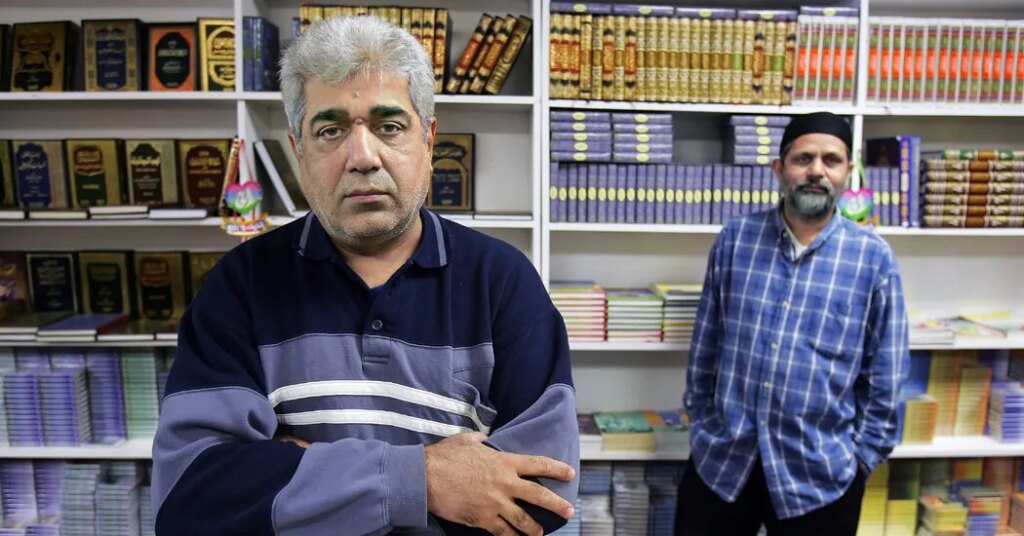
Law enforcement agents violated Muslim civil rights in the name of keeping America safe, even as American Muslims came under persistent assault. The shop windows of a Brooklyn fabric store owner named Mohammed Razvi were shot out while the ashes of the World Trade Center were still blowing over Coney Island Avenue. A decade later, in Tennessee, unknown assailants burned construction equipment intended for use in the building of a mosque. This past May, two teenage gunmen entered the Islamic Center of San Diego and shot to death three men who stopped them from advancing on the 140 children inside.
Even the specter of violence is life-changing. It happens to the Omars, a Palestinian family of five whose journey Ali arrestingly chronicles (and to whom she gives a pseudonym). Their 50-something neighbor in an unnamed Eastern Seaboard suburb harasses them for years. The American flag the Omars hang outside their home is no shield. They refer to their neighbor only as Mr. Happy, adding to the air of menace looming over these chapters. When the Omars win a protective order against him, which would expire after two years, Mr. Happy laughs his way out of the courtroom.
“Seasons of Fury,” which has been longlisted for the National Book Award, insightfully shows how even before 9/11 American Muslims were already dehumanized. The F.B.I.’s infamous Cointelpro initiative (1956-71) involved spying on Arab lawyers, activists and students for perceived ties to radicals. The bureau escalated its espionage when Palestinian resistance to Israel grew militant in the 1970s. In 1972, Operation Boulder put Arab American groups under surveillance and compiled watch lists of people it designated terrorists. F.B.I. surveillance was supplemented by Jewish groups like the Anti-Defamation League, despite its posture as a civil rights organization. “Over the years, the ADL had fashioned itself into an intelligence agency,” Ali writes, monitoring pro-Palestinian expression on college campuses, in particular.
The Iran hostage crisis, the 1991 Persian Gulf war and the 1993 World Trade Center bombing fueled a portrayal of terrorism as something only Muslims did. When the white supremacist Timothy McVeigh bombed the Alfred P. Murrah Federal Building in Oklahoma City in 1995, a Democratic former House Intelligence Committee chairman, along with pundits from mainstream outlets like Newsday and The Chicago Tribune, presumed Muslims were responsible. “The terrorist will almost invariably be an Arab national, having been born and raised in Palestine or one of the Arab countries most involved with Israel,” read an internal F.B.I. report from 1970, expressing what appears to have been the bureau’s guiding assumption for decades to come.
Ali’s ambition to trace the evolution of American Islamophobia occasionally grows too expansive for her four-family structure, and she wisely introduces new characters when necessary. Her book might have benefited from examining how Black American Muslims, an often overlooked cohort, experienced a distinctive persecution. But the book’s flaws are insignificant compared with its achievements.
By bringing the ordeal of American Muslims out from the margins, “Seasons of Fury” indicts the society that sacrificed them on the altar of 9/11. The recent ICE raids and roundups emerge directly from normalizing the repression of Muslims. Those now locked in ICE detention centers, and those soon to be, can only hope they will not be similarly abandoned by their neighbors.
SEASONS OF FURY: Four Families and the Rise of Islamophobia in America | By Rozina Ali | Crown | 446 pp. | $32
The post How the War on Terror Came for America’s Muslims appeared first on New York Times.