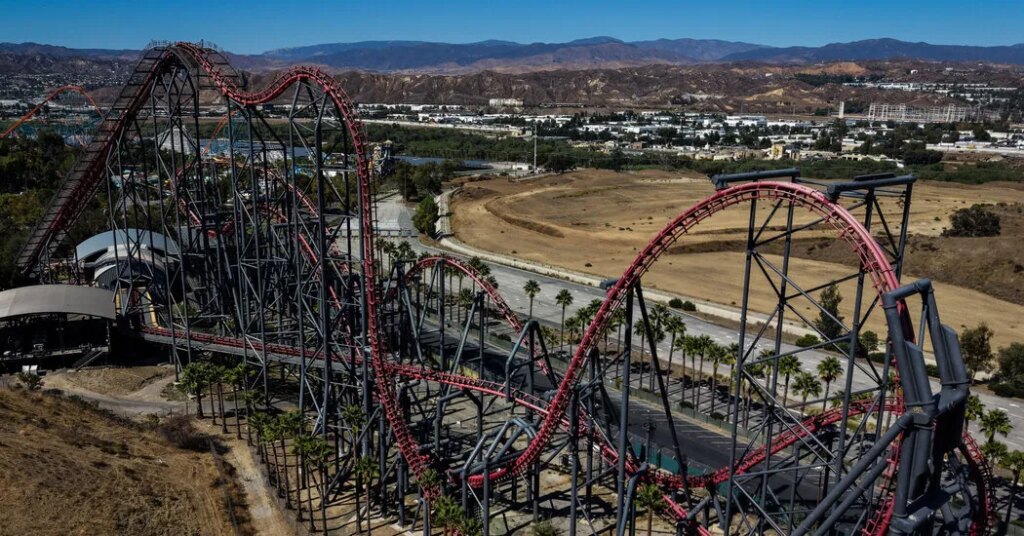
X2, the beleaguered roller coaster at Six Flags Magic Mountain near Los Angeles that has been at the center of numerous lawsuits, including at least two wrongful death cases, is permanently closing, the theme park’s operator said on Tuesday.
The ride, which tops out at about 200 feet and reaches speeds of up to 76 miles an hour, has not operated since July, amid a flurry of complaints accusing Six Flags and S&S Worldwide, the company that built the roller coaster’s train cars, of failing to warn riders about the risks.
Riders experienced up to four times the force of gravity on X2, which featured multiple inversions and twists and was classified as a “fourth-dimension” roller coaster because of the way its seats were designed. The seats rotated independently as the train traveled along the track, spinning riders as much as 360 degrees.
Its design spawned intense criticism over the years, with lawsuits linking it to cerebral hemorrhages and other traumatic brain injuries.
More than 16 million people rode the roller coaster since it was renamed X2 in 2008 after a redesign, according to Six Flags. The original ride opened as X in 2002.
In a blog post on Tuesday, Brian Oerding, the president of Six Flags Magic Mountain, said that the ride was being retired.
“While X2 consistently passed a multitude of safety tests, we have decided to close the ride because we believe it’s the right thing to do,” Mr. Oerding said. “Ride safety is a cornerstone of our business, and when we see guest confidence affected, we take it seriously.”
The roller coaster’s decommissioning came eight days after three people sued Six Flags and S&S Worldwide, claiming they suffered catastrophic brain injuries after riding X2.
The California Division of Occupational Safety and Health had begun an inquiry into the ride.
The announcement on Tuesday also followed a settlement for an undisclosed amount in late August between Six Flags and the family of Christopher Hawley, 22, a San Diego State University graduate who died one day after riding X2 in June 2022. The case had been scheduled to go to trial this month in Los Angeles County Superior Court.
Mr. Hawley lost consciousness after exiting the ride, according to a lawsuit filed by his family, who said the ride caused a catastrophic right subdural hematoma. The Los Angeles County medical examiner’s office ruled that Mr. Hawley had died from blunt head trauma and said that his death was accidental.
In a statement provided on Tuesday by Wisner Baum, the law firm representing Mr. Hawley’s family, his mother, Anne Hawley, said she was relieved to learn that X2 had been permanently shut down.
“This ride should have been closed long before our son Christopher was injured, and it certainly should have been closed after he died,” Ms. Hawley said. “Instead, it took more than four years and dozens of other injured riders for Six Flags to do the right thing.”
S&S Worldwide, which also settled the lawsuit for an undisclosed amount, did not respond to a request for comment on Tuesday about the ride’s closure and safety complaints over it.
In court filings, Six Flags and S&S Worldwide argued that Mr. Hawley had an arachnoid cyst in his brain, a pre-existing condition, that had ruptured and caused bleeding. The companies said that X2 had passed industry-standard acceleration tests in 2008, 2018 and 2023.
In October 2010, Hilda Farias, 28, died after riding X2. The cause was an acute cerebellar hemorrhage, according to the Los Angeles County medical examiner’s office, though doctors suggested at the time that she had an underlying brain abnormality. Her family also received a settlement to resolve a lawsuit over the ride.
Four Gs is greater than the gravitational force of about three Gs that astronauts experienced during the launch of the space shuttle, Erik Seedhouse, an associate professor at Embry‑Riddle Aeronautical University in Daytona Beach, Fla., said in an email on Tuesday.
Professor Seedhouse, who is the author of “Pulling G: Human Responses to High and Low Gravity,” said that four Gs would usually not be harmful.
“Roller coaster rides are G-limited to five G — not a problem for a single ride but if a person with a medical condition rides a coaster multiple times, then there may be a problem,” he said.
The post X2, the Troubled California Six Flags Roller Coaster, Reaches Its End appeared first on New York Times.