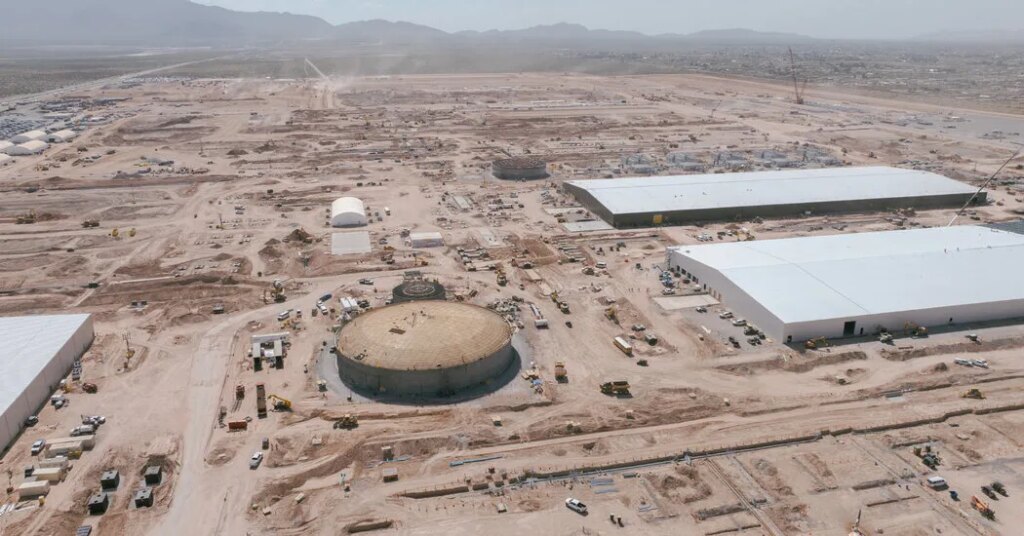
Rajiv Vohra, a private equity investor who develops data center infrastructure, recently reminisced about the good old days of a year ago. “Nobody knew what a data center was,” he said last week at a gathering of industry leaders in Dallas. “We’d put a data center in, and nobody cared.”
But in the past year, that’s changed, said Mr. Vohra, who previously spent a decade working at Google. Communities across the country are up in arms over new data centers, especially the large, hyperscale projects behind the artificial intelligence boom. “The whole industry has been caught on its heels,” he said.
Diane Sullivan, chief development officer at the power developer Hecate Energy, put it another way: offering modest benefits to the local community in exchange for hosting a data center is no longer enough. “We used to buy a fire truck,” she said. “Now we have to be more creative.”
At Data Center World, a meeting held Sept. 21 to 23 at a sprawling conference center, I got a peek inside an industry grappling with the sudden eruption of community objections to data center projects across the country.
Hitting pause
Texas Gov. Greg Abbott had just announced he was effectively pausing the development of new data centers amid growing opposition to the projects and concern over their environmental effects. At least a dozen other states have introduced or considered legislation imposing bans, moratoriums or heavy restrictions on new data center construction.
Under scrutiny is the strain these gargantuan projects have brought to local power grids, causing steep increases in local electricity demand and in some cases driving up residential utility costs. Cooling requirements for massive hyperscale centers draw millions of gallons of water daily, triggering opposition in drought-prone regions of the country. That’s on top of fears of the havoc A.I. itself could wreak.
More recently, air pollution from the natural-gas-burning plants that will power these data centers has risen to the fore of community concerns, as I wrote about last month — especially as more data centers, in their rush to go online, propose building their own power plants, rather than face a yearslong wait to connect to the electric grid.
“It’s not just data centers that are a problem. It’s natural-gas-fired power plants,” said Scott D. Deatherage, a Dallas-based environmental lawyer who frequently represents corporations seeking to build energy infrastructure. Already, he said, environmental groups were starting to demand administrative hearings and filing lawsuits to challenge air pollution permits granted to data center projects.
“This is the next big bomb,” he said. “Power plants and emissions are a big deal, and data centers may need to spend a whole bunch of money to severely limit those emissions.”
One thing was clear, conference participants said: The old, under-the-radar way of doing business was over.
“You go into a small rural community,” said Ms. Sullivan of Hecate Energy, “and perhaps you try to behave a little under the radar.” You’d cultivate a relationship with the local town supervisor, she said, and get the project off the ground — and then let the public know about it.
“And that is just a terrible idea these days,” Ms. Sullivan said. Data center developers now need to “be as transparent as we possibly can and come in early and often with information,” including the tax revenue and other benefits they can bring to communities, she said.
Still pushing for speed
Still, the concerns over community backlash seemed at odds with the other big theme at the conference: In the A.I. race, speed is everything.
Why the rush, I asked Bill Kleyman, chief executive of the A.I. infrastructure platform Apolo.us and the organizer of Data Center World. What was at stake?
“Potentially everything. Potentially your entire business,” he said. “If you’re not shovel ready, somebody else will get there faster.”
But that obsession with what the industry calls “speed to power” had also led to some bad practices, Mr. Kleyman said.
To power the supercomputers required for training A.I. models without waiting for traditional grid upgrades, or permits, Elon Musk’s A.I. company installed dozens of natural gas combustion turbines on-site. Environmental and civil rights groups have now sued the company, accusing xAI of operating massive natural gas turbines without obtaining the federally mandated air quality construction and operating permits beforehand.
“Whoa! Time out, right?,” Mr. Kleyman said. “He needed power. He wanted to get ahead of the game. But I don’t think that’s the right way to do it.”
Still, “Those types of facilities, they’re outliers,” Mr. Kleyman said. “And don’t get me wrong, the facilities that he’s building are extraordinary.”
(xAI did not respond to a request for comment.)
The coal industry asked for a rescue. Trump obliged.
Early last year, a top coal lobbyist sent a letter to Energy Secretary Chris Wright with a dire warning.
Roughly one-third of the nation’s coal-burning power plants were scheduled to close within five years, according to the letter, dated Mar. 11, 2025, from a coal trade group. Many of the closures would occur during President Trump’s second term.
But what if the plants didn’t have to shut down? The trade group, America’s Power, proposed an unusual remedy: The Energy Department could deploy rarely used emergency powers to force them to stay open longer.
Two months later, the Trump administration began doing exactly that.
The letter, which has not been previously reported, reveals some of the earliest known discussions about a move that experts have called an extraordinary intervention into the nation’s energy markets. — Brad Plumer and Claire Brown
THE FORECAST
California needs water, but will El Niño bring too much?
El Niño threatens to dump torrential rains on California this winter. With a megadrought that’s been affecting the American West since 2000, that water should be welcome.
But there’s such a thing as too much water. All that rainfall can outpace the state’s ability to capture and store it for when the dry years return, gushing into the Pacific Ocean but not before causing floods and mudslides.
“We all hope that it’s wet,” said Stephanie Anagnoson, the director of water and natural resources in Madera County, in the state’s agriculture-dominated Central Valley. “But maybe not too wet.”
El Niño, a phenomenon that naturally occurs every few years, tends to bring wetter-than-average weather to California and the Southwest. The current “super” El Niño, which is still gathering strength and will continue into 2027, is expected to be one of the most powerful on record. — Scott Dance
In other El Niño news:
-
Beachfront homeowners and beachcombers in California are already watching sand vanish into the ocean as powerful waves strike the coast.
-
Hurricanes near Hawaii. A nor’easter on the East Coast. El Niño’s influence on storms around the country may just be getting started.
More climate news from around the web:
-
One of America’s great wildlife recoveries is coming undone, the Washington Post reports. Across the Chesapeake Bay this year, scientists recorded the worst osprey breeding season they have ever documented. A silver, oily fish is at the center of the crisis.
-
A Cambodian wetland has been formally declared a genetic conservation area to protect the habitat of one of the world’s last wild populations of Siamese crocodiles, the Guardian reports.
Read past editions of the newsletter here.
If you’re enjoying what you’re reading, please consider recommending it to others. They can sign up here.
Follow The New York Times on Instagram, Threads, Facebook and TikTok at @nytimes.
Reach us at [email protected]. We read every message, and reply to many!
The post Inside a Data Center Industry Conference appeared first on New York Times.