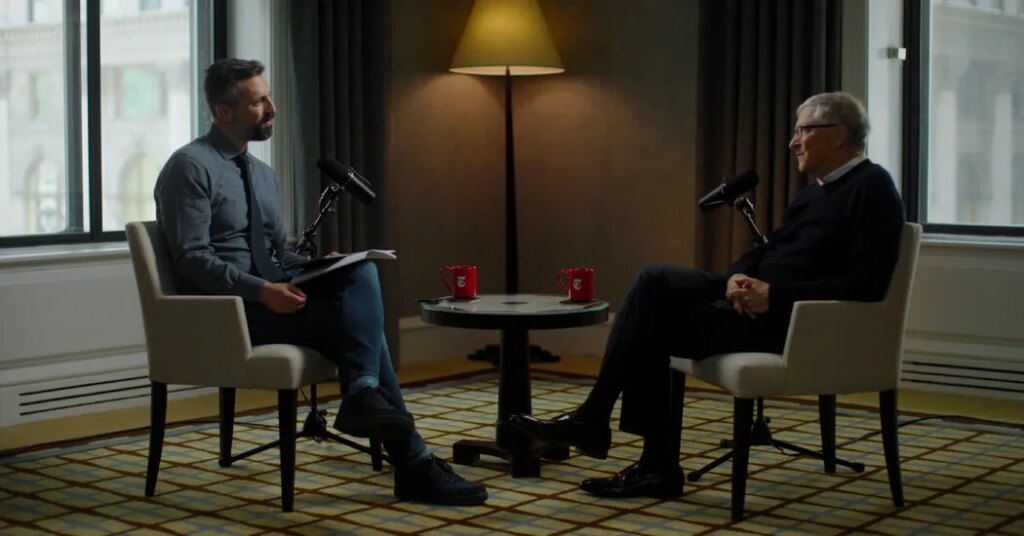
This week on “The Ezra Klein Show,” Bill Gates gave a blistering assessment of the risks that artificial intelligence poses and how unprepared the world is for the technology we’re building. Here are six takeaways from the conversation, which you can watch, listen to or read here.
Gates believes the era of A.I.-enabled cyberattacks and bioterror has arrived.
Gates acknowledged that there was risk of A.I. systems going rogue and endangering lives in the future. But he believes there are huge, present risks from A.I. that haven’t received nearly enough attention: human actors wielding current A.I. systems to wreak havoc.
Gates said that A.I. has passed what he called the “bio threshold” and the “cyber threshold” — the ability to come up with new molecules and quickly find and exploit bugs in code — earlier this year.
“A.I. has crossed the threshold that its ability to empower a bioterrorist to kill hundreds of millions — that exists today,” he said. “The ability to do a cyberattack that scrambles all of the bank accounts, shuts down the electric grid — that exists today, and we know that’s the case.”
He thinks it would be “insane” to rely on A.I. labs to self-regulate.
Jensen Huang, the chief executive of Nvidia, argued on “The Ezra Klein Show” last week that the A.I. industry doesn’t need new regulation because companies are already incentivized to release safe products; otherwise, they’ll get sued. When I put that perspective to Gates, he said, “I almost can’t believe you’re asking that. This is the most dangerous thing that humans have ever gone near.”
“In other areas, do we just say: Hey, release your drugs? There’s no F.D.A., there’s no airline safety board, there’s no requirement that cars use seatbelts. … Oh, you’re shipping opioids. Somebody should just sue you. I mean, we’ve created a society that tries to keep people safe not by saying: Oh, we can bankrupt the person who does that.”
He believes there will be an A.I. job apocalypse.
Gates acknowledged that there was “no doubt” that, so far, A.I. has been responsible for creating more jobs than it has destroyed, but argued that it was only a matter of time before A.I. models become reliable enough to begin replacing large swaths of the work force. “We will, in the next few years, cross over those thresholds for accounting, legal work, telesales, telesupport — where there’s service 24 hours a day, in every language, with infinite trivia capability and no urgency,” he said.
He disagreed strongly with the idea that some economists have put forward that A.I. could lead to a boom in “relational” jobs as people seek out human services in a world of so much automation. “The notion that the market-demand preference for driving or the nurse or even the person on the phone will favor humans — that’s a quality threshold which will be passed through,” he claimed. “In every category where A.I.s come along, the preference for the A.I. is very, very strong.”
He supports a robot tax and “human-reserved” jobs.
Gates offered two main policy proposals to blunt A.I. labor disruption. One is a tax on robot labor, which he thinks could help fund the safety net and blunt the rush to replace human workers. The current tax structure, he argued, incentivizes rather than discourages A.I. automation. “If you’ve let go of a worker and hired a robot to do that job, why are you so incentivizing the trade-off against the human labor that you don’t ask the robot to also pay into the pension fund?” Gates argued.
Gates also called for regulations that would reserve certain jobs for humans. “The idea here is that you would decide, in advance, that things like child care or elder care or some portion of medical care, some portion of education — although you could have some A.I. enhancement — that you would maintain the employment and call those things ‘human-reserved,’” he explained.
He thinks A.I. can be a force for global equality.
While A.I. may lead to mass job loss in wealthier countries, Gates said that in low-income countries, A.I. “will overwhelmingly be a good thing, and it should be pushed forward as quickly as it can.”
He explained that A.I. could help farmers learn the best seeds to plant and provide medical advice to people who spend their lives never seeing doctors. “A.I. is a tool for good in terms of helping those people in by far the greatest need with very basic human problems.”
And Gates is hopeful that we are in a transition period, and that A.I. could ultimately lead to “superabundance.”
Gates remains optimistic about the world that A.I. could usher in. He believes A.I. will lead to “mind-blowing advances” that will lower the cost of food, housing and education, and could lead to an era of “superabundance” in the future. The key question for Gates is how we ride out the transition period.
The task for this generation, he said, is to “make sure we get through that with humanity still in control, and with the disruption — the number of bioterror events, or the number of people whose lives are damaged by job loss — we need to minimize that over what’s probably a 20-year-plus transition period.”
If that happens, then the next generation will face a very different challenge: “There, you have deep, almost philosophical, religious issues of: If we don’t have the shortages that we’ve organized society around, why should you learn? And how do you find purpose?” he said.
Jack McCordick is a producer for “The Ezra Klein Show.” He produced and researched the interview with Bill Gates.
The Times is committed to publishing a diversity of letters to the editor. We’d like to hear what you think about this or any of our articles. Here are some tips. And here’s our email: [email protected].
Follow the New York Times Opinion section on Facebook, Instagram, TikTok, Bluesky, WhatsApp and Threads.
The post 6 Takeaways From Ezra Klein’s Interview With Bill Gates appeared first on New York Times.