What Life Looks Like in the ‘Fortress Cities’ Russia Is Trying to Break
Sept. 29, 2026
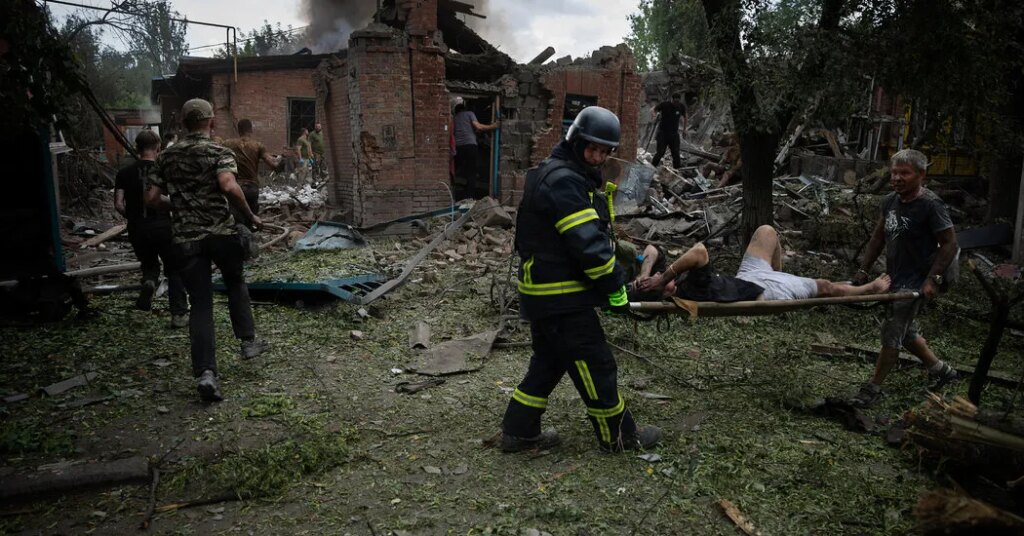
When explosions ring out across Kramatorsk, Oleksandr Chyvenkov and the police paramedic unit under his command do not rush immediately to the scene. Instead, they listen.
In this compact industrial city, where every detonation reverberates off concrete high-rises, the first blast is often bait. The team monitors military communications channels for reports of any incoming secondary strikes before racing in heavy protective body armor to save lives.
“Most people in our unit have faced double-tap strikes in some way,” said Mr. Chyvenkov, using a common term for such attacks.
He has led rescue teams for more than four years, including in the ruins of the nearby cities of Pokrovsk, Toretsk and Avdiivka, witnessing their methodical destruction before their fall to the Russians. Moscow’s forces are now using the same tactics in Kramatorsk and Sloviansk, adjacent cities that form the core of Ukraine’s defenses in the Donbas, the region most coveted by President Vladimir V. Putin of Russia.
When Mr. Chyvenkov’s team rolls out to a shattered apartment block or a blasted-out business, the protocol is stripped down to raw triage: grab the “red” critical cases, stabilize them on the fly and speed toward the hospital before the next Russian strike.
They repeat the process, over and over again.
“Personally, I don’t really have any emotions left,” he said. “As the person they rely on, I don’t have the right to be sad or give in to despair. Stay strong, keep moving forward.”
As Russian attacks grew more intense over the summer, the Ukrainian authorities expanded evacuation orders to more and more neighborhoods.
In Kramatorsk and Sloviansk, the pace of departures has slowed because those who remain are often older or have limited mobility, or are municipal workers keeping power lines, gas mains and hospitals functioning under fire. Others have grown used to the raging war at their doorstep and hope to make it through the onslaught.
About 60,000 people still live in Kramatorsk and Sloviansk. More broadly, in the 20 percent of the Donbas under Ukrainian control, 93,000 civilians remain, including more than 4,200 children, according to local officials.
“What upsets me is that some parents ignore the calls to evacuate, and small children are still walking around the city, seeing all of this and hearing the sounds of explosions,” Mr. Chyvenkov said. “That really gets me down.”
Russian ground divisions remain miles from directly assaulting these urban redoubts. Capturing them would most likely require months or years of grinding infantry combat, in which tens of thousands of soldiers would almost certainly be killed or injured.
But Russia is not waiting for its foot soldiers to arrive in these cities, resolving to bomb them until they are uninhabitable.
For now, life goes on for those who remain. To try to protect them, nets to guard against drones have been strung up over nearly every major road. Sandbags are stacked at the remaining shops and gas stations. Razor wire snakes across once-peaceful residential streets.
Essential municipal services like power and water, medical facilities, banks, and internet and mobile communications remain operational despite regular shelling. People try to maintain a semblance of normality, but as Russia’s precision weapons extend their reach, life is increasingly reduced to the confines of basement shelters.
Daily barrages of guided bombs packing hundreds of pounds of explosives, cluster munitions delivered by rockets, and ubiquitous small drones directed by Russian pilots are systematically erasing the fabric of urban life. Familiar streets have been transformed into open hunting grounds.
It was all too much for Olha Volodymyrivna, 61, who left Sloviansk in early September.
“Everything was flying around. There were constant air raid alarms, constant drones,” she said. “Military guys came to us and told us that we had to evacuate, because my husband is disabled, and if something worse happened, it would be much more difficult to evacuate him.”
“Throughout the summer, it was getting worse and worse and worse,” she added. “And at some point I understood that I simply couldn’t take it anymore.”
The drones fly fast, Ms. Volodymyrivna said, and she cannot run. “So if something happens, I understand that I won’t be able to escape anywhere,” she said.
Guided bombs instill a different kind of terror. They often come at night, and the only warning is a quick whistle in the air before impact. The explosions are powerful enough to destroy a six-story apartment building.
“God knows you wouldn’t wish such a life on anyone,” Ms. Volodymyrivna said. “It’s very stressful and very frightening.”
Serhii Chepyga, 27, a firefighter who lives in Sloviansk, described a recent rescue operation that showed how the region’s cities have been transformed over the past year and how emergency crews are being directly targeted.
Ukrainian officials say that attacks on essential workers are part of Russia’s campaign to dismantle the safety net required to keep a place livable. Mr. Chepyga recalled how his team recently arrived at the location of an explosion only to get an alert that another guided bomb was inbound.
They dashed to a basement and emerged after more explosions to survey a courtyard choked with wreckage. Sirens then screamed again.
“They started to hit us with the cluster munitions,” he said. “Everything was scattered all over the place, lots of debris around. I don’t remember running that fast before.”
They narrowly escaped. And then it was back to work.
“All that’s left is to hope for the best, joke, to poke fun at each other, and be happy that you’re alive,” he said. “You have to be happy that you can wake up every day again, drink coffee, breathe clean Ukrainian air. And that’s all.”
Dzvinka Pinchuk and Liubov Sholudko contributed reporting.
The post What Life Looks Like in the ‘Fortress Cities’ Russia Is Trying to Break appeared first on New York Times.