The Trump administration escalated its withering diplomatic assault on South Africa this month when it announced new visa bans on South Africans who it said were complicit in anti-white discrimination.
South African officials said they were blindsided by the news.
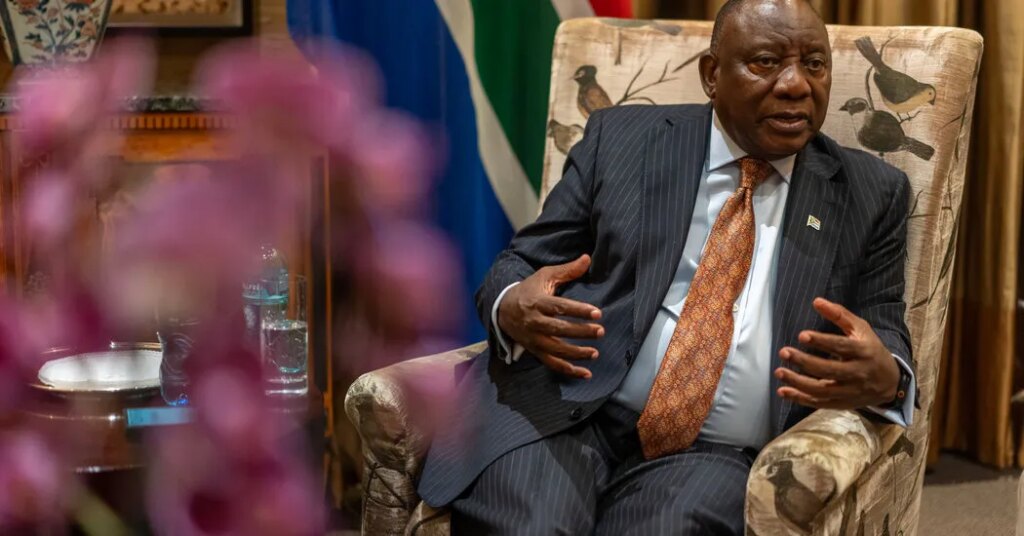
Earlier this year, Washington demanded that South Africa address what it said were racist polices that hurt white South Africans. Days before the new visa restrictions were announced this month, President Cyril Ramaphosa sent a six-page letter to President Trump laying out his government’s efforts to address Washington’s requests.
Mr. Ramaphosa’s response was not enough.
“President Ramaphosa failed to meaningfully respond” to three of the administration’s requests, the State Department said in a statement to The New York Times this week. “The lack of a meaningful response to these requests made clear that the South African government does not want a constructive relationship with the United States.”
Here are some of those requests.
1. Condemn an anti-apartheid song
Washington has asked Mr. Ramaphosa to condemn “incitement to race-based violence,” the State Department said, singling out a song called “Kill the Boer,” or “kill the white farmer.” The song became popular during the fight against apartheid, when the white-minority government violently oppressed Black South Africans, driving them off their land and killing activists.
Supporters of the song say it was never meant to incite violence, but referred to Boers, or white farmers, as a symbol of oppression. South African courts have ruled that the song was not a call to violence and that it can be chanted in public — though most politicians no longer sing it.
“I don’t care what your courts say,” L. Brent Bozell III, the U.S. ambassador to South Africa, said in March in reference to the song.
In his letter, Mr. Ramaphosa highlighted that he had condemned racial intolerance and that he had signed a law to combat hate crimes and hate speech, according to Alistair Ruiters, an adviser to Mr. Ramaphosa.
2. Prioritize rural crime
Central to Mr. Trump’s criticism of South Africa is his unsupported claim that white farmers are being killed in a genocide in the country.
The State Department said it had asked Mr. Ramaphosa to make rural crime a priority, “with a real plan” to address it.
Mr. Bozell said last week that the United States had offered to help pay for a private security initiative for farming communities in South Africa, where most major commercial farms are white owned.
Mr. Ramaphosa told Mr. Trump in his letter that the country’s current rural safety plan was having success in reducing crime, Mr. Ruiters said. Mr. Ramaphosa also noted that the government was working with various stakeholders on rural safety. That includes discussions with AfriForum, an activist organization run by white Afrikaners, Mr. Ruiters said.
Mr. Ruiters added that U.S. officials had asked the South African government to negotiate some of Washington’s demands directly with AfriForum and other Afrikaner groups.
Werner Human, the deputy chief executive of AfriForum, said that the organization has had productive conversations with South African officials, but the government has not turned those talks into action.
“As soon as you exit the layer of discussion and you enter the layer of decision-making and action, that is where it is still unclear,” Mr. Human said. “And I think that is where the frustration lies.”
3. Reform affirmative action laws
South Africa has Black empowerment laws that in some cases require foreign companies operating in the country to sell shares of their businesses to Black South Africans.
The U.S. State Department said it had asked the South African government to allow companies in the telecommunications and mining sectors to meet Black empowerment requirements without having to give up company shares.
Known as Broad Based Black Economic Empowerment, supporters of the policy say it is foundational to addressing the economic imbalance created by apartheid, when Black South Africans were almost entirely prohibited from land and business ownership.
Elon Musk has been one of the loudest critics of the policies. Born in South Africa, Mr. Musk has been unable to get a license to operate his satellite internet business, Starlink, in the country because he has refused to sell shares to Black South Africans.
U.S. officials have said Broad Based Black Economic Empowerment policies are an impediment to American investment in South Africa.
While the policies can be a challenge for foreign companies, “I would not consider it a roadblock,” said Lee du Preez, a South African consultant who works with businesses on fulfilling their economic empowerment requirements. “If it were, there would not be 600 American companies based here.”
Mr. Ruiters said that Mr. Ramaphosa, in his letter, told Mr. Trump that the government was exploring alternatives to the Black ownership rules in the mining and telecommunications sectors. Mr. Ramaphosa also said he had called for a full review of the economic empowerment policies to refine and strengthen them.
The post 3 Reasons Trump and South Africa Disagree on Anti-White Racism Claims appeared first on New York Times.