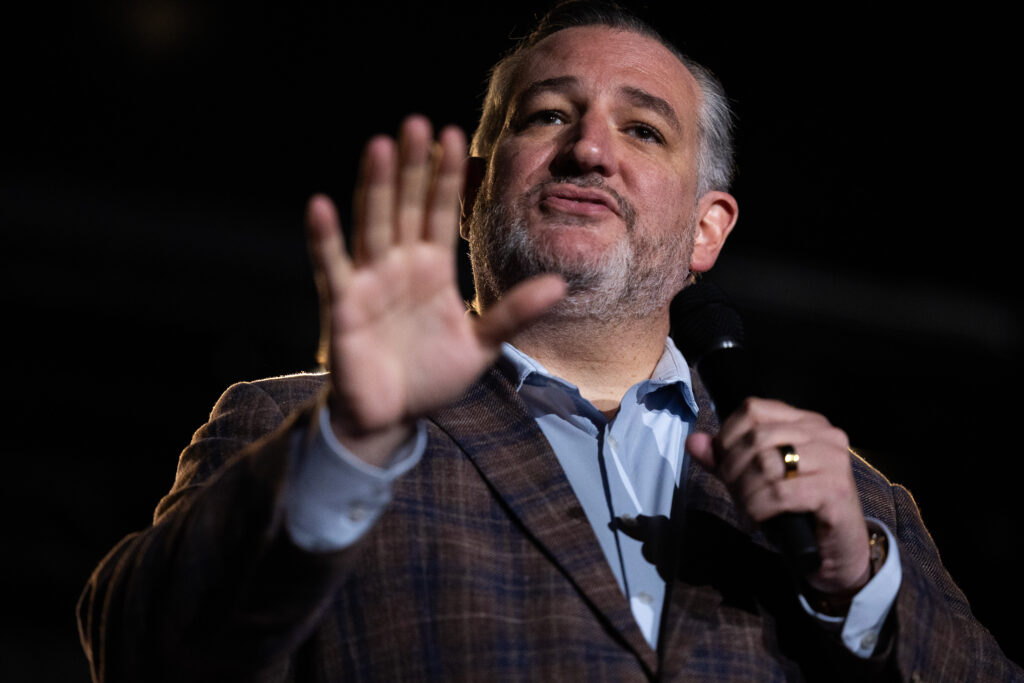
When Ted Cruz first arrived in the Senate in 2013, he achieved notoriety by reading Dr. Seuss’s “Green Eggs and Ham” during an all-night speech on the chamber’s floor — part of a doomed campaign to defund the Affordable Care Act that angered Democrats and irritated some of his Republican colleagues.
On Monday, the Texas Republican again spent hours on the Senate floor. But this time he was trying to pass a major bipartisan bill — and he emerged triumphant.
The Senate passed legislation negotiated by Cruz and Sen. Maria Cantwell (D-Washington) to overhaul regulation of college athletics, a rare bipartisan achievement in a Congress marked by government shutdowns and partisan brawling.
Cruz spent years drafting the legislation and working to win the support of his colleagues — including Democrats, whose backing he needed to overcome a filibuster. The bill passed 77-22, with 26 Democrats and Sen. Angus King (I-Maine) joining Republicans to support it. Two Republicans voted against it.
The vote displayed a side of Cruz that did not get much attention during his early years in the Senate: a bipartisan dealmaker.
“I’ve seen several versions of Senator Ted Cruz,” Sen. Dick Durbin (D-Illinois) said. “I like the version where he’s doing constructive work to pass legislation and actually asks me for my vote. It’s quite a change from some of the other roles I’ve seen him play.”
Republicans sometimes ribbed Cruz during their weekly lunch meetings about his newfound willingness to work with Democrats, Sen. Thom Tillis (R-North Carolina) said.
“We’ve joked with him,” Tillis said. “We’ve said, ‘Wait. Whoa, whoa, whoa, whoa, whoa. You’re saying we’ve got to compromise here? We’ve got to work together?’”
One of the Republicans who gave Cruz a hard time, according to Tillis: Sen. Mitch McConnell (Kentucky), with whom Cruz once clashed during McConnell’s years as the Republican Senate leader. “He said, ‘I’m really liking the new Ted,’” Tillis said, imitating McConnell’s deep voice and slow style of speaking.
Cruz, 55, was first elected to the Senate in 2012 after defeating the establishment candidate, Texas Lt. Gov. David Dewhurst, in an upset in the Republican primary. He quickly became a hero of the conservative tea party — but exasperated some of his colleagues on both sides of the aisle. The late Sen. John McCain (R-Arizona) once described Cruz and two other Republicans as “wacko birds.”
Cruz’s profile rose higher when he ran for president in 2016. He won the Iowa caucuses and 10 other contests before dropping out and endorsing Donald Trump.
Cruz is widely considered a potential presidential candidate in 2028 and has not ruled out another campaign. He has traveled to Iowa and criticized Vice President JD Vance — another potential candidate — for his role in negotiating an agreement with Iran earlier this year that later fell apart.
Cruz plays a different role in the Senate now than he did a decade ago. Once a partisan gadfly, he is now a committee chairman who has said he speaks to the president weekly. He has spent nearly 14 years in the Senate — longer than most of his colleagues.
In an interview, Cruz acknowledged he had learned some things since he was first elected — but he said his conservative principles had not changed.
“I hope I’m a more effective senator today than I was when I was newly elected,” Cruz said. “But the principles I’m fighting for are the exact same principles, and the victories that we’ve been winning have been consistent over 14 years. It is easier to win big victories when you have a majority and when you’re the chairman of a major committee.”
The bill is not Cruz’s first bipartisan achievement. After he became the top Republican on the Senate Commerce Committee in 2023, Cruz played a crucial role in passing a bipartisan bill to reauthorize the Federal Aviation Administration and overhaul air travel regulations.
When Republicans retook the Senate in 2024, Cruz became chairman of the Commerce Committee — and he threw himself into drafting the college sports bill and finding enough Democratic votes to pass it.
Cruz described the negotiations as “slow and painstaking and excruciating.” He sat in a conference room with Cantwell, the top Democrat on the committee, he said, “for six, eight hours a day, day after day, week after week, negotiating every provision, every line of every provision.”
At one point last month, Cruz said, he agreed to drop his push to take up the bill before Congress left for its summer recess after Sen. Brian Schatz (D-Hawaii) warned that it would alienate some of the bill’s supporters.
The bill would restrict athletes’ ability to transfer schools and limit how many years they could play — changes that Cruz argued are needed to rescue a beloved American institution.
“The system we have today is unsustainable, plain and simple,” Cruz said on the Senate floor. “Students are transferring three and four times. Pros are trying to play ball against college kids. Conflicting court decisions have created a fragmented system — one that no one intended.”
Some Democrats who opposed the bill criticized it for not doing enough for student-athletes. It would give athletes new protections but also make it tougher for them to sue colleges and sign deals to make money from their name, image and likeness.
“I beg my colleagues not to do this,” Sen. Cory Booker (D-New Jersey), who played football at Stanford University and voted against the bill, said on the Senate floor. “It’s wrong.”
Sen. Tim Kaine (D-Virginia), who also voted against the bill, said he could not support legislation that would restrict payments to student-athletes but not their coaches. An amendment to cap coaches’ salaries at $5 million a year failed on a 52-47 vote.
Still, Kaine said he found much to admire in the bill and praised Cruz for working on it.
“I give him credit for working through a complicated issue with a lot of different pieces,” Kaine said.
Sen. Peter Welch (D-Vermont), who voted for the bill, said Cruz spent time explaining the bill’s provisions to senators and listening to their concerns. Welch referenced a famous 2016 quip from the late Sen. Lindsey Graham (R-South Carolina) about Cruz’s ability to irritate his colleagues: “If you killed Ted Cruz on the floor of the Senate, and the trial was in the Senate, nobody would convict you.”
“I would say he’s a long way from that,” Welch said.
The bill still needs to pass the House, which is not scheduled to return to Washington until after Election Day, before it reaches Trump’s desk. Cruz has urged House Speaker Mike Johnson (R-Louisiana) to bring lawmakers back early to pass the bill, he said, which would allow them to campaign on it. A Johnson spokesman declined to comment Tuesday.
Passing the bill, Cruz said, would demonstrate “to voters — including a lot of voters who don’t necessarily follow politics all that closely — that ‘I’ll be damned, these guys can actually get something done.’”
Asked whether he might also run on the bill if he runs for president in 2028, Cruz demurred.
“I’m a big believer that good policy is good politics — that if you’re fighting for principles that matter, if you’re making a difference for your constituents, that also helps you at election time,” he said.
The post How Ted Cruz, once a Republican gadfly, became a bipartisan dealmaker appeared first on Washington Post.