The history of fashion photography can be divided into before and after Irving Penn.
On the eve of Paris Fashion Week, the MEP (Maison Européenne de la Photographie) is marking its 30th anniversary with “Penn & Fashion,” an Irving Penn retrospective that focuses on his work for American Vogue. The exhibition includes 140 original photographs drawn from MEP’s permanent collection and loans from the Irving Penn Foundation in New York, the Nicola Erni Collection in Switzerland and the Miyake Issey Foundation in Tokyo.
Penn’s collaboration with Vogue lasted a record-breaking 66 years, with his first credit in August 1943 and his last published in August 2009. He died later that year at age 92.
“Working at Vogue magazine offered Penn a monthly platform to share his creative vision with the public,” his son, Tom Penn, said. “Before the digital era and the rise of social media, magazines were a powerful force for shaping culture — so part of the incentive for staying at Vogue for so long was likely the opportunity to have his work seen and to influence the direction of our visual culture.”
Born in 1917 in Plainfield, N.J., to Russian-Jewish immigrant parents, Penn studied art at the Pennsylvania Museum School of Industrial Art. He trained in graphic design under Alexey Brodovitch, who hired him as his assistant at Harper’s Bazaar.
In 1943, Vogue’s art director, Alexander Liberman, hired Penn as a graphic designer to create cover concepts for the magazine’s photographers. Recognizing the originality of his vision, Liberman proposed he start taking the photographs himself. With his mastery of composition, contrast and negative space, combined with his skill in eliminating all but the essentials of an image, Penn quickly become Vogue’s star fashion photographer. His surreal sense of humor also played a role.
“Penn & Fashion” unfolds chronologically by decades. The evolution of fashion is traced through new designers, models and poses. The freshness of Penn’s vision never falters through almost seven decades. In “12 Models Moving Their Heads,” his 1947 group portrait of the 12 most photographed models in designer ball gowns, a crumpled rag lies in the foreground. Why? We’ll never know.
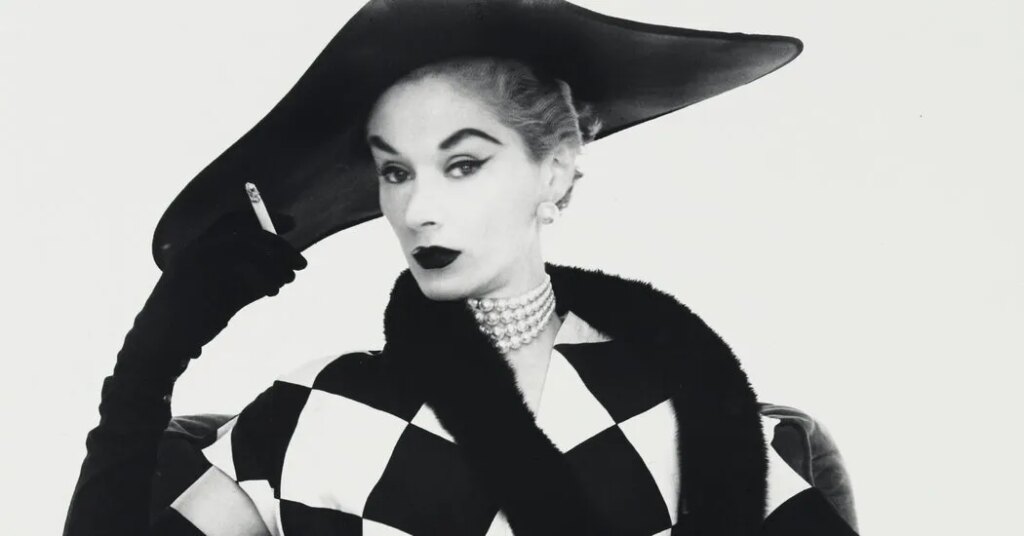
It was at this sitting that Penn met Lisa Fonssagrives, remembered as the world’s first supermodel. She became his wife in September 1950 and, according to Liberman, the subject of his greatest photographs. An accomplished dancer, she called modeling “still dancing.”
For “The Black and White Idea,” the Vogue issue of April 1950, Penn shot his first black and white cover with another favorite model, Jean Patchett, with a portrait of Fonssagrives in a harlequin dress, both masterpieces of composition and contrast. Using an old theater curtain as a backdrop, Penn eliminated any visual distraction from the designer’s vision.
Penn documented the postwar revival of haute couture, set off by Christian Dior’s New Look. Balenciaga, Rochas, Lafaurie and Jacques Fath had their clothes delivered to the daylit studio he hired on Rue de Vaugirard, reversing the usual order, when photographers were expected to report to the couture house’s showroom.
Pascal Hoël, the head of collections at the MEP and curator of the exhibition, said that, at the time, “Vogue was no ordinary fashion magazine.” He continued, “It pushed the aesthetic boundaries, providing young artists with the opportunity and resources to explore their vision.” Penn’s work for Vogue was not confined to fashion. He also shot beauty, features and even cooking pages.
His iconic portraits gave us Yves Saint Laurent hiding all but one eye; a tetchy Picasso, who arrived in a sweatshirt “like a high-school basketball coach,” in Penn’s words; an uncomfortably perched Jean Cocteau (perhaps a reference to his book “La Difficulté d’Être”); a lolling Christian Dior and a cornered Elsa Schiaparelli.
His Flowers series, shot annually from 1967 into the 2000s for Vogue’s Christmas issue, is shown at the MEP in its original magazine layouts. Each close-up captures a flower beginning to decay, a poetic refection on the impermanence of beauty.
In the 1950s, Penn found a kindred spirit in Cristóbal Balenciaga. Each distilled their work to its essence, the couturier in line, volume and proportion. The notoriously press-shy Balenciaga entrusted Penn with complete creative freedom. Penn photographed his work over several years, describing him as “a master of clothes-architecture.”
Increasingly frustrated by the limitations of magazine reproduction, Penn began experimenting with platinum-palladium printing. This sophisticated process produced a subtle tonal range of deep blacks, delicate grays and precisely controlled highlights without the harsh, glossy contrast that black-and-white photography sometimes has. The image appears matte, velvety and textured, perfect for Balenciaga’s creations.
Penn’s compositions were meticulously planned to the last detail. He sometimes sketched out his concept months in advance. He was intransigent, often exhausting his models.
For a 2001 piece entitled “Mascara Wars,” Penn photographed a heavily made-up model, tugging her eyelashes apart with mascara wands for hours. He ended the shoot without feeling he had captured a great image. When she opened her eyes, they were completely bloodshot. He had his shot.
By the 1970s, Penn was experiencing fashion fatigue. The era’s ready-to-wear could not, he said, withstand a close-up. Diana Vreeland’s 1973 Costume Institute exhibition at the Metropolitan Museum of Art, “The 10s, the 20s, the 30s: Inventive Clothes, 1909-1939,” with works by Paul Poiret, Madeleine Vionnet, the Callot Soeurs, Jeanne Paquin, Elsa Schiaparelli and Madame Grès, reignited his interest. Photographing original couture in an improvised studio at the Met, he felt “a thrill I had not as a fashion photographer known before.”
Penn’s collaboration with Issey Miyake spanned more than a decade. As with Balenciaga, Miyake appealed to Penn’s fascination with pure form, with a radical new dimension of pleating, folding, volume and movement. “Penn’s photographs allow me to see my own designs,” Miyake remarked.
Toward the end of his life, Penn became more selective in the designers he photographed. At 90, he photographed John Galliano, Karl Lagerfeld and Christian Lacroix, capturing their extravagantly theatrical couture in color.
Pascal Hoël remembers being awe-struck at meeting Penn at the MEP in the 1990s. He was surprised to discover “a short man in a beige raincoat, very quiet and discreet.”
“He was in Paris to photograph the haute couture collections,” Hoël said. “He seemed very touched that a French museum would be interested in acquiring his work for exhibition.”
The post Penn, Before and After appeared first on New York Times.