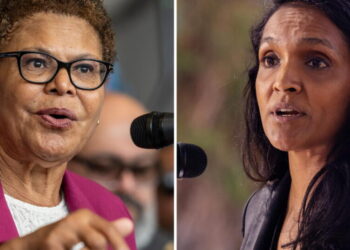
The Make America Healthy Again movement has been closely associated with Health Secretary Robert F. Kennedy Jr. and the Trump administration, but at least one Democrat in a closely watched Senate race is making a play for MAHA supporters.
Abdul El-Sayed, the Democratic candidate for Michigan’s pivotal Senate seat, on Tuesday is releasing a “Building a Healthier America” policy agenda focusing on cracking down on pesticides, changing drinking water standards and boosting access to healthy food. However, El-Sayed, a former public health official, does not share some MAHA supporters’ skepticism of vaccines, saying in an interview that he “believe[s] in vaccines.”
El-Sayed said the country needs to “severely, severely rethink” how much pesticides are used and in what context. He said he would seek to draft “broad legislation led by science to limit pesticide use” if he wins in November. His newly released policy agenda says he would fight against legal immunity for pesticide manufacturers — a divisive issue after the Supreme Court this year ruled to limit lawsuits over a popular weed killer’s potential health impacts. He said he would also aim to ban pesticides already prohibited in Europe, though the document didn’t specify if he was targeting particular chemicals.
Polls show that while 4 in 10 adults say they support MAHA, the majority are Republicans or Republican-leaning and supporters of the Make America Great Again movement. Republican operatives have credited Kennedy with helping woo some left-leaning and independent voters to support the GOP.
Recently, some influential MAHA leaders, particularly those focused on pesticides, have become disillusioned with the White House, warning the administration risks losing voters in the midterms if they don’t reduce the use of pesticides. White House officials have said delivering on the MAHA agenda is a “top priority,” but some Democrats, like El-Sayed, are seeking to capitalize on the split.
The Senate contest in Michigan is being watched closely across the country as Democrats’ chances of flipping the upper chamber, once viewed as a long shot, have grown in recent months. El-Sayed had a three percentage-point lead — which is within the margin of error — over Republican Mike Rogers, a former congressman, a Washington Post-Schar School poll found earlier this month. The majority of the state’s likely voters said they want Democrats to control the Senate next year, but Republicans say Rogers, who narrowly lost a 2024 bid for the seat, is a formidable candidate.
Pesticides, food and vaccines
The MAHA movement was born out of the 2024 political alliance between President Donald Trump and Kennedy. It consists of various, and at times competing factions, such as those pushing for tighter regulations over pesticides, the elimination of vaccine mandates and healthier foods. Majorities of the public say there isn’t enough regulation of chemical additives in food and pesticides used in agriculture, according to polling by health policy research and news organization KFF, while vaccine changes are divisive.
El-Sayed said for those solely focused on vaccine changes, “we are going to have to agree to disagree.”
“But when it comes to the broader goal of keeping kids safe, when it comes to the slop that they’re being fed by big food corporations and the pesticides that are being forced into our food environment by big ag, when it comes to addressing corporate consolidation, when it comes to standing up to pharma, I think there’s a lot that we agree on there,” he said.
In particular, MAHA supporters have been frustrated over the Trump administration’s handling of glyphosate, a popular weed killer that officials say is harmful. They have sought for the administration to halt its use for preharvest desiccation, which is when crops are sprayed shortly before harvest. There is a scientific divide on the safety of glyphosate, and the industry has maintained it is safe.
El-Sayed did not provide a specific position on glyphosate and preharvest desiccation when asked, but instead said he was focused on broader themes such as limiting pesticide use. He said he has had conversations about pesticide use with the farming community, and that particularly small farms have been supportive of his plans.
Other plans revolve around strengthening limits on PFAS, also known as “forever chemicals,” in drinking water and replacing lead pipes. He also wants to increase nutrition in school lunches, a focus of Kennedy and the Trump administration.
The Trump administration has frequently touted its MAHA agenda and has previously told The Washington Post that “administration officials frequently engage with the MAHA movement, and billions of dollars in new investments into regenerative agriculture reinforce our commitment to ensure our food supply is the healthiest, most abundant and most affordable in the world.”
MAHA Action, an advocacy group, has not endorsed in the Michigan Senate race.
El-Sayed is not the first candidate to take a stance that could pose a threat to the agriculture industry. In Iowa, Republican Zach Lahn built his bid for governor off of bashing Big Agriculture, which was once unthinkable in the Corn Belt.
The post This Senate Democratic candidate is making a play for RFK Jr.’s MAHA supporters appeared first on Washington Post.