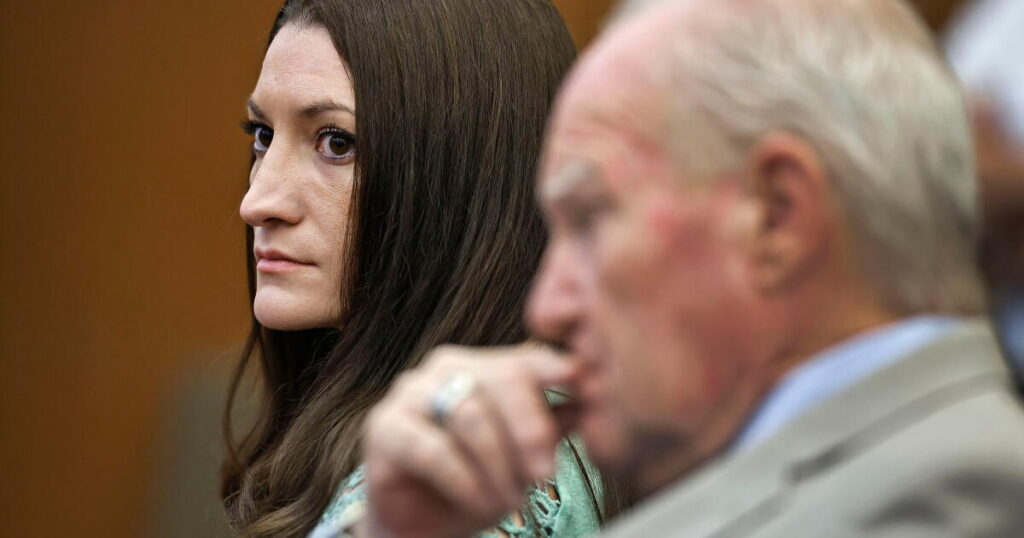
The mistrial declared on Sept. 4 in the case of Lindsay Clancy, the Massachusetts mother who strangled her three children while, her lawyers argued, in the grip of postpartum psychosis, has forced the country to confront postpartum mental illness and the gaping holes in how we care for it. A jury deliberated seven days and could not agree on whether Clancy was criminally responsible. Whatever a second jury decides, the harder question to answer is why her illness was allowed to reach that point.
That question gained fresh urgency amid the trial’s deliberations with a seemingly unrelated horror. On the afternoon of Aug. 31, Pamela Cisneros, a 49-year-old Queens, N.Y., woman armed with two large knives, attacked two strangers in Times Square. Cisneros killed Erin Piacenti, a 32-year-old bank executive who’d recently returned from maternity leave, and wounded Tak Kam, a 68-year-old man visiting the city with his wife. When police could not subdue Cisneros, and she refused to drop the knives, officers shot her dead.
These crimes appear to have nothing in common. But in fact, they are chapters of the same story.
The psychosis that drove Cisneros to attack people she’d never met started, as best we can determine, with a mental disturbance following childbirth many years earlier and never fully resolved. Instead, the disturbance hardened into a chronic psychotic disorder requiring continuous treatment — and that point matters. Her father, Mario Cisneros, told reporters she’d been receiving monthly injections to treat her illness. Such long-acting injectable medications are typically antipsychotics, the kind clinicians turn to when patients have repeatedly stopped taking their pills and a treatment reserved for those known to be at high risk of relapse.
New York State’s Office of Mental Health runs programs designed for exactly such patients: those who struggle to stay in treatment and may become dangerous when they relapse. We do not yet know whether Pamela Cisneros was enrolled in one, or what her care looked like in the weeks before the attack. But if a patient at this level of risk fell out of treatment and deteriorated unnoticed, then the horror in Times Square was not a bolt from the blue — it was the kind of foreseeable outcome such programs exist to prevent. A system meant to keep track of high-risk patients has to actually keep track of them. Otherwise it is not a safeguard. It is only a promise.
Cisneros’ story ended in her death at the hands of police in the most public square in America. Clancy’s story has not ended yet. Both cases sent us back to a phone call Nyna Giles made to me years ago. She rang my office and explained that she was writing a memoir, which would eventually become “The Bridesmaid’s Daughter.” For the book, she wanted to understand why her mother had developed such strange behaviors after an emergency cesarean section and hysterectomy, and she needed help to clarify the diagnosis.
During our meeting days later, Nyna told me all about her mother, Carolyn Scott, who arrived in New York from southern Ohio in the late 1940s to become one of Eileen Ford’s most successful junior models. Scott lived at the Barbizon Hotel for Women on the Upper East Side in a room next to another young model named Grace Kelly. The two became fast friends, and when Kelly became engaged to the Prince of Monaco, she asked Scott to be a bridesmaid at the wedding of the century.
Those were the happy years. Then Scott married an older man, and after her third pregnancy — the one that produced Nyna — she began to come apart. Scott’s husband had little patience for what he did not understand. Nyna, a child, watched her mother descend into illness and eventually vanish due to what was then diagnosed as paranoid schizophrenia, but which I recognized as postpartum psychosis.
That story had an ending the others did not: a reunion, and Giles’ book, which reached many readers. But it is the symmetry of these three women, separated by seven decades, that should trouble us. A postpartum illness in the 1950s, one in the early 2000s, one in the 2020s, and in each case the same pattern: a woman’s mind unravels after childbirth, the people and systems around her fail to recognize it or fail to follow through, and the illness runs its course until it destroys her or someone else.
We have long known that the enormous hormonal shifts of pregnancy, delivery and lactation can disturb mood, thinking and perception. Most women experience what is euphemistically called the “baby blues” and are left to grin and bear it until it passes. But in more than 1 in 10 women, it deepens into a clinical depression that is distressing, disabling and corrosive to the bond between mother and newborn. Sleeplessness and the burden of caring for an infant compound the distress and may help tip some women into psychosis, which strikes one or two in every thousand. Lindsay Clancy, Pamela Cisneros and Carolyn Scott were each among them.
What makes these cases more tragic still is that we know how to do better. Every woman should be screened for psychiatric symptoms during pregnancy and after delivery — not once but repeatedly, because postpartum psychosis can erupt weeks later. Obstetricians in training should learn to recognize the symptoms and to begin treatment or refer to psychiatrists with expertise in reproductive mental health.
Referral must mean more than a phone number; someone must be responsible for coordinating follow-up care. That was the glaring gap in Clancy’s case. And when an illness becomes chronic, the programs that exist to prevent dangerous relapses must be held to account when they fail.
Until then, every woman of childbearing age carries the risk that Lindsay Clancy, Pamela Cisneros and Carolyn Scott faced — and so does everyone in their path. That can no longer be tolerated.
Jeffrey A. Lieberman, a professor of psychiatry at Columbia University and a past president of the American Psychiatric Assn., is the author of “Malady of the Mind.”
Nyna Giles is the author of “The Bridesmaid’s Daughter.”
The post The tragic fates of three women due to the same failure appeared first on Los Angeles Times.