Russia’s war with Ukraine shows itself in many ways in North Ossetia, a remote mountainous region with a centuries-long history of furnishing soldiers for Moscow’s battles.
It can be seen in the martial songs now sung in schools. In a government stocked with veterans. In a habit of making patriotic comments for public consumption and then whispering true feelings. In the scarcity of men. And in the scale of the loss.
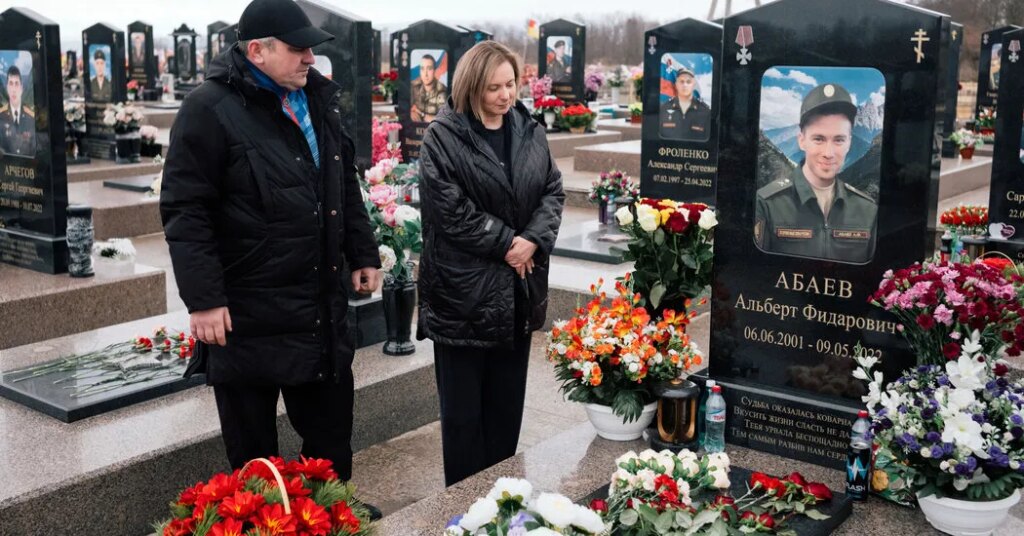
So many soldiers have returned from Ukraine in body bags that they are now being buried in a dedicated plot in Vladikavkaz, the regional capital. The new tombstones are ornamented with color photographs of the fallen, retouched and then baked in a furnace at 1,800 degrees Fahrenheit.
In the growing graveyard lies the son of Oksana Abaeva, 47, who founded an organization for women who have lost loved ones in the war. She reflects a region pulled between a deep pride in fighting for the motherland and an aching lament for the erasure of its young men.
Ms. Abaeva’s son Albert Abaev was part of the full-scale invasion of Ukraine in February 2022. He would call home when he could, she said. He never complained about the cold and the hunger in the miserable frontline conditions. He promised her he would come home.
Less than a month after the first missiles fell on Kyiv, her husband, Khetag R. Zaseyev, joined the Russian military, too.
“He couldn’t take it,” she said of his discomfort in sitting on the sidelines while Albert, the stepson he had raised, was fighting. “He hoped to find Albert, or at least hug him, because we all understood what it was like where he was.”
On May 17, 2022, men in uniform knocked on her door, saying that Albert, 20, had been killed. Her husband was on the front lines. When they spoke, she could hear the roar of artillery shells for the first time.
Granted leave, Mr. Zaseyev journeyed alone through Ukraine — on foot, motorcycle and bicycle — until he reached the Russian military morgue in Rostov-on-Don. He collected Albert’s body and returned with it to Vladikavkaz.
“We have all endured such grief, of course. We are no longer the same as we were,” Ms. Abaeva said. “Over these four years, our life has been turned upside down into a ‘before’ and ‘after.’”
She wants the war to be over. But not yet.
President Vladimir V. Putin has told Russians for years that they are in a fight for survival against a fascist regime in Ukraine and against Kyiv’s European masters. The propaganda has set the foundation for a normalization of war as a permanent feature of Russian life. While fatigue is rising as Ukrainian strikes exact a growing economic toll, the Kremlin has used the attacks as a rallying cry for Russians to remain united behind Mr. Putin and the military.
Russia should stop fighting, Ms. Abaeva said, only once what she called the Nazis in Ukraine are vanquished.
“I do not wish for any mother to bury her child, neither in Ukraine nor here,” she said. “I want peace. I want there to be no Nazism.”
The photographer Nanna Heitmann and I spent a week in North Ossetia to understand how deeply the war had penetrated society there.
A majority-Orthodox Christian region of 680,000 people abutted by predominantly Muslim areas, Ossetia has a proud warrior culture dating to ancient times.
Everyone we spoke with had a family member or a close friend who had fought in Ukraine or died there. Most had more than one.
That is reflected in a death toll that is about a third higher than the national average, according to a report by a banned human rights watchdog, Memorial, using information collected from newspapers and social networks. Impoverished regions like North Ossetia have disproportionately supplied soldiers for the Russian military, keeping big cities insulated from the war.
The Ossetians we met encapsulated the conflict’s complexities. One of them was Anatoly Betruzov, a 65-year-old veteran of three wars. The first was in Afghanistan, the last in the Donbas region of Ukraine, where his leg was permanently injured in 2015, a year after Russia began to stir up conflict there.
Even as he parroted the Kremlin line about Nazis in Ukraine, he said there was “no justice” in the current war, with people dying “who have nothing to do with it.” He said he had forbidden his 33-year-old nephew to go to Ukraine. The nephew went anyway, called by a sense of duty, Mr. Betruzov said, and was now dead.
We met Zelimkhan Kozaev, director of the region’s traditional dance ensemble, which toured across Europe even during the Cold War but now finds itself ostracized overseas as the Ukraine invasion has made Russia a pariah on much of the continent.
Sitting in his office under a portrait of a young Mr. Putin, Mr. Kozaev did not overtly bemoan the isolation or criticize the war. But he said he was not encouraging the men in his troupe to fight. “Not everyone has to run around with machine guns,” Mr. Kozaev said.
We also spoke with Aza Biragova, who works in human resources for a home-and-garden chain. She told us how the war had remade the region’s economics and civilian life.
In 2019, she helped open a store in North Ossetia. It once employed about 80 men. In September 2022, when Moscow carried out a mobilization for the war, the company received large numbers of draft summonses. Other men decided on their own to go.
She and her colleagues decided to decrease the size of their team to 60, because they did not think they could find enough workers and because the scarcity of men had driven up salaries. Eventually, she said, “everyone started hiring women.”
One person who declined to meet with us was the head of the region, Sergey Menyaylo. He instead sent a member of his press team, Batraz Ilaev, a former journalist who collected humanitarian aid for troops before becoming a soldier himself.
Mr. Ilaev is one of many Ossetians who have entered government service after fighting in Ukraine, a trend that Mr. Putin has promoted nationwide and was reflected in parliamentary elections this month.
Over pots of fruit tea, Mr. Ilaev described new housing developments and employment efforts for veterans. He told of a plan to hire a veteran in every school to serve as an adviser on “patriotic education.”
It’s all part of a Kremlin campaign to militarize society now and for generations to come.
Many of those we met with spoke of the need to defend Russia in a hostile world. That worldview was shaped in part by a terrorist attack that took place two decades ago at School No. 1 in Beslan, 30 minutes from Vladikavkaz.
On Sept. 3, 2004, after a three-day standoff with armed militants linked to an insurgency in neighboring Chechnya, Russian special forces stormed the school. By the time the siege was over, 334 hostages were dead, 186 of them children. Mr. Putin, furious that Western governments were fighting in Iraq and Afghanistan while condemning his war against Chechen separatists, accused the West of trying to bring Russia down.
I heard echoes of that when I spoke to Timur S. Adyrkhaev, 53, who was among those who carried hostages out of the school and is now a member of North Ossetia’s Parliament. He said that the current war was a profound “tragedy” but that the conflict was a historically inevitable outcome of Western powers’ use of Ukraine to encroach on Russia.
School No. 1 is now a heart-wrenching museum. A new building with the same name was built across the street. When we visited, younger students were assembling for a patriotic concert. A song performed by fifth graders had three soloists, each one representing a generation of soldiers. It was a march, with the children shouting the minor-key harmonies over a synth-pop track.
The refrain went:
A fallen soldier protects his homeland, The Russian soldier protects you and me.
The school opens its doors to veterans who deliver lectures to students. Erik G. Bagaev, a volunteer with a group that helps the families of killed or disabled veterans, said that members emphasized “love for the homeland” when addressing children.
“If, for example, in American comics the heroes are Batman and Spider-Man, we want our kids to view the soldiers the same way,” Mr. Bagaev said.
Boxes of supplies in his organization’s storage room were heaped with letters from schoolchildren. I read a few, in loopy cursive. “I want to say ‘Thank you’ for giving your life for us,” said one. “I believe in you!”
We returned to the cemetery in Vladikavkaz on a Saturday, when Ms. Abaeva gathered with a dozen other women to recite a panihida, a Russian Orthodox prayer for the departed.
As we spoke with a priest, some of the women began arguing, agitated by the presence of foreign journalists, whom Russian media has taught citizens to mistrust.
“We do not have a war in this country, there is no war!” said Marina M. Danilova, who was wearing an old-fashioned tippet and veil with a red cross.
“We have a special military operation,” she continued, using the Kremlin’s euphemism for the war. The conflict in Iran, which President Trump had started that morning, using a euphemism similar to the Kremlin’s, was a “real war,” Ms. Danilova said.
Her comments were met with murmurs of disagreement.
“For some, it is not a war. For us, it is a war,” said another woman, whose son was a paratrooper based in Pskov, a region bordering Ukraine.
“Everyone expresses their condolences, they pity us, but when we close the door, everyone lives with their own grief,” added the woman, whose name is being withheld to protect her from possible repercussions with the authorities. “Understood? Let them call it whatever they want.”
The women went their separate ways. As they departed, shots rang out from the far end of the cemetery, where the fresh graves lie, adorned not yet with tombstones, but with flags that whip in the wind.
It was a military honor guard. Another funeral.
Ms. Abaeva went to Albert’s grave. Her husband and her son David, 8, watched and then helped as she patted the plastic wreaths.
As I watched David, I remembered something she had told me: “He already says, ‘I will also go to war, and I will defend our people.’”
Milana Mazaeva, Oleg Matsnev and Alina Lobzina contributed reporting.
The post What Russians Who Lost Sons in Ukraine Think About the War Now appeared first on New York Times.