A faint buzzing noise high in the sky was the first hint of danger. The source was a single-person flying machine, a motorized paraglider, that was barely visible. It cut its engine and floated quietly toward the ground.
As it reached an altitude of a few thousand feet, the pilot tossed bombs overboard that exploded with devastating effect among civilians on the ground.
Such aerial attacks — in which light, recreational aircraft, or paramotors, have been turned into deadly weapons — are carried out by the military almost daily now in central Myanmar, giving it an edge in its campaign to crush pro-democracy forces.
“In other countries, people feel happy and excited when they see a paramotor or paraglider,” said Moe Gyi, 27, a guerrilla in the Sagaing Region who has fought the junta since 2022. “But in our country, they have become weapons used to kill people. Here, when we see one, we have to run for our lives.”
Myanmar’s generals seized power from a democratically elected government in 2021 and brutally suppressed peaceful demonstrations. Many protesters fled to the countryside where they formed rebel groups, allying themselves with armed ethnic groups that have been battling the military for decades.
The ensuing civil war has killed more than 100,000 people, according to the Armed Conflict Location & Event Data Project, and driven 3.7 million from their homes. The United Nations estimates that more than 12 million will face acute food shortages this year.
Unable to defeat the rebels, the military has bombed civilian targets repeatedly for years, first with fighter jets and helicopters and later with drones, too. Last year, it began ramping up attacks with paramotors and gyrocopters and has used them in more than 1,600 bombing raids in the past 20 months, according to the rebel National Unity Government.
A spokeswoman for the junta did not respond to requests for comment on the military’s use of paramotors and gyrocopters or its frequent bombing of civilians. The number of these attacks reported by the N.U.G. could not be independently verified.
Lightweight Aircraft
The feared flying machines have several advantages. They are cheaper than attack drones, which are destroyed on impact, and far more affordable than jet fighters, which require costly aviation fuel. Much quieter than conventional bomber jets, they can sneak up on unwary civilians to launch surprise attacks and strike terror on the ground. A pilot can reach an altitude of 10,000 feet without needing supplemental oxygen, presenting a tiny target that is difficult to shoot down.
One of the deadliest bombardments occurred in October 2025 when a motorized paraglider bombed a Buddhist festival of lights in Chaung U township in the Sagaing Region, killing dozens of people and injuring at least 40. Survivors said they did not hear it approaching over the noise of the festival and had no chance to run.
“We never imagined that a paramotor would come and drop bombs,” said May Zin Oo, 23, whose husband was killed and who lost a leg in the attack. “It was only when I heard the sound of the engine afterward that I realized they had attacked us with a paramotor.”
As the paraglider ascended, she said, it sounded like a noisy motorbike.
Half an hour after the first attack, she said, the paraglider returned and dropped two bombs on rescuers who were helping the injured.
She was still lying on the ground holding her 1-year-old son when a piece of shrapnel from the second bombing struck him in the chest, denting a small gold pendant that he wore on a chain around his neck.
“If he had not been wearing that pendant, my son definitely would have died,” she said.
The junta has justified indiscriminate attacks on civilians by declaring that anyone who supports the revolutionary forces is an enemy.
These lightweight aircraft have proved most effective where the terrain is flat and there is relatively little air turbulence, particularly in the low-lying central plains that include the Sagaing and Mandalay Regions, said Naung Yoe, a former major in the Myanmar military who defected soon after the 2021 coup.
In recent months, paramotor and gyrocopter bombing raids have compelled revolutionary forces to retreat, making way for junta troops to advance.
“When the military is relocating its ground columns, they use paramotors and gyrocopters to carry out bombing attacks first to clear the area ahead of the troops,” said Myint Naing, a fighter with the Myingyan People’s Defense Force in the Mandalay Region. “After our revolutionary forces have moved away, their ground troops advance and occupy the area.”
Mr. Naung Yoe, a founder of the Myanmar Defense & Security Institute, a pro-democracy research group, said the paramotor and gyrocopter attacks have helped neutralize the upper hand that the rebel forces held in the central lowlands.
“Since the Myanmar military maintains a significant advantage in the air, the revolutionary forces will continue to face a stalemate,” he said.
Gyrocopters
Since the junta introduced the lightweight aircraft last year, they have become increasingly sophisticated. The simplest version is a paraglider with a propeller and a gas-powered engine, which was used in the attack on the Buddhist festival. It features a parachute-like canopy and a harness that serves as a seat. It generally carries two bombs and can travel up to 120 miles on a single tank of gas.
Similar single-person paramotors are being developed by militaries in several other countries, including the United States and Britain.
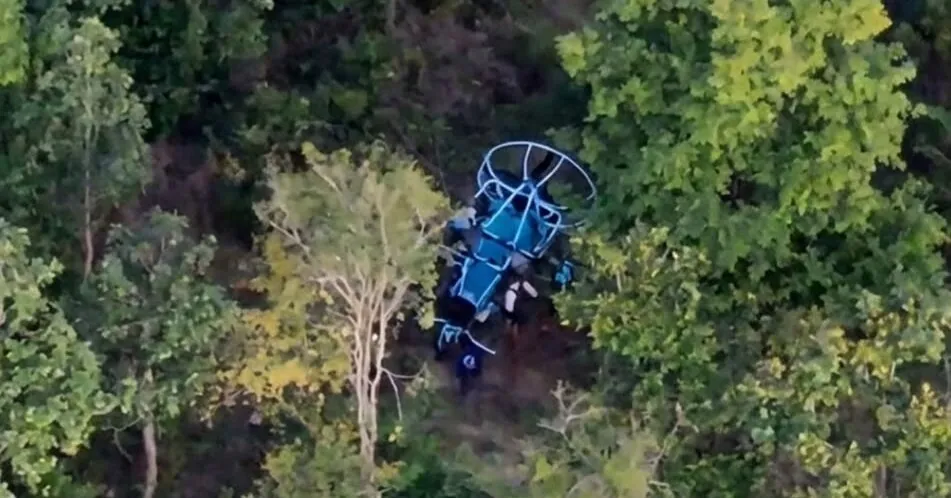
More recently, Myanmar’s rulers have been deploying three-seat, sky-blue gyrocopters fitted with a metal frame that can hold eight 120-millimeter mortar shells. With a propeller at the back to provide thrust and a rotor blade on top to provide lift, it has a range of up to 500 miles, Mr. Naung Yoe said.
Soldiers who are already trained as paratroopers can easily master flying a paramotor or gyrocopter, he added. The machines require little space for takeoff and landing — an area the size of a football field is enough.
Both versions used by the Myanmar military lack targeting systems for their bombs. The pilots simply drop munitions over populated areas or public gatherings. Typically, the pilot of a paraglider drops two bombs by hand. A gyrocopter crew can release its eight bombs with the press of a button.
Victims of attacks say the flying machines are terrifying because the bombs seem to fall at random.
“All we can do is pray that we will not be hit,” said Phyu Phyu Win, a farmer in Salingyi township in the Sagaing Region.
Faced with such small targets in the air, the lightly armed guerrilla forces have had little success downing them.
“We do not have any weapons capable of shooting them down,” said Myint Naing, the fighter with the Myingyan People’s Defense Force. “So, when they come, all we can do is hide and pray they crash on their own.”
Indeed, at least two of the sky-blue gyrocopters have crash-landed. In both cases, the crew escaped. But the rebels were able to recover the wreckage and see what they are up against.
The rebels do not try to fly paramotors themselves because the military controls the skies with its fighters and helicopters. It also has weapons that could shoot down them down, Mr. Naung Yoe said.
Myo Zaw, a grocery store owner in Ye-U township in the Sagaing Region, watched on Sept. 7 as three gyrocopters appeared out of nowhere and dropped bombs on his village.
At least one bomb hit a car repair shop, killing seven and injuring five, all civilians with no connection to the rebel forces, he said. After the gyrocopters left, he said, a helicopter came and dropped more bombs on the community, which is home to several thousand people.
He said the military has increasingly deployed gyrocopters in the area this year.
“As if we didn’t have enough problems, including the rising cost of living, we now have another fear of wondering when a gyrocopter might appear overhead and drop bombs on us,” he said.
“If I am reincarnated,” he added, “I just pray that I won’t be born in Myanmar.”
The post Small Flying Machines Become Weapons of War in Myanmar appeared first on New York Times.