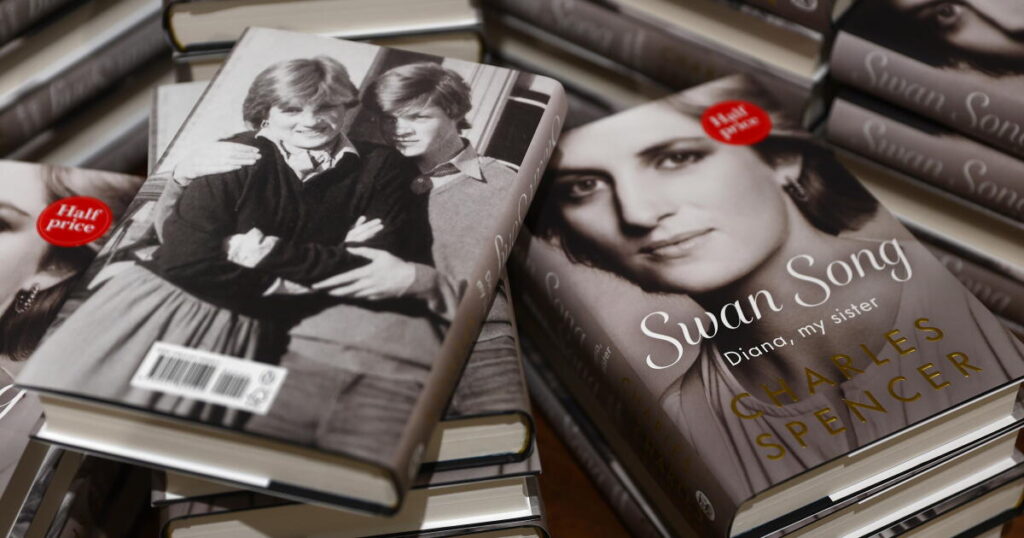
Although the details of Princess Diana’s life have been scrutinized for decades, it’s been nearly 30 years since her untimely death, and her younger brother, journalist and author Charles Spencer, is telling his side of the story in “Swan Song: Diana, My Sister.”
The explosive and heart-wrenching tell-all, released this week, has reportedly ruffled feathers inside Buckingham Palace, and its not hard to imagine why. The book delves into Princess Diana’s upbringing, her red-flag-ridden engagement and marriage to then-Prince Charles, the 1997 car accident that ended her life and the aftermath.
Here are five takeaways from Spencer’s book, including his regrets over not addressing Princess Diana’s eating disorder and his memory of a private reading of the eulogy he’s so well known for delivering at her funeral.
Shocked by ‘the seething mob’ that was the press around Diana
“The British press’s cat-and-mouse relationship with Diana’s privacy — and her life — had been an issue since the moment she came onto their radar,” he wrote. By Spencer’s account, in the early days of Diana’s relationship with Prince Charles, and because she was only his “latest girlfriend” rather than his fiancée or wife, she was not entitled to police protection, and the media could hound her as they pleased.
“The reports failed to capture the terrifying energy of a seething mob of men around a fragile young woman,” he wrote. “To view it in the flesh was truly shocking.”
Spencer writes that William said of his childhood: “I sadly remember most of the time that she ever cried about anything, it was to do with press intrusion.” Spencer claimed that William’s childhood memories include “photographers not only shooting at his mother, but even spitting at her. “
Anorexia and bulimia were ‘demons’ Diana often battled alone
Spencer wrote that he aimed, always, to be on his sister’s side but always to tell her the truth, and that he hadn’t realized how fragile Princess Diana had become. In retrospect, he feels immense guilt for not being able to help as she “battled such demons.”
“Her weight loss between her engagement and marriage, when she had felt and been told that she was chubby, had returned with a vengeance after she gave birth to William, less than a year after her wedding,” wrote Spencer. He detailed how, a few months before her death, she admitted that her weight had dropped, at one point, to 8½ stone, or 119 pounds. For Diana, who was 5-foot-10, this weight worried her doctors.
“She found it slightly easier to talk to me of her anorexia than she ever did her bulimia. That condition she shrouded with secrecy.”
Diana believed Charles was in love with someone else from the start
Three months before Princess Diana agreed to marry Prince Charles, the Sunday Mirror published the “Royal Train Scandal” exposé. An “impeccable source” claimed that Charles had used the publicly funded Royal Train for an hours-long nighttime tryst with a blond woman. The media assumed the woman was Diana, but the soon-to-be princess knew she was 50 miles from the area on the night of the rendezvous, and that her relationship with the prince, although romantic, had not yet become sexual. Diana suspected the blond in question was Camilla Parker-Bowles.
By February 1981, Charles and Diana were engaged. In a televised interview, they were asked if they were in love, and Diana said, “Of course!” Prince Charles said, “Whatever ‘in love’ means.” Shortly after, Princess Diana found a bracelet that Prince Charles had bought for Camilla.
Years later, when Princess Diana announced to her brother that she was getting divorced, he expressed support but also concern. Spencer, whom Diana called “Carlos,” worried the public would punish her for ruining their fairytale. “She looked up at me, nodded, and as her huge, sad eyes locked on to mine, she said in a quiet voice: ‘But, Carlos, my husband is in love with his valet.”
“I gulped. ‘Well, I guess, in that case, you really don’t have a choice.’ She did not name the member of the staff, and I never asked her who it was, or why she would believe such an improbable thing. It was not important: the end of her marriage, and of her dreams, was.”
‘Convinced’ that Princess Diana had undiagnosed ADHD
Spencer wrote that Princess Diana struggled academically and found school excruciating at times.
“I find it heartbreaking that her self-esteem was allowed to sink so low. It is the postscript, for me, of her being failed by such an inadequate and amateur education.”
Although she was never formally diagnosed with attention-deficit/hyperactivity disorder, a condition marked by focus issues, hyperactivity and impulsivity, per the Mayo Clinic, Spencer writes that he is “convinced” she suffered from it.
Before reading his searing and impassioned eulogy before the public, he shared it first at Diana’s side
A day or two before Princess Diana’s funeral, Spencer visited the Chapel Royal, where her coffin was placed for private viewing before the service.
He’d had the eulogy he wrote for her in his pocket, and he decided to read it to her once alone, without the crowds and cameras.
“‘I stand before you today …’ I started, while in fact remaining seated beside Diana’s body, and carried through to the end, when I proclaimed my deep pride at being her brother.”
The post 5 heartbreaking takeaways from Charles Spencer’s book ‘Swan Song: Diana, My Sister’ appeared first on Los Angeles Times.