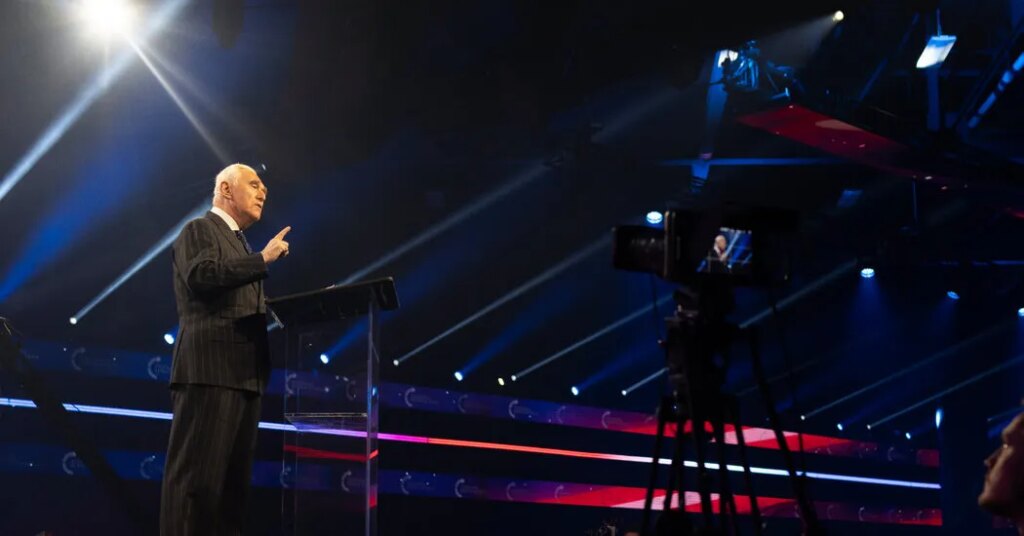
Few people have better access to the White House than Roger J. Stone Jr., a close friend and associate of President Trump. Even so Mr. Stone’s latest lobbying deal, worth nearly $800,000 with the government of Haiti, is raising eyebrows.
The Republican political operative was hired by Haiti’s Foreign Ministry to conduct unspecified “issue advocacy” on U.S. government policy relevant to Haiti, according to a document filed last week with the Department of Justice.
Haiti’s prime minister, Alix Didier Fils-Aimé, declined to discuss details of the contract, though he highlighted migration as a priority.
“Certain matters of importance to the Haitian people are being addressed at the highest levels of the U.S. administration, notably at the White House,” he wrote in a text message. “The issue of migration is among the topics of concern to us.’’
Mr. Stone, 74, confirmed the contract but declined to discuss the nature of his work for Haiti’s government.
“I have a policy of not talking about the work I do for my clients beyond that which is legally required which is in my filing,” he said in a brief phone call.
He declined to say if he had ever visited Haiti.
Mr. Stone, a self-described “dirty trickster,” is a close confidant of Mr. Trump, though he is not well known for work related to Latin America. In May, he weighed in on Haiti in a brief social media post about a political debate over the timetable for long overdue elections in the country.
“There cannot be elections until there is security and stability,” he wrote. “The Trump administration is moving in the right direction, but we are not there yet.”
Haiti has not held elections for president, or its parliament, in 10 years, having delayed them since its last president was assassinated five years ago. Violence fueled by gangs that control much of the capital has set off a humanitarian crisis.
The country is entering a key phase in international efforts to restore security and push gangs out of their stronghold. Elections have been scheduled for December, though there are serious doubts that the vote will actually happen.
Haiti already pays $35,000 a month for lobbying services to Continental Strategy, a firm run by Carlos Trujillo, Mr. Trump’s former ambassador to the Organization of American States and a Cuban American from Miami who is close to Secretary of State Marco Rubio.
Mr. Stone could work with Haiti’s government on the Trump administration’s recent decision not to extend protected status for Haitians, which shielded an estimated 300,000 Haitians lacking legal status in the United States and are facing deportation.
The end of the protection has led to a spike in detentions and an increase in deportations to Haiti, a major challenge for a poor country lacking basic services.
Migrants are also an important financial lifeline for Haiti. Money sent back home by Haitians living abroad totaled $4 billion in 2025, about 17 percent of the value of all goods and services produced within a country, according to official government data.
Beyond the scant details about Mr. Stone’s work, it is unclear why Haiti hired him.
Mr. Stone has built a reputation, in part, for using his connections to Mr. Trump to win pardons for people convicted of wrongdoing. Last year he was a key intermediary in Mr. Trump’s pardon of a former Honduran president, Juan Orlando Hernández, who was convicted of trafficking more than 400 tons of cocaine into the United States.
“His value is that he could talk directly to the president,” said Damian Merlo, a former lobbyist for Haiti who is now registered to work for the government of El Salvador.
Mr. Stone was convicted in 2019 for lying to Congress during its investigation into Mr. Trump’s connections to Russia, but Mr. Trump commuted his prison sentence.
André Michel, a lawyer in Haiti and opposition political leader, criticized Mr. Stone’s hiring, saying his contract was “a scandalous amount for a country like Haiti. It’s a waste of public funds.’’
The post Haiti Turns to Roger Stone to Lobby Trump Administration appeared first on New York Times.