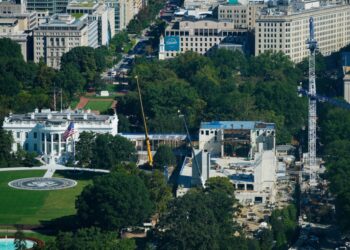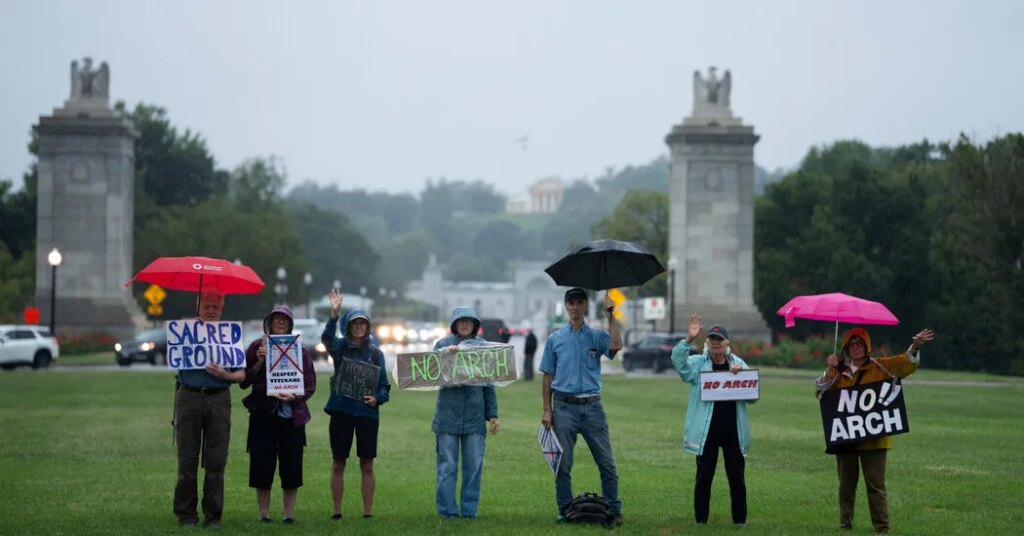
An advisory council composed largely of allies of President Trump has terminated a legally required review of how his proposed triumphal arch in Washington could detract from historic properties around it, removing one of the final hurdles for the project to advance.
The move brushes aside the National Park Service’s acknowledgment that the 250-foot-tall monument would obstruct symbolic views between the Lincoln Memorial and Arlington National Cemetery and “adversely affect” more than 40 historic sites.
The Park Service said it could not come to an agreement with local preservation officials and outside organizations about how to address those effects, under a process required by a federal preservation law. It then notified the Advisory Council on Historic Preservation (A.C.H.P.). The panel, an independent federal agency created by the 1966 law, sent a letter to the Park Service on Thursday formally terminating the process, a step it has rarely taken.
“It is clear that the proposed undertaking and its potential effects on historic properties have raised significant public interest,” wrote Travis Voyles, the vice chair of the council. But he noted that the Park Service believed additional consultation wouldn’t lead to an agreement, and that it had said changes to the arch would alter the goals of the project. “In recognition of the public’s significant concerns regarding the adverse effects the undertaking would pose to historic properties, we are hereby terminating consultation.”
The council will share with the Interior Department its own comments on the project by Oct. 7, it said, inviting the same preservation groups whose feedback has been dismissed so far to comment again. But the effective result is that the president’s allies — who now control the review panels approving his designs, the advisory council overseeing preservation disputes, and the Interior Department managing the project — are swiftly pushing the arch toward construction.
The administration is planning for the arch to come before the National Capital Planning Commission for a final vote on Nov. 5, two days after the midterm election. But it has not yet publicly explained how the arch could function as a military facility, as Mr. Trump announced earlier this week, while officials still intend for it to remain open to the public as a tourist site.
Preservationists dismissed the idea that the Park Service was unable to resolve the harms it identified, arguing that officials had made no effort to do so. The Park Service declined to consider relocating the arch, making it smaller, or altering the design to avoid or minimize effects on surrounding monuments and historic landscapes.
Outside organizations also said they couldn’t respond to a draft agreement when they did not even understand what the administration was now proposing to build. On Sunday, Mr. Trump upended the review with his announcement that the arch would be a “military complex” — a shift in purpose that would normally require redrawing plans for the project and restarting environmental and historic reviews of it.
“Do you turn right for the gift shop, and left for the arsenal?” said Charles Birnbaum, the president and chief executive of the Cultural Landscape Foundation, one of the outside groups participating in the review. “None of us know how to make heads or tails out of this.”
He said the administration’s behavior with the arch was a preview of how it would conduct historic preservation reviews more broadly under new proposed rules that sideline public participation and empower federal agencies to operate as they see fit.
It’s rare for the advisory council to terminate reviews, said Sara Bronin, a George Washington University law professor who was the chair of the council during the Biden administration. That step normally takes place only after extensive efforts at resolving disputes. Ms. Bronin terminated a review only once during her tenure, she said, with a wind energy project that went through years of consultation before reaching an impasse.
By moving so quickly to terminate the process for the arch, she said in an email, the council is “making a farce” of the historic review process.
“True consultation has never occurred for the triumphal arch,” she added, “and it looks like the Park Service and A.C.H.P. will bend over backwards to avoid it.”
The preservation law doesn’t require federal agencies to reach particular outcomes, nor does it give preservationists a veto over projects. But the review process was designed to force agencies to identify historic properties that would be harmed by federal actions, and to consider ways to address those harms. By failing to meaningfully consider any alternatives to the current arch proposal, preservationists warned, the administration was inviting new legal challenges on top of the lawsuit the arch already faces from a group of veterans.
“This isn’t the way to make good public policy — it’s the bare minimum and they are just going through the motions,” said Brent Leggs, the president and chief executive of the National Trust for Historic Preservation, in a statement. The trust is a voting member of the advisory council but was alarmed to learn of the announcement Thursday, he said (the action the council took Thursday did not require a vote).
An advisory council spokesperson pointed to an earlier case, when the panel terminated the review for a copper mining project in Arizona in 2021, as precedent for its action with the arch. But the council declined to comment further.
The National Park Service did not respond to questions for this article.
The historic review was one of the final steps the Park Service had to legally complete before the project could receive final approval from the planning commission. It already received approval earlier this year from another review body, the Commission of Fine Arts.
Opponents of the arch suggested that the timing of the announcement Thursday, and the Sept. 29 deadline for any public comment, were designed to bring the review to a close in time for the Park Service to submit materials ahead of the November planning commission meeting.
The administration is now running out of time to begin construction before House Democrats, favored in the midterms, could take power in January. They have vowed to stymie the arch and the president’s other construction projects that have tried to skirt congressional approval.
The Park Service has also begun work this week at the proposed arch site, which the administration has described in court as archaeological excavation. That excavation work was intended to be part of the historic review. And so it was unclear on Thursday why it was proceeding if the review had been terminated.
A Democratic congressman, Don Beyer, who represents part of Northern Virginia where the arch would be located, said he had visited the site Thursday morning to see the equipment operating there.
“The logical conclusion,” Mr. Beyer said in a statement, “is that the presence of this heavy equipment and additional surveyors is a clear indication that the Trump administration is preparing to move forward with construction.”
Mr. Trump’s announcement that the arch now has a national security purpose appeared intended to help speed it along, following a similar legal strategy that the administration deployed with the White House ballroom. But it could ultimately complicate the administration’s legal defense of its design, environmental and historic reviews. Up to this point, just weeks from when the administration says it expects a final approval, none of those reviews have taken into consideration an arch that is also a repository for ammunition and a platform for snipers and drones.
The post Federal Council Terminates Review of Arch’s Effects on Historic Sites appeared first on New York Times.