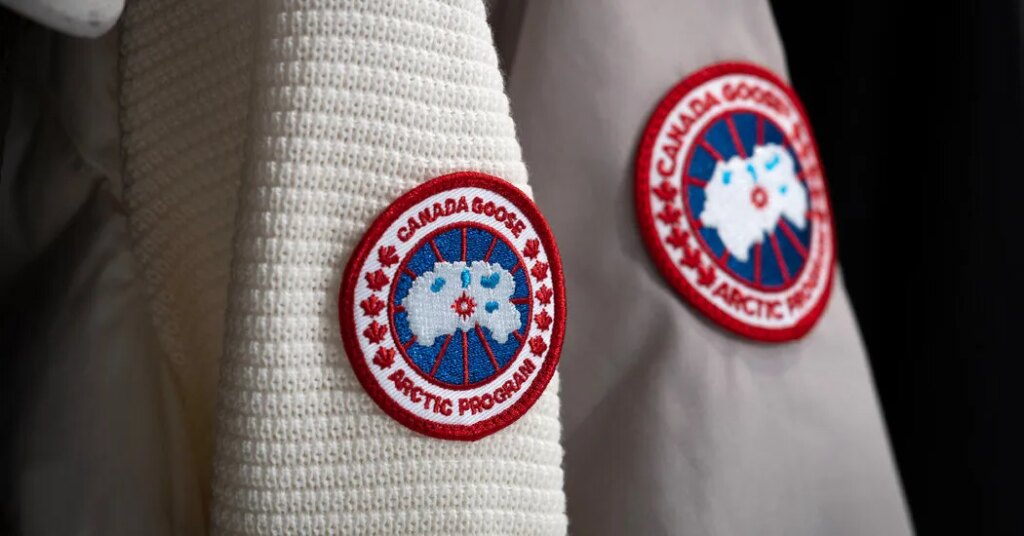
Coats, jackets and parkas made in Canada are getting caught in the middle of a trade war between Canada and the United States, as some of the biggest players in outerwear hunker down to try to endure the latest tariff shock.
In August, President Trump claimed that Canada had put unfair levies on American products and imposed a punishing round of tariffs on a wide variety of goods, including food, building materials, recreational gear and apparel. The list contained many types of outerwear, such as anoraks, overcoats, car coats, windbreakers, capes and cloaks.
The new 50 percent tariff Mr. Trump imposed has put pressure on Canadian coat makers such as Canada Goose ahead of the winter rush for cold-weather gear and the crucial holiday shopping season.
Canada’s top outerwear companies sell their coats around the world, but the United States is the industry’s single largest market, surpassing even the domestic market. That has left few options to move business elsewhere, as Canadian coats have become a coveted luxury item in many American closets. Prices for Canada Goose parkas, for example, start above $1,000.
“While the world around us continues to change, our focus remains the same: serving customers with Canadian warmth,” Dani Reiss, the chief executive of Canada Goose, said of the tariffs in an email. “In times of uncertainty, that means staying steady, making thoughtful decisions and continuing to deliver the exceptional products and experience our customers expect.”
The Toronto-based company is the nation’s largest luxury outerwear company and reported revenue of more than 1.5 billion Canadian dollars ($1.1 billion) in its last fiscal year. About two-thirds of its products are made in Canada, according to a person with knowledge of the company’s operations.
Canada has turned its proficiency in dealing with frigid winters into a big business by producing and exporting all sorts of items that help manage the chill, such as central heating boilers and smart thermostats. But coats have been a defining slice of the Canadian economy since the 19th century, when businesses such as the Hudson’s Bay Company would buy raw furs from trappers and sell them to dressers and dyers in cities to be sewn into garments. Modern coat production in Canada is centered in Quebec and Ontario.
Mr. Reiss said “nothing is changing” in Canada Goose’s long-term strategy in the United States, which accounted for about 25 percent of the company’s sales in its last full fiscal year. The company has one of the largest international operations of the Canadian coat makers and has stores in Britain, France, China, Japan and Australia.
Should the Trump administration apply new tariffs, Canada Goose executives said in July, they would hurt the company’s operating margin by less than 2 percent this year if management did not take any action to mitigate them.
“It’s still going to hurt them,” said Sam Poser, an analyst at Williams Trading, a financial services firm. “We don’t know exactly how much.”
As the two governments negotiated a trade deal in August, many Canadian retailers rushed more product into the United States in case talks fell apart, people with knowledge of the matter said. That extra inventory could help limit the tariff damage, if the nations come to an agreement in the coming months.
A spokeswoman for Canada Goose declined to say what actions, if any, the company would take to alleviate the impact of the tariffs, such as whether it would absorb the additional costs or raise prices.
Brands such as Kanuk, Quartz Co., Wexly, Audvik and Arctic Bay also depend on coat production in Canada and must now try to cope with the higher cost of doing business in the United States.
Arc’teryx makes about 5 percent of its goods in Canada at a facility near Vancouver, with the rest made mostly in China, Vietnam, Indonesia, Bangladesh and Myanmar. Its domestic factory produces “a critical portion” of its product lines, including its most technically complex jackets, the company said on its website.
A spokesman for Arc’teryx said the company was confident that it could navigate the latest trade challenge and had “taken steps over time to mitigate the impact of tariffs” on its business.
Moose Knuckles, a high-end outerwear brand in Montreal, counts on domestic manufacturing in three factories for many of its goods, which include $1,500 parkas and $500 bomber jackets. The average coat involves around 90 craftspeople, such as patternmakers, fabric cutters and sewing machine operators.
“We inject millions of dollars annually in the Canadian economy, while preserving a tradition of Canadian craftsmanship,” the company said on its website. A spokeswoman for Moose Knuckles declined to comment on the tariffs.
Outerwear is the largest category of apparel sold in the United States under the “Made in Canada” label, according to an analysis by Sheng Lu, a professor at the University of Delaware’s department of fashion and apparel studies.
“Canadian outerwear producers would find it challenging to identify alternative export markets in the short to medium term,” Mr. Lu said.
The post Canada’s Coat Makers Find Themselves in the Middle of a Trade War appeared first on New York Times.