In the summer of 1986, when he was a college student in Pennsylvania, Samuel Paparo took his future wife Maureen to watch Top Gun.
Many young Americans emerged from theaters across the country with a new hero: the brash, daring, risk-taking Maverick, played by Tom Cruise, who became an avatar of American power at the twilight of the Cold War. But Paparo took away a different lesson.
“The hero of the movie is supposed to be Maverick, but the hero of the movie is actually Iceman,” Paparo tells TIME, referring to the main character’s rival at the elite Navy pilot training school. “Maverick’s got all the personal charisma, but Iceman is fastidious, quiet. He’s the hard-working guy that does the right thing, that doesn’t do flashy, dangerous stuff for its own sake.”
Paparo had already passed the Navy’s entrance exams when he went into the theater that day, and joined the next year. His career would precisely mirror the fictional Iceman’s: He attended the Navy Fighter Weapons School, also known as TOPGUN; became a fighter pilot; then a four-star admiral; and eventually commanded the Pacific Fleet. But Paparo would go further, taking the helm of the U.S. Pacific Command, the nation’s oldest and largest geographic combatant command, which covers about half of the earth’s surface.
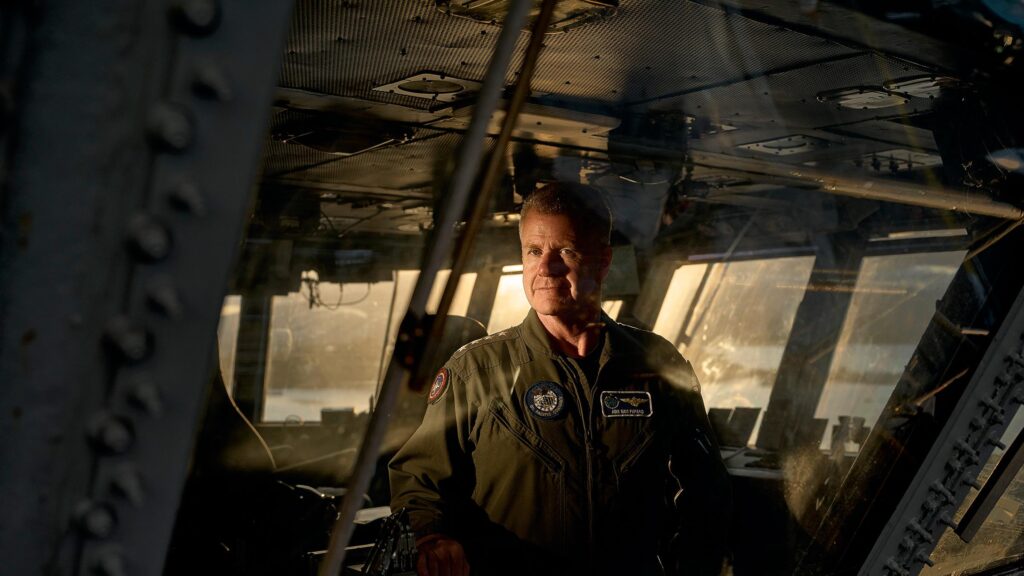
Few Americans will have heard of Admiral Paparo, and that suits him fine. “If I do my job right, history will never know my name,” he says in his office at the headquarters of the U.S. Pacific Command in Hawaii, on a hill overlooking Pearl Harbor, in late July. But his role places him at an inflection point, as American dominance in the Pacific faces its most serious challenge since World War II.
His command is designed to be the immovable object that blocks the unstoppable force of China’s expansionist ambitions in the region. And those ambitions have been stated clearly: Beijing has vowed to bring Taiwan, the self-ruling island that has been politically separate from the mainland since China’s civil war ended in 1949, under its control—by force if necessary. China’s President Xi Jinping has described unification as “a historical inevitability.”
Paparo’s job, in its simplest terms, is the projection of American power. His most important mission is to deter a Chinese invasion of Taiwan, an event that would challenge the very foundations of a global system underpinned by American hegemony. That the outlines of this mission stay the same regardless of which party or President is in the White House speaks to the importance of his role. The force Paparo builds and the plans he puts in place last for decades, and could determine to whom the next century belongs.
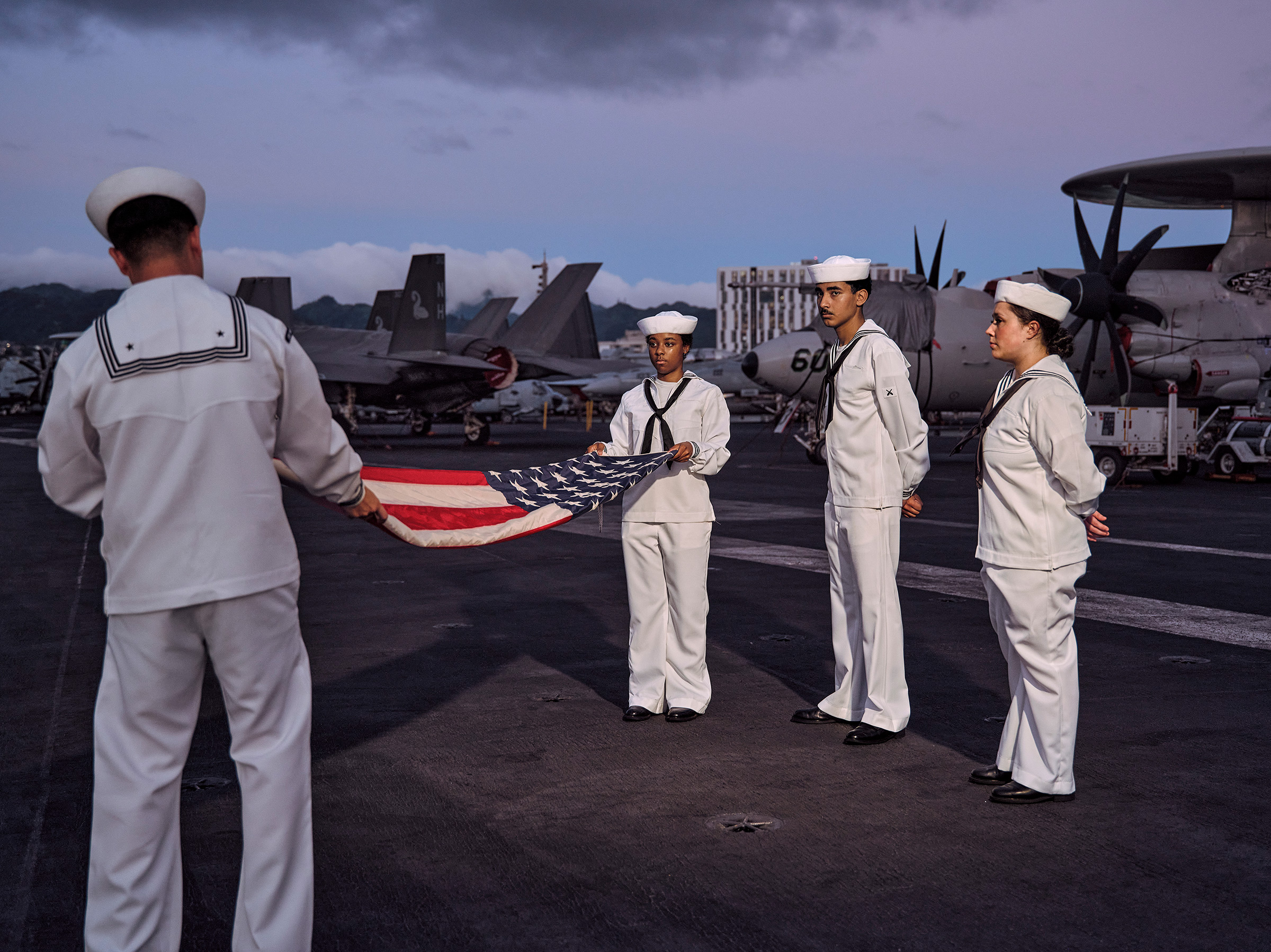
The public face of American military power is, of course, the Commander in Chief. The public voice emanates from the Oval Office and the podium in the White House press briefing room. But behind that power sits commanders like Paparo, overseeing the often hidden and awesome infrastructure that backs up that public face and voice—his command oversees some 400,000 military and civilian personnel, a Pacific Fleet of some 200 ships, including five aircraft carrier strike groups, and more than 1,000 aircraft. He marshals that power in distant oceans, islands, and military bases that most Americans will never see or even think about.
With President Donald Trump set to meet Thursday with China’s Xi for their third face-to-face summit since he returned to office, the cameras are trained on the White House; reporters will parse each utterance by the two leaders to divine whether the two powers are heading toward cooperation or conflict. It is Paparo’s job to ensure that whatever happens when the leaders talk, U.S. power remains pre-eminent—and that if somehow in the future conflict breaks out, it comes out on top. He must hold to that approach even as wars elsewhere consume the munitions and resources he may need, and upheaval at the Pentagon raises the stakes of pushing back.
“I’m almost quoting Sun Tzu when I say winning without fighting is the acme of skill,” he says, referencing the Chinese military strategist who wrote The Art of War. “Mission success for me is not to fight and win a war; it’s to provide a deterrent capability so that we never go to war in the first place.”
Paparo, 61, speaks deliberately and in a low voice, smiling often. But when conversation turns serious, so does his expression—his brows become furrowed, and he stares into the middle distance to summon his words. “We don’t seek to become great wartime leaders,” he says. “We seek to be great peacetime deterrers.”
What if deterrence doesn’t work? The U.S. emerged from World War II with its dominance of the Pacific unquestioned, but that may now be changing. Over the past few decades, as China has transformed into the world’s second largest economy, it has been engaged in a historic military buildup. China’s defense spending has increased 13-fold over the past three decades, and it now spends more on defense than the next 22 Indo-Pacific countries combined, according to the Center for Strategic and International Studies (CSIS), a bipartisan Washington, D.C.–based think tank. It has made rapid technological advances in artificial intelligence and fielded several generations of fighter jets. Its navy has grown from a coastal force into something capable of projecting global power, and by hull count it is now the largest in the world.
Brian Hart, deputy director of the China Power Project at CSIS, describes it as a “comprehensive, across-the-board modernization effort,” one that has changed the calculus for every power in the Pacific. The People’s Liberation Army, he tells TIME, has “significantly transformed the balance of power.”
Paparo need only look out his office window at the turquoise waters of Pearl Harbor to be reminded of the last time U.S. supremacy in the Pacific was truly tested. He describes China’s buildup as “historic” and “an exponential increase in military power, and more specifically, in power projection capability.”
“Twenty-five years ago the People’s Liberation Army Navy was about 37 warships, and today it’s 12 times that,” he says. “Just in the last 18 months they’ve delivered two cruisers, eight destroyers, eight frigates, an aircraft carrier, 11 submarines, four amphibious ships, and four long-range combat logistics ships.” He is particularly concerned by China’s advances in space and missile development and the rapid expansion of its nuclear arsenal. “They’re moving toward world reach,” he says.
For all of its global ambitions, much of China’s military development has been pursued with one target in mind. U.S. intelligence assesses that China’s Xi has ordered his military to be capable of seizing Taiwan by force by 2027, the centenary of the People’s Liberation Army. The intelligence community’s annual threat assessment, released in March, suggests no invasion is currently planned for next year, but by then, the pieces Xi needs to do so will likely be in place.
If there appears to be a path to capturing Taiwan without using force, Xi insists he would prefer to take it. Presidential elections in Taiwan in January 2028 may provide some clarity in that regard: China’s old rival, the Kuomintang, is increasingly amenable to negotiations with Beijing. If the political party wins in 2028, the likelihood of an invasion may decrease. If Taiwan’s President Lai Ching-te, a fierce opponent of China’s sovereignty claims, wins reelection, Hart says, “Beijing could significantly ramp up pressure on Taiwan.”
Paparo’s job is to convince Xi that the costs of military action will be too much to bear, regardless of what is happening politically on the island. By act of Congress, the U.S. is obliged to sell Taiwan the weapons it needs for its own defense; while it does not require the U.S. to defend the island directly, the commitment could go further to include direct conflict with China. He describes his mission as a delicate balancing act between ensuring that his counterparts know American capabilities well enough to understand the risks of engaging, and protecting its necessary secrets and strategy. “It’s demonstrating credible combat power, demonstrating capability and will, but keeping the crown jewels of the nation that are going to deliver combat success opaque to your counterparts, so that they can’t build a counter for it,” he says.
Paparo describes the strategy as deterrence by denial. “It’s a way of expressing that we’re not seeking the overthrow of the Communist Party,” he says. “It’s just that you should know that where America’s direct vital interests are involved, there’s a high probability of denying your aggression.”
This theory of deterrence operates on a grand, geopolitical scale, and in much smaller interactions. Paparo recounts a confrontation with a Chinese counterpart over what he describes as an “unsafe” encounter in June 2023 during a transit of the Taiwan Strait in which a Chinese Luyang destroyer cut across the bow of an American ship.
In the ensuing back-and-forth, Paparo told his counterpart that he had been in command at the watch center for the engagement and had video showing that their version of events was not true. He offered to share it, then let the matter rest.
“I’m not going to impugn his own character in it. He’s representing his country. He’s in uniform, and you know, if we do have a fight, him and I might have to shake hands at the end and agree to go to our separate sides,” he says.
In that moment, Paparo chose a diplomatic approach. He does, however, have a more direct plan to deter a Chinese attack on Taiwan. It is based on a term he uses to describe the environment Chinese forces would walk into if they took military action: “Hellscape.”
The strategy has been partly inspired by Ukraine’s defense against Russian invasion, and its ability to halt Moscow’s advances by turning the front lines of that conflict into a no-man’s-land patrolled by killer drones. Paparo would aim to saturate the Taiwan Strait with cheap, mass-produced precision drones, along with more conventional high-tech missile power, to deny China the ability to land an amphibious assault, or at least significantly delay it.
“We’ve seen that assault warfare, whether that is an amphibious assault, an airborne assault, has become a much more costly human endeavor,” he says. “In the ways that Ukraine is about a 600-mile-by-30-mile hellscape of drone warfare, I seek to put those principles at work to deter an armed invasion.”
He continues: “Putting 21st century technological change to work for the United States of America is what that’s about. We need not gain air or maritime superiority of a space; we need only deny its use to aggressors.”
Direct American involvement in a conflict over Taiwan is by no means assured. Paparo is tasked with building a force to confront China, but the President will decide how to respond. “The highest ideals of American civil-military relations are such that policy is king,” he says.
Who would win that conflict is something that is fiercely debated. A 2023 CSIS war game found that the U.S. and its allies defeated a Chinese amphibious invasion of Taiwan in most scenarios, but the costs to the U.S. were substantial: two aircraft carriers, dozens of ships, and hundreds of aircraft, the heaviest American losses since World War II. Those war games were run before the war in Iran depleted U.S. missile stocks.
“I am confident in our ability to prevail,” Paparo says. “What I am working toward is the margin by which we do, and that margin expresses itself in lives, capability, money, and time. I want to drive that bill down to zero.”
An enormous map of the Indo-Pacific theater lines the wall of Paparo’s office. His desk overlooks a large room adorned with historical Pacific artifacts and gifts given to the admiral and his predecessors: a five-star flag that belonged to General Douglas MacArthur; a barometer gifted to Admiral Harry Harris Jr., who led the command from 2015 to 2018, by China’s Ministry of National Defense. Closer to his desk is a large computer screen showing the positions of every vessel under his command. As he toggles through the ships on the screen to demonstrate the scale of his fleet, he pauses somewhere near the Indian Ocean to press home a point: His command is not merely preparing for war; it is fighting one. “The Iranian frigate was sunk by us,” he says. He is referring to an incident in March, when the U.S.S. Charlotte submarine torpedoed and sank the Iranian navy frigate IRIS Dena in the Indian Ocean as it was returning to Iran from India, where it had taken part in an international exercise. More than 100 Iranian sailors were killed. Paparo’s forces have also helped enforce a blockade of Iran’s coastline and support logistics for the war.
That the U.S. Pacific Command is fighting one war on one side of the world while preparing for another 6,000 miles away in the Taiwan Strait is a measure of its scale. As he stands in front of his map, Paparo sweeps his arm down the Western seaboard, along the coast to Southern California, and across the central Pacific, pointing out an array of U.S. territories and possessions. These places may seem like distant lands to many Americans. To Paparo, they are as much a part of the U.S. as New York or California. To see the Pacific in this way is to understand the meaning behind this projection of power: it’s not just for the protection of an important strategic partner in Taiwan; it is for the protection of the U.S. itself. “There’s no more Pacific a country in the world than the United States of America,” he says.
It’s not just about Taiwan and China, either. The North Koreans, he says, “are seeking a nuclear deterrent” and want to present the world with a “fait accompli.” The Russians “have increased their air, missile, and maritime capabilities.”
Much of the job is managing friends rather than enemies. The Pentagon has called on Paparo to mediate between allies at odds with one another, and he says there is nothing new in that. Those military-to-military relationships, he adds, “tend to be an anchor that attenuates the ups and downs of policy disagreements among political leaders … but it always respects the national policy of our civilian leadership.”
Few conflicts in the world today do not brush up against the Indo-Pacific theater or impact it in some way. The Iran war and U.S. support for Ukraine have placed severe strain on the resources available to all commands, causing a depletion in the stockpiles for missile defense like the Patriot and THAAD systems, and in long-range ground attack missiles, according to the Pentagon and CSIS estimates.
In May, a planned $14 billion arms package for Taiwan was put under review in part to preserve munitions for the Iran war. Experts have warned it may take years to replenish those stocks, a timeline that could affect the calculus of China and Russia.
Those shortages are no secret, but it’s a perilous time to be out of step with the White House and the Pentagon. At least 20 top military leaders, including generals and admirals, have been fired or left their positions since Pete Hegseth became Secretary of Defense at the start of the second Trump Administration. The turmoil culminated in the late August resignation of Army Secretary Dan Driscoll, who reportedly left his role after clashing with Hegseth over the firings of senior generals and the Secretary’s alleged stymieing of Army modernization efforts in the midst of a U.S. war against Iran.
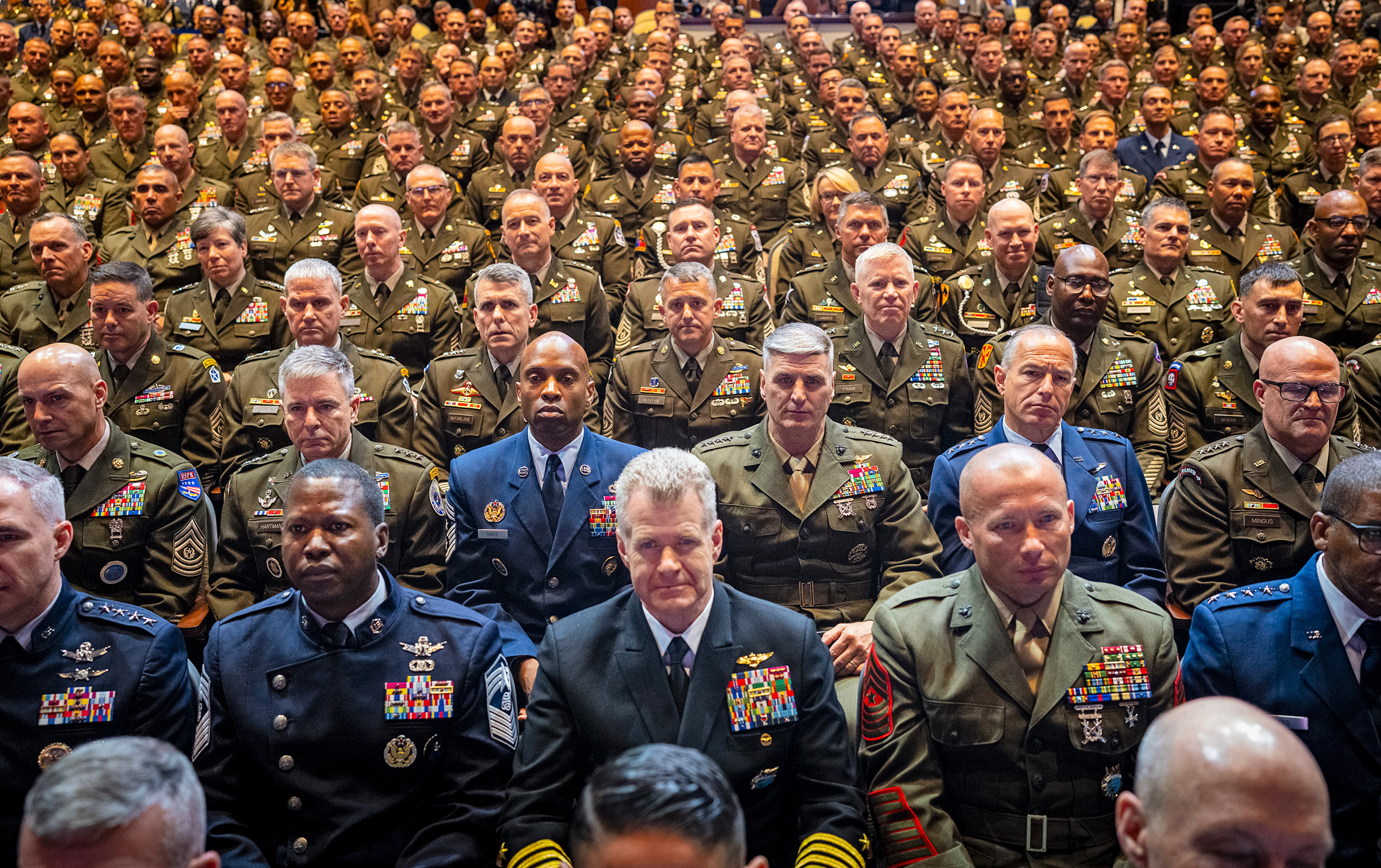
Hegseth has characterized those departures as part of a campaign to undo what he saw as the promotion of “woke” leadership. In a speech in September 2025 in Quantico, Va., to the military’s generals and admirals, all of whom were required to attend, Hegseth criticized the promotion of leaders for what he described as “the wrong reasons, based on their race, based on gender quotas, based on historic so-called firsts.” Paparo was visible in the front row of that gathering, his expression giving nothing away.
He has been careful in his public remarks about the impact the war in Iran has had on the readiness of his command. When questioned in the Senate about how prolonged conflict could impinge on his mission, Paparo conceded only that “there are finite limits to the magazine, and I have all the faith in the world that they’re being employed judiciously.”
In private, he appears to have been more candid. Paparo’s name emerged recently in a Washington Post report on a classified assessment, along with other combatant commanders, in which he is said to have objected to the continued use of an aircraft carrier strike group and destroyers for the war in Iran. He was also named in a New York Times report as one of several “private interlocutors” who had been offering “unvarnished” views of the Iran war to Vice President JD Vance. Vance’s team declined to comment on the report.
Ward Carroll, a Navy veteran who flew in F-14s and a friend of Paparo’s for many years, says the admiral’s circumspection is part of his character. “He doesn’t want headlines,” he says. “He’s not out there like some other folks have been, saying Epic Fury was a huge mistake. He may say it in private … but he’s certainly not going to say it to the media or allow it to be leaked.” Paparo excels, Carroll says, by choosing not to “wade into the food fight that is modern-day media and politics at all.” A spokesperson for Pacific Command declined to comment on Paparo’s private conversations about the Iran war.
When TIME asks Paparo about the potential impact of Ukraine and Iran, he is again cautious, pivoting to the lessons the U.S. is learning from both: namely the rapid deployment of drones in Ukraine and of AI-enabled operations in Iran, which were used to select and recommend targets for the U.S. military.
“The nature of an operation in the Pacific would be to counter an amphibious invasion. Well, we’ve just not used a lot of anti-ship weapons—we still maintain robust inventories of those,” he says. “And so, while I’m not going to whistle past the problem of the expenditure of munitions, it is our job to charge into the learning, and for us to get better.”
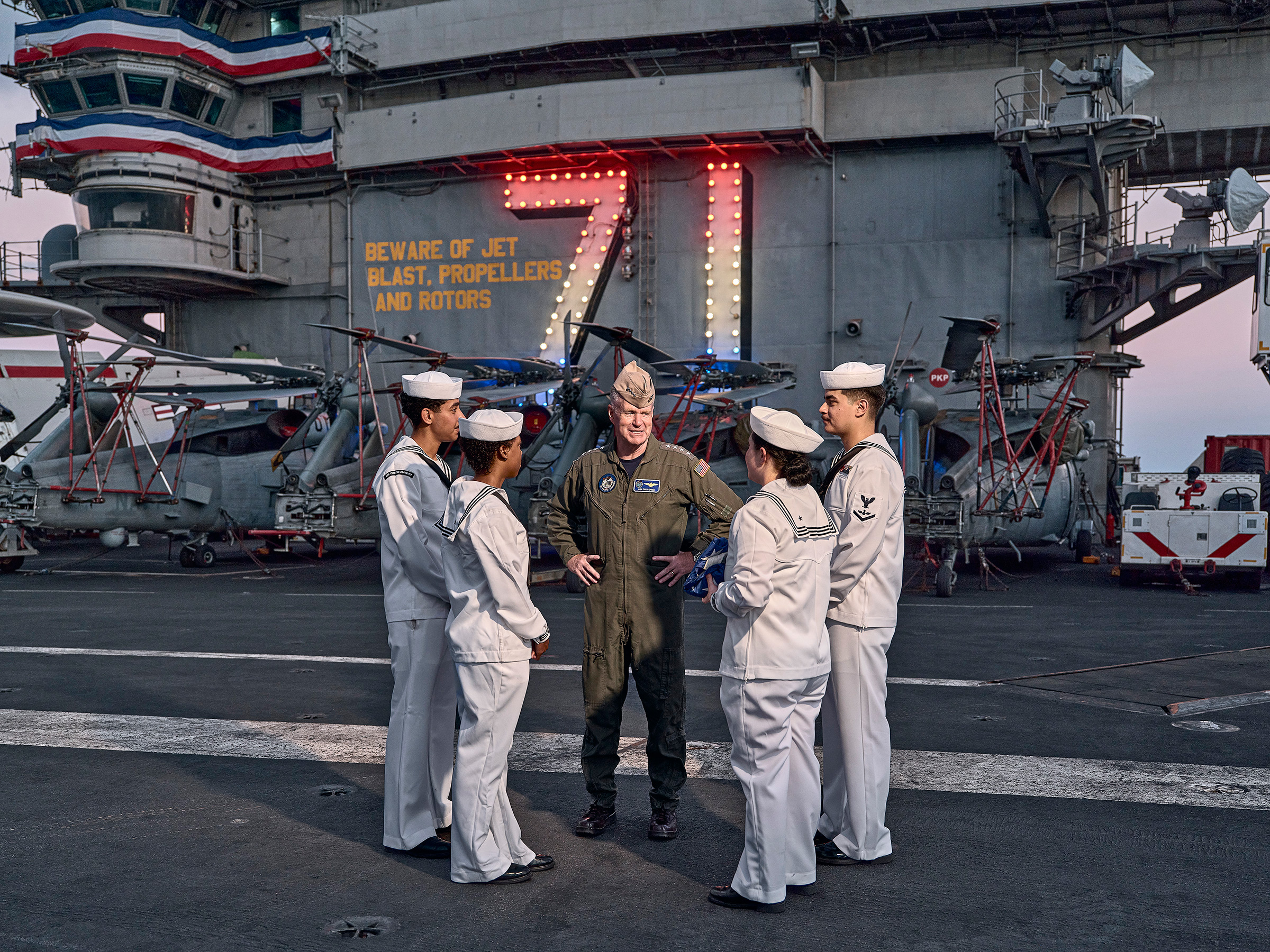
If there is a permanence to America’s projection of power in the Pacific, it can also be found in Paparo’s own family. His father Samuel Paparo Sr., who died in February, served four years in the Marine Corps before becoming a shipworker at the Philadelphia Naval Shipyard. There he helped refit the aircraft carrier U.S.S. Kitty Hawk and repair the U.S.S. John F. Kennedy. The younger Paparo would later fly from both. “He was really proud of that,” he says of his father. His grandfather was a Seabee, serving in one of the Navy’s construction battalions across the Pacific during World War II, in Bora Bora, Guam, and other islands. He died when Paparo was 13, but he left behind an old wooden scrapbook he had built with pictures from the war and all the places he had been. A young Paparo would pick it up from time to time and leaf through it. “I don’t think he imagined his grandson to be here in command,” he says.
His mother washed hair in a South Philadelphia barbershop and later worked a makeup counter in a department store. “Neither my father nor his father finished high school. In fact, nobody in my family before me had ever had a university education,” he says. He would later attend Villanova, the Catholic college also attended by the first American Pontiff, Pope Leo XIV. “We make Popes and admirals,” he says of his alma mater.
He joined TOPGUN, whose exacting culture left a lasting impression. “What the school confers is attention to detail, dedication to execution, dedication to getting better, and being introspective and running to your own problems, of seeking the perfect flight that you’ll never get,” he adds. He flew F-14, F-15, and F/A-18 jets, and clocked more than 6,000 flight hours and 1,100 carrier landings. He says he initially aimed to serve as long as his father. “Serving for four years was intentional, and serving for 40 was a blessing,” he adds.
Paparo’s time leading the Pacific Command is historic not just for the opponent he faces, but also because it coincides with a rapid and dramatic change in the nature of warfare. On one wall of his office hangs a reprint of a TIME cover from May 18, 1942, depicting Admiral Chester Nimitz, the naval commander who led the U.S. to victory over Japan at sea in the Pacific war. Nimitz took command of the Pacific Fleet in December 1941, also at a time of great technological change.
After Pearl Harbor, and under Nimitz’s watch, the battleship would be eclipsed by the aircraft carrier. Amphibious warfare would be revolutionized and directed under a single commander. And then there was the kamikaze—organized suicide attacks by aircraft flown by Japanese pilots—and their foreshadowing of the questions posed by the advancement of unmanned aerial drones in warfare today. “He adapted to change, including the unknown,” Paparo says of Nimitz. “That’s the greatest leadership model I can think of.”
Paparo hopes that he never has to fight the war he has spent so long preparing for, that his plans go untested and passed on to the next commander. In the meantime, he will continue with the quiet work. “Mine is not a heroic story,” he says. “Heroism is service that happens at the unforgiving hour. The best service prevents the unforgiving hour.”
The post Exclusive: The Admiral Who Must Prevent War With China appeared first on TIME.