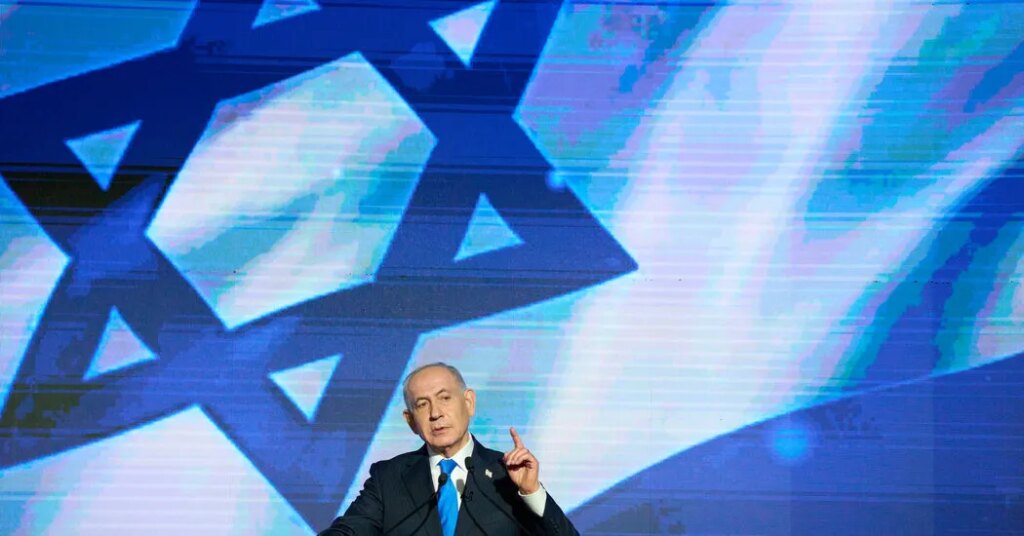
No matter how hostile the reception, for Prime Minister Benjamin Netanyahu of Israel, just being able to address the United Nations General Assembly on Thursday as the country’s leader is a personal win in itself.
Against the odds, he has survived politically, even after the policy, military and intelligence debacle that led up to the Oct. 7, 2023, attack on Israel. His government is about to complete a full, if tumultuous, four-year term, the first Israeli coalition to have done so in more than 30 years.
Yet Mr. Netanyahu will be taking the world stage with his political future on the line, largely directing his words at the audience back home, analysts say, not at the international community from which Israel is more isolated than ever.
A tight race for control of Israel’s Parliament is on the national ballot scheduled for late October. This will be the country’s first election since the day that Hamas led the deadly surprise attack on Israel, igniting the devastating war in Gaza.
As fighting spread to Lebanon, Iran and beyond, the total victory that Mr. Netanyahu promised has remained elusive. Israel’s wars have come to no end. Many Israelis view the coming election as fateful for the future of their deeply shaken and divided country.
Mr. Netanyahu’s conservative Likud party and his far-right and religiously conservative coalition are trailing in the polls. Still, he is Israel’s longest-serving prime minister, a master politician who was made comebacks after being written off, so few are counting him out.
“At one point after Oct. 7, I don’t think anybody anticipated that he would manage to get through a full term.” said Shalom Lipner, who has served as a prime ministerial aide for several Israeli leaders, including Mr. Netanyahu. “But a variety of circumstances aligned to allow him to keep juggling.”
Mr. Lipner, now a senior fellow at the Atlantic Council, a centrist research institution, pointed to a combination of Mr. Netanyahu’s political skill, a country distracted and fatigued by three years of war and, he said, “a hapless opposition that was unable to remove him and was outmaneuvered at every turn.”
Mr. Netanyahu’s main rival is Gadi Eisenkot, a centrist former military chief who lost a son and two nephews in the Gaza war and is the front-runner in a political bloc unified primarily in its opposition to Mr. Netanyahu and his coalition.
Mr. Eisenkot has been beating Mr. Netanyahu in surveys asking about suitability for the top office. But currently the polls show that the opposition would need the support of at least one of the predominantly Arab parties to form a government. It could either include them in a majority coalition or exclude them from the government but gain their backing to assemble a fragile minority coalition.
Any reliance on Arab parties is a prospect that many Jewish voters reject, and that Mr. Netanyahu has been inciting against, even though Israel’s foundational Declaration of Independence promised “complete equality of social and political rights” to all the country’s citizens.
The final outcome may be determined by the fate of a few small parties that may or may not scrape past the electoral threshold for representation in Parliament. They could tip the calculations for the inevitable post-election coalition math.
Mr. Netanyahu has become an increasingly polarizing figure in the aftermath of the Oct. 7 attack, having refused to take any personal responsibility for the failure that led to the deadliest day in Israel’s history. He has also failed to establish an independent commission of inquiry.
That attack killed about 1,200 people in Israel, most of them civilians, and took some 250 others hostage, according to the Israeli authorities. More than 70,000 Palestinians were killed in the ensuing war, including thousands of children, according to the Gaza health ministry, which does not distinguish between combatants and civilians. Much of Gaza had been left in ruins, many of its people displaced and destitute, and human rights groups and foreign governments have accused Israel of war crimes.
A more combative Israel, along with rampant settlement expansion and violence in the occupied West Bank, have left the country increasingly isolated internationally. Old friends in Washington have warned of eroding support for Israel across the board in the United States, Israel’s most critical ally.
Even before Oct. 7, Israel was in turmoil over a divisive government plan to overhaul the judiciary in a way that opponents called antidemocratic. The plan was put forward as Mr. Netanyahu stands trial on corruption charges.
“This election is about what kind of Israel there will be here,” said Gayil Talshir, a political scientist at the Hebrew University of Jerusalem. “Will it be a nationalist, racist, antidemocratic, illiberal state and an international pariah? Or one that repairs the democratic rules of the game, invests in high tech, education and welfare.”
The old Israeli doctrine of waging short wars that end with security or diplomatic agreements has gone. “Netanyahu is leading Israel to a war with no victory and stretching the military to its limits,” she said.
Mr. Netanyahu has neglected Israel’s international standing out of narrow interest, Ms. Talshir said, prioritizing the demands of his extremist coalition partners to stay in power.
Former aides to Mr. Netanyahu say his mission to maintain his grip on power is driven by a belief that nobody else is capable of taking on the challenges Israel faces.
Mr. Netanyahu plans to make a lightning one-day visit to New York to deliver his speech at the annual U.N. General Assembly. He is likely to speak to a near-empty hall. Last year, as he approached the podium, dozens of international delegates staged a walkout in protest over Israeli actions in Gaza.
But Mr. Netanyahu, rarely put off, will relish the opportunity to present himself as Israel’s leading statesman, analysts said.
He appeared to be arriving in a bellicose mood. This week his office shared a government-produced video depicting the General Assembly as an anti-Israel echo chamber filled with parrots squawking, “Blame Israel.”
Mr. Netanyahu is likely to speak about Israel’s military achievements in degrading the capabilities of its enemies, analysts said, and he may threaten them with future action.
Mr. Netanyahu’s office said on Thursday that he would be meeting in New York with several foreign leaders, including from Argentina, Ethiopia, Greece and Papua New Guinea. “Many world leaders requested to meet with the prime minister during the visit,” his office said in a statement, adding that because of a tight schedule and the need to return to Israel in time for the onset of a Jewish holiday, “he was only able to accommodate some of them.”
No meeting has been arranged with President Trump, who has so far refrained from openly endorsing Mr. Netanyahu’s candidacy. While Mr. Netanyahu had long championed his close working relations and friendship with Mr. Trump as a winning ace, the relationship has become complicated in recent months as Israeli and American interests diverge over Iran.
But Mr. Netanyahu always has the option of reverting to his previous tactic, used under Democratic administrations, of presenting himself as the only Israeli politician who can stand up to an American president.
Given the polls, analysts say, his best hope may be an inconclusive election result in which neither side secures a solid majority in Parliament. “The most likely outcome is that Netanyahu loses but the opposition doesn’t win,” Mr. Lipner, the former aide, said.
Referring to the small parties that may not cross the electoral threshold, meaning that their votes will go to waste, Mr. Lipman said, “We are all talking about the big issues, but it’s the technical minutiae that may determine where we end up.”
The post Beleaguered at Home, a Bellicose Netanyahu Heads to the U.N. appeared first on New York Times.