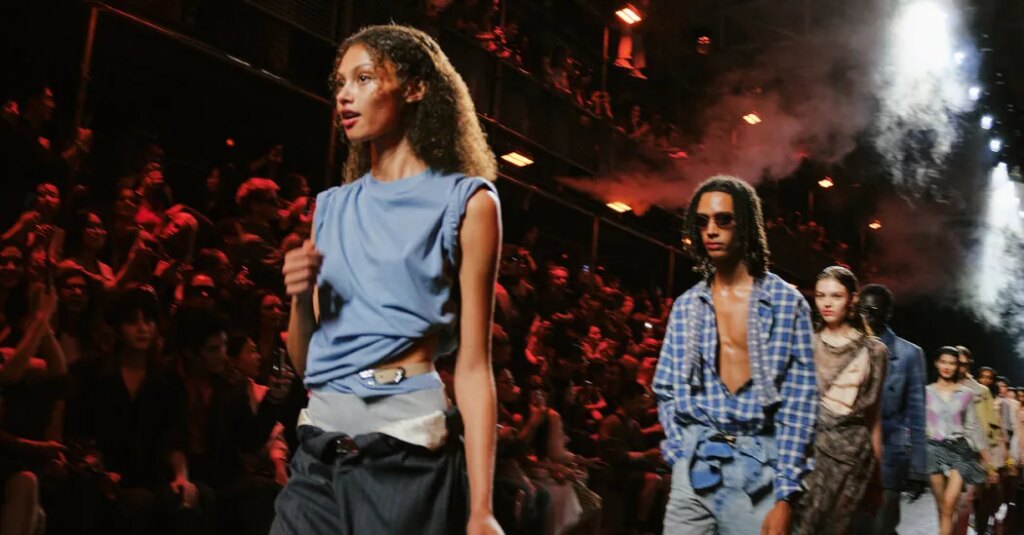
It was the woman draped languidly on the stairs next to me, sucking suggestively on her fingers during Glenn Martens’ final Diesel show, that gave the game away. Across the aisle, a man in the second row began running his hands over the torso of the woman in front of him, who nuzzled him back. Up in the rafters, a couple commenced some torrid grappling.
Then a male model in nothing but hot pants and a pair of slides appeared on the runway, hairy butt cheeks exposed to the air, and the moans on the soundtrack got faster and faster. Martens was going out on a — yup — climax.
As a designer, he has always brought a sort of gleeful hedonism to Diesel. He once built a mountain out of condoms in the middle of his runway, inviting every guest to take a box, and tried to bring back the bumster. In that context, all the heavy breathing (courtesy of performers planted in the stands) made for a fitting end to his six years at the brand — a reminder that he knows what it takes to capture a slice of the attention economy and isn’t afraid to cater to it. (He is leaving to focus on his other job as creative director of Maison Margiela.)
But it was also a kind of eye-rolling distraction. Because beyond the stunty sex, Martens did something at Diesel that no one thought remotely possible when he arrived in 2020: He gave it substance.
Not just as a jeans brand, but as a hothouse of inventive techniques that moved fashion forward. He transformed Diesel from a show no major editors would ever attend (literally, never), and most people wouldn’t bother to look at, to one of the hottest tickets in Milan, pushing denim in directions that were both mind-boggling and occasionally transcendent. And he proved just how much the right designer can change the status of a house. In the annals of turnarounds, this one was a doozy.
At a time when creativity is generally regarded as work for hire and the name over the door is all that matters, Martens’ Diesel was one of the most compelling counterclaims.
Now he leaves it with both a clear identity and foundation. You could see it in his final collection, which took his rave-going Gen Z-ers and reimagined them as slightly more grown-up working stiffs (white collar, blue collar, any collar), stopping off at a dive bar after work and then heading to the club, only to slink home the next morning post-hook-up, lipstick smudged, clothes askew, grin difficult to contain.
So there were jeans, sure — faded, coated to look like leather — but also suits, sometimes lilac, piped in lounge lizard stitching. Knitwear seemed to erode into striped shirting, making it hard to know where one layer began and the other ended. Plastic was bonded atop tailoring so it appeared shrink-wrapped and pressed flat; trench coats treated to seem as if the top layer was decomposing, peeling away to reveal the underneath; and sweatshirts were laser cut into shreds of vines, as if nature was taking over.
Oh, and there were pantasocks: leather trousers with their own footie attachments to slide into pumps. Because … well, easy on, easy off. Plus those very tiny hot pants (honestly, they were more like mere strips of denim) for both men and women.
The final model of the show wore a pair, this time with a white shirt buttoned just at the breastbone. In a neat bit of closure, she was Ella Snyder, the same woman who wore the first look of Martens’ first collection for the brand, in October 2021, during the pandemic period when all anyone could see was a video because runways were still on hold.
And it was hard not to think: Yeah. His work here is done.
The post Hot Pants, Hedonism and Heavy Breathing on the Runway appeared first on New York Times.