As voters headed toward a polling site in New York City in early summer, a campaign volunteer made a last-minute pitch.
Claire Valdez, a state assemblywoman running for an open congressional seat, was a rank-and-file union member, the volunteer offered. A prospective voter was intrigued, and asked which union.
Ms. Valdez belonged to the United Auto Workers. And no, the volunteer acknowledged, she was not actually an auto worker.
The U.A.W., a large international union headquartered in Detroit, has done what many labor groups have found impossible. After a steep decline in membership, it has expanded its ranks even as its core industry has shrunk, finding new life by using organizing efforts in New York City to enroll white-collar workers in private universities, museums and public-interest law practices.
In doing so, the U.A.W. has managed to upend the political establishment in New York City, gaining clout by buoying insurgent power.
The union’s regional branch, which includes the city, was an early endorser of Zohran Mamdani’s long-shot bid for mayor over former Gov. Andrew Cuomo, who had the support of virtually every other union in New York. It backed Ms. Valdez, who won her congressional primary in Brooklyn and Queens against Antonio Reynoso, the Brooklyn borough president supported by most of the city’s unions.
The U.A.W. Region 9A also endorsed Darializa Avila Chevalier, a democratic socialist who upset Representative Adriano Espaillat in a district covering Upper Manhattan and parts of the Bronx. Mr. Espaillat also had the widespread backing of labor organizations.
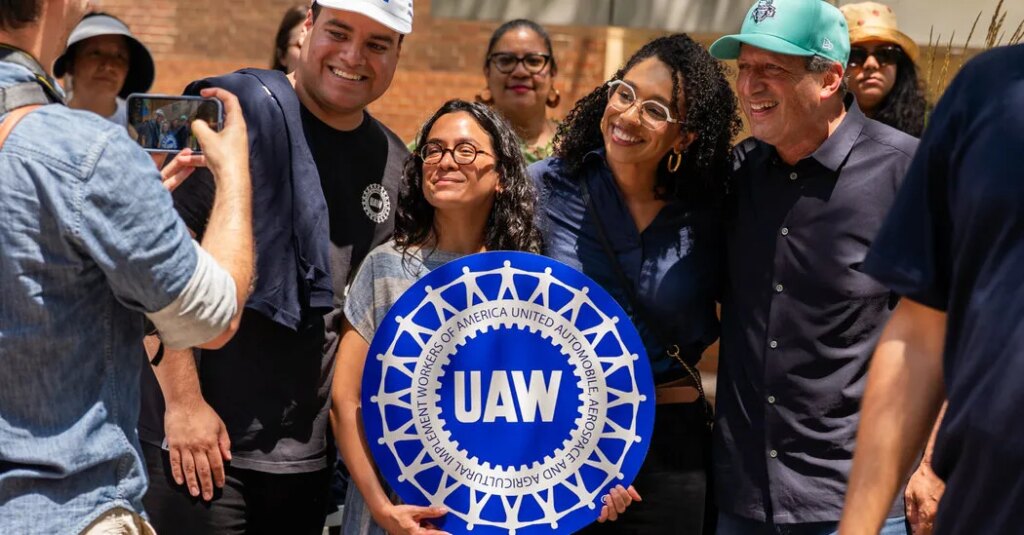
Ms. Avila Chevalier, like Ms. Valdez, is a U.A.W. member; she joined the union through her work as an investigator for public defenders. Ms. Valdez joined in 2018, when she was a visual arts program assistant at Columbia University, a job she held for six years until being elected to the Assembly.
Bringing white-collar workers like Ms. Valdez and Ms. Avila Chevalier into the fold has helped the union buck a prolonged and substantial decline in union membership across the nation. Membership rates dropped from roughly 20 percent in 1983 to 10 percent in 2025.
The U.A.W. had been experiencing similar declines. After swelling its ranks to 1.5 million in the 1970s, its membership dropped to 370,000 in 2023, its lowest level since 2009, according to a report filed with the U.S. Labor Department. By the end of 2025, it had risen to more than 390,000.
In Region 9A, which covers eastern parts of New York, New England and Puerto Rico, only 1,000 of the region’s 35,000 active members work in the auto industry, according to Brandon Mancilla, the region’s director. Roughly 20,000 are based in New York City, up more than 50 percent from 2022.
Mr. Mancilla, 32, argued that organized labor’s diminished power helped fuel Donald J. Trump’s victory in 2024, as Mr. Trump capitalized on working-class Americans’ economic frustrations.
“Our members, like a lot of working-class, middle-class people, feel like the establishment hasn’t worked for them,” Mr. Mancilla said in an interview from a Yemeni coffee shop in the West Village. “They’ve fallen behind. What we’re doing as a labor movement isn’t working.”
Through interviews with two dozen current and former U.A.W. members and people in other unions in New York, a picture emerged of how the union’s Northeast branch has managed to reinvent itself.
Region 9A has fought for contracts for legal services professionals, helped to unionize student workers at Columbia University and is trying to organize low-wage employees at a popular New York City bakery. It also represents gunmakers in Connecticut and submarine builders in Maine.
“You might say, what do they have in common with auto workers?” said Diane Savino, a labor leader-turned-politician who later served as an adviser to Mayor Eric Adams. “Doesn’t matter. If a union wants to remain relevant, it has to have members, and if the work that you originally started doesn’t exist anymore, well, there are lots of people out there who need representation.”
The union’s growth has also led to political friction. Some of U.A.W. Region 9A’s newer leaders are members of the Democratic Socialists of America, and work closely with the political organization — a relationship that, at times, has led the U.A.W. to push for progressive causes in divisive situations.
The Israel-Hamas war is a prime example.
In December 2023, less than two months after the Hamas-led attack on Israel on Oct. 7, to which Israel responded with deadly force, the union declared its support for a cease-fire resolution. It also announced the formation of a Divestment and Just Transition working group to “study the history of Israel and Palestine” and the union’s economic ties to the conflict.
The war came up again during the union’s international convention in Detroit in June, when Local 7902 from Region 9A pushed for a resolution to cut ties between the union’s funds and Israeli bonds.
Earlier versions of the resolution were struck down before getting to a vote because they vilified defense workers represented by the U.A.W., according to several people who attended the convention.
“In a perfect world, I wouldn’t want the U.S. manufacturing weapons that they use to kill people anywhere,” said Micaela Suminski, president of Local 7902, which represents adjunct professors and graduate student workers. “But I hold the president and Congress responsible for that, not the workers at the weapons plants.”
After fierce debate, the measure passed by a margin of 321 to 287.
Pam Smith, past president of Local 2320, the Manhattan-based branch that represents legal service workers, recalled how some members were passionate about supporting Gaza, but noted that “others had serious concerns about particular positions the union took, the union’s role in the issue or the resources devoted to it.”
“I believe unions have an important role in speaking out against injustice, including around the Israel-Palestine conflict,” Ms. Smith added. “At the same time, a union’s fundamental obligation is to its membership.”
The international U.A.W. has long engaged in political activism, having spoken out against apartheid in South Africa and racial segregation in America.
Still, the fierce debate over Israel underscored an inherent contradiction within the union. Local 376, located in Connecticut, represents workers who produce firearms for Colt’s Manufacturing Company, which sells weapons to Israel.
Another local union in Maine represents marine draftsmen who design nuclear-powered submarines for Bath Iron Works, a subsidiary of the defense company General Dynamics. That arm, Local 3999, abstained from the cease-fire resolution vote.
And when the Connecticut branch of the D.S.A. demonstrated outside the Colt’s plant in West Hartford three years ago to protest “their role in supplying weapons to Israel’s genocidal war on Gaza,” some U.A.W. members expressed an interest in joining.
Aaron Eisenberg, political director for U.A.W. Region 9A, said the protest was “unappreciated by our membership,” as were requests to protest outside a different site in Connecticut, where members of Local 571 also make nuclear-powered submarines.
“We don’t have the same relationship with Connecticut D.S.A. as we do with New York City D.S.A., because they did lead one of those types of pickets, and we had to be like, This is not cool,” Mr. Eisenberg said. “These are people showing up to work. Do you think they’re happy about what’s going on? You haven’t asked them anything.”
The presidents of Locals 376 and 571 did not respond to requests for comment and the president of Local 3999 declined to comment.
The issue persists in the union halls of New York.
U.A.W. Local 2179, which counts among its members retail workers and guide dog trainers, has been trying to organize workers at the popular Breads Bakery, known across New York City for its babka. The effort, which garnered attention in January, included a demand that the owners “halt use of bakery profit to materially support the Israeli occupation.”
William Bobrowski, an official with Local 2179, based in suburban Pelham, N.Y., said that employees are upset that “they, in their daily work, are handling products that come from the occupied territories.”
Asked how he feels about being in a union that includes defense workers who make guns sold to Israel, Mr. Bobrowski, a former worker at the Strand Bookstore in Manhattan, called it “wonderful.”
“It creates a more volatile dynamic, there’s more debate, there’s no Stalinist, one-party line,” he said. “Life is full of contradictions and paradoxes.”
Jennifer McPartland, a spokeswoman for Breads, said the company was not interested in taking sides in international conflicts. “We bake babka for people to enjoy,” she said. “We don’t engage in politics. We celebrate peace and welcome individuals of all cultures and beliefs.”
With a budget of $1.2 billion, a strike fund of over $850 million and an international president, Shawn Fain, being bandied about as a long-shot progressive presidential candidate, the U.A.W. has become an undeniable, if complicated, force. It also remains under a federal monitor, after a national corruption scandal that preceded Mr. Fain’s rise.
The union’s success has been regarded with some suspicion and, perhaps, jealousy, from other unions in New York. Their leaders privately contend that it’s easy for the U.A.W., a union with politically active members and relatively high turnover, to back insurgent candidates, when other large unions typically have longstanding relationships with incumbent lawmakers.
Mr. Eisenberg described a call of union political directors in the state A.F.L.-C.I.O. after the June election, saying many of his compatriots expressed frustration that their election tactics failed in several congressional primaries.
Kevin Elkins, who recently left his job as political director of a New York City-based carpenters union, seemed inclined to dismiss the U.A.W.’s performance in local primaries.
“When you have a union that is ideologically driven because of their membership,” he said, “and the most competitive elections are all in districts where the voters are younger, more college educated and prone to support far-left candidates, of course you’re going to have a great night.”
The post How a Labor Union Bested the Political Establishment in New York appeared first on New York Times.