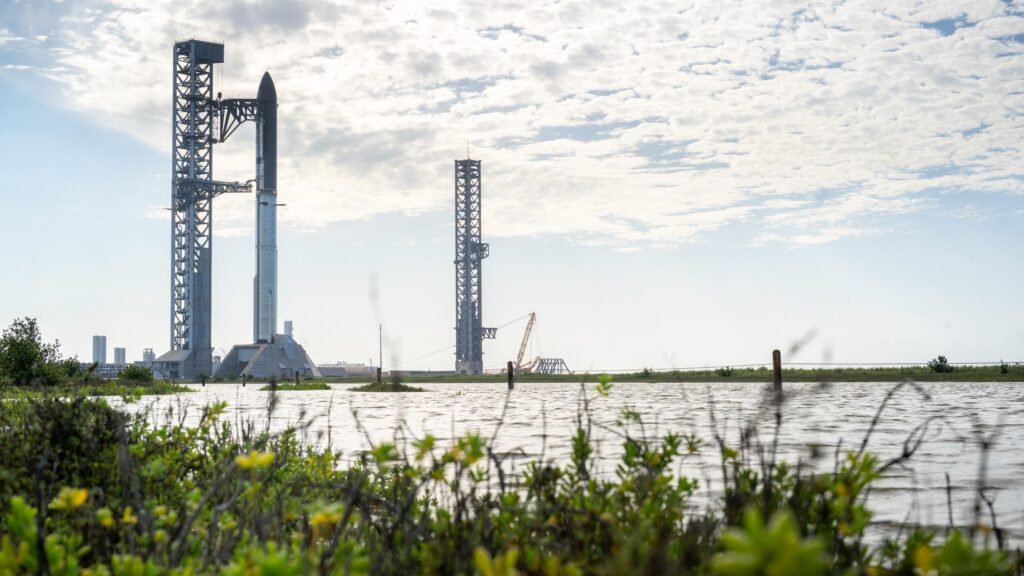
SpaceX has not always distinguished itself as a good environmental citizen. Part of that is unavoidable. You can’t launch 170 rockets per year—as the company did in 2025—without releasing a lot of black soot into the upper atmosphere and creating a lot of light and noise around the launch site, which can be harmful to local wildlife. Environmental organizations have mounted multiple legal challenges against the company over the years to enjoin or minimize its freedom to launch until multiple corrective measures are taken.
Now SpaceX faces another day in court. On Sept. 21 a judge ruled that a proposed land swap with the federal government that would allow the company to expand its launch pads, factory, and related infrastructure into a protected wildlife area in Texas could go ahead. That might have settled the issue but the environmental groups that sued to stop this, plan to appeal—and they believe they have a strong case.
Why did environmental groups sue to stop SpaceX’s land swap?
On June 10, a group of plaintiffs filed suit against the Department of the Interior to block a Trump Administration plan to cede SpaceX 725 acres of land in the Lower Rio Grande National Wildlife Refuge hard up against the company’s Starbase factory and launch site in Boca Chica, Texas, in exchange for 692 acres the company owns in the Laguna Atascosa National Wildlife Refuge about 20 miles north of Starbase. The land that would be annexed by SpaceX is not only home to thousands of species of plants and animals including the ocelot, which is endangered in the U.S.; it is also considered sacred by the Native American Carrizo/Comecrudo Nation of Texas, which is a plaintiff in the suit. What’s more, the tract has cultural and historical significance as it includes the Palmito Ranch Battlefield, the site of the last land battle of the Civil War.
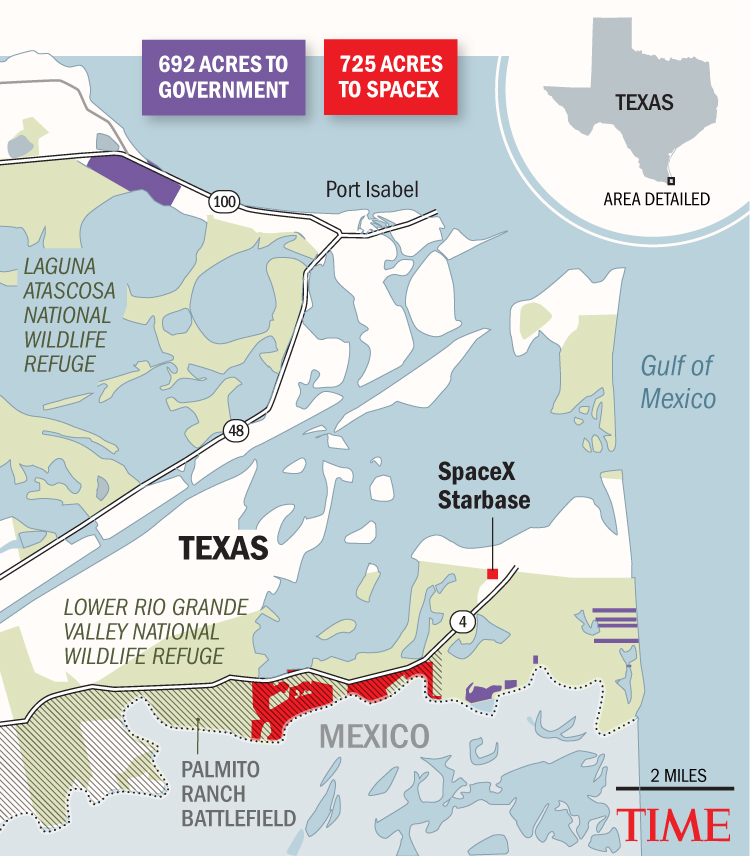
The fact that the acreage that SpaceX gets will not be a gift, but rather an exchange for land the company currently owns—taking that latter plot off the table for development—does not solve the problem, says Laiken Jordahl, public lands advocate for the Center for Biological Diversity, the lead plaintiff in the lawsuit. “The whole point of the Lower Rio Grande Valley National Wildlife Refuge is to establish a chain of connected habitats along the river that allows for the migration of ocelots and other wildlife,” he argues. “This will cut out one of the key east-west areas of wildlife connectivity, and in return, we’re getting a smaller amount of land in a different area.”
What did the Judge say in its decision that would allow the SpaceX land swap?
On. Sept. 21, Judge Fernando Rodriuguez, Jr., of the U.S. District Court for the Southern District of Texas, denied the Center for Biological Diversity’s request for a preliminary injunction that would prevent the move, ruling that the plaintiffs did not have standing to sue. In their filing, the plaintiffs argued that the land swap would cause them irreparable harm since they would lose access to those acres and the freedom to observe wildlife there. The Interior Department countered that the land was already closed to the public as part of its wildlife refuge status, so the plaintiffs suffered no loss.
The plaintiffs, in their filing, anticipated this finding and sought to rebut it in advance with 2014 case law. “[T]he affected individual,” they wrote, “need not always have direct access to the area at issue. Individuals can possess a cognizable interest ‘in observing the landscape from surrounding areas[.]’”
Rodriguez—appointed to the federal bench by President Donald Trump during his first term—was unmoved, and if anything, saw SpaceX as the potentially aggrieved party. The requested injunction, he wrote, “would impose uncertainty into and would result in modifications to SpaceX’s development plans, placing additional hardship on the company’s ability to meet milestones and contractual obligations.”
“We are obviously, extraordinarily disappointed in the judge’s decision,” says Jordahl. “This effectively clears the way for the bulldozers to start destroying the refuge land. But the judge did not rule on our overall claims; it was just on the injunction. So yeah, the challenge will press forward.” (The denial of a preliminary injunction falls short of the judge actually ruling on whether the proposed land swap violates federal law—which the plaintiffs claim it does.)
What is SpaceX’s environmental impact?
It’s not for nothing that environmental groups worry about the impact of SpaceX’s south Texas site. That’s where the company launches its massive Starship rocket—a 33-engine behemoth that stands 40-stories tall and puts out up to 18 million lbs of thrust, more than twice as much as NASA’s Space Launch System, the second most powerful rocket in the world.
Four minutes into Starship’s inaugural launch on April 20, 2023, it exploded spectacularly, raining debris downward—most of which fell into the Gulf of Mexico. But the mere ignition of the nearly three dozen engines on the concrete launch apron did plenty of harm of its own.
“Impacts from the launch include numerous large concrete chunks, stainless steel sheets, metal and other objects hurled thousands of feet away along with a plume cloud of pulverized concrete that deposited material up to 6.5 miles northwest of the pad site,” the U.S. Fish and Wildlife Service wrote in an email to the media at the time. “Approximately 385 acres of debris was found on both SpaceX’s facility and in the surrounding Boca Chica State Park, and a 3.5-acre fire burned on park land south of the launch site.”
Jordahl is not worried just about similar environmental damage, but the harm to be done when those bulldozers he mentions begin to roll.
“I’ve heard different things [about what SpaceX wants to do with the land], from additional manufacturing areas to warehouses to worker housing,” says Jordahl. “We haven’t gotten any clear and obvious plans. But the way that they’ve been treating the land out there already is telling. They pave over everything. They turn it into an industrial manufacturing zone.” SpaceX did not respond to a request for comment.
The harm won’t stop there. As SpaceX expands into the refuge, more land that is currently a comfortable distance from the complex will be exposed to the damage the launches can do. SpaceX claims it has cured the problems that made the first launch such a mess, installing a water-cooled metal deflection plate and a retaining wall to control debris. The other 12 Starship launches that have taken place since the inaugural one have indeed caused far less damage to the surroundings.
If that mitigates the environmental damage the rocket can do, however, the planned launch cadence exacerbates it. In August, SpaceX founder and CEO Elon Musk told Aviation Week that he envisions daily Starship launches—carrying crew, satellites, and other cargo to space—as early as 2027. More headsnapping was his 2025 boast on X, that “In about 6 or 7 years, there will be days where Starship launches more than 24 times in 24 hours.”
Clearly, not all of those launches could come from the Texas site, but SpaceX has other launch facilities at Vandenberg Space Force Base in California, and dedicated pads at the Kennedy Space Center and the Cape Canaveral Space Force Station in Florida. A company so large, with more than a $2 trillion valuation, could always build more launchpads at more coastal sites whenever it chooses.
What precedent could the SpaceX land swap set?
The Texas base is making news at the moment, not simply for what it means for this potential development site, but for others elsewhere in the U.S. The Trump Administration is currently pursuing a similar land swap with a private land developer, involving a strip of land in Yosemite National Park for an undeveloped parcel in California so that residents in a planned private housing complex near the park will have easier access to it. Yet another land exchange is under consideration that would open up a federally designated wilderness area on Georgia’s Cumberland island to the construction of luxury homes.
“This [Texas] land transfer is part of a broader scheme by this administration to give away public lands to private interests,” says Jordahl. “The precedent that this transfer will set is extremely concerning when it comes to corporations setting their sights on and taking over public lands across America.
The post Everything You Need to Know About SpaceX’s Wildlife Refuge Land Swap with the Trump Administration appeared first on TIME.