NO LAND TO STAND ON: Notes From Detention, by Mahmoud Khalil
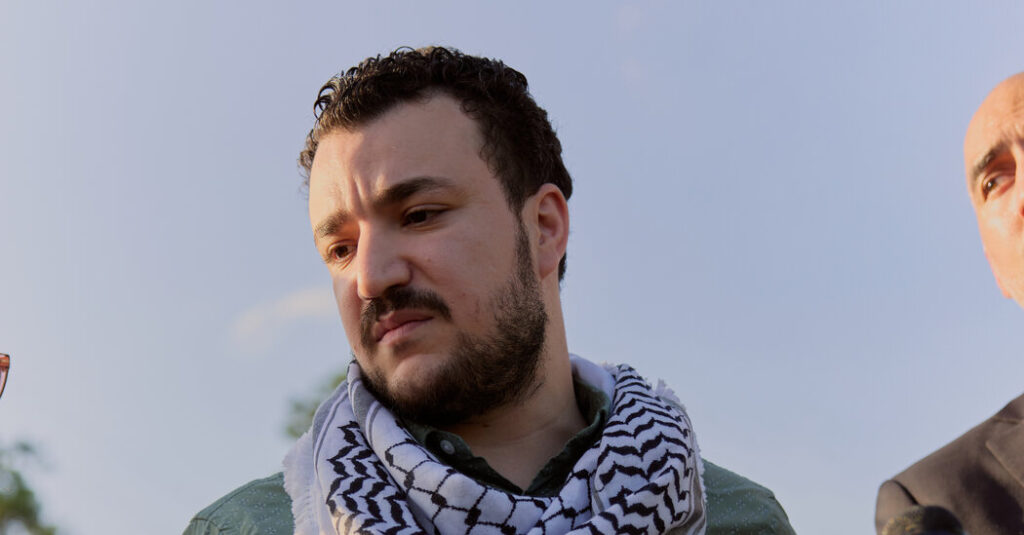
As a Palestinian born and raised in a refugee camp in Syria, Mahmoud Khalil grew up with a particularly dark understanding of unchecked state power. “In Assad’s Syria, there was no such thing as legal rights,” he says in his quietly shattering memoir, in a passage about the brutal regime of Bashar al-Assad. “No warrant, no lawyer, no phone call. You disappeared, and if you were lucky, someone might find out where they had taken you.”
In the land of the free, the rules were different — or so he believed. After fleeing Syria for Lebanon, Khalil moved to the United States in 2022 and enrolled at Columbia as a graduate student. In the wake of Hamas’s attack on Oct. 7, he became a constant presence at campus protests against Israel’s bombardment of Gaza. Other protesters wore masks; he didn’t. Other protesters were worried about the precariousness of their student visas; he was married to an American citizen and had a green card. People started to post calls for his deportation, with some tagging the White House and the secretary of state.
But Khalil was living in a country with an independent judiciary and a constitutional right to free speech. So when he read the “Know Your Rights” guides online, he only skimmed the sections on ICE: “I was a legal resident. ICE wouldn’t be coming for me.”
Then, on March 8, 2025, they did come for him. In “No Land to Stand On: Notes From Detention,” Khalil recounts in stark detail the terrifying experience of being surrounded by men in the lobby of his Manhattan apartment building, handcuffed in front of his pregnant wife, pushed into an unmarked car and flown to a detention camp in Louisiana.
For nearly two days, he was denied a phone call. When he was finally able to call his wife, Noor, she told him what the White House was posting about him on social media: “Radical Foreign Pro-Hamas Student. Terrorist sympathizer. National and foreign policy security threat.”
None of it was true, he says. But what was especially surreal was how the truth of the matter seemed largely beside the point. The White House was laying claim to vast powers. According to a two-page memo from Secretary of State Marco Rubio, Khalil’s presence in the country undermined “U.S. policy to combat antisemitism around the world and in the United States.” Khalil was declared “deportable” on the basis of his “past, current or expected beliefs, statements or associations that are otherwise lawful,” at the discretion of the secretary of state.
In other words, a legal resident whose beliefs and behavior are “otherwise lawful” could be booted from the country because the Trump administration said so.
Much of “No Land to Stand On” recounts the efforts of Khalil’s legal team to free him from detention and keep him in the United States. Natural-born Americans who have never been at the mercy of the immigration system will learn a lot from his clear parsing of the differences between immigration courts and federal courts, as well as from his descriptions of “bureaucratic quicksand.”
The prose in this prison memoir is matter-of-fact and unadorned, noticeably free of self-pity. Especially striking is Khalil’s account of being caged in a camp apparently designed to get people to give up hope and self-deport by wearing them down. He recalls the harsh glare of bright lights that were never turned off and the unrelenting blast of frigid air that cut like a blade. Even the tiniest decencies were forbidden. At 3 a.m. guards would come around and tear down the sheets that inmates hung around their bunks to keep out the light and the cold.
Khalil was denied a furlough to attend the birth of his first child. Such parental deprivations were cruel but not unusual. He met a man from Mexico, detained after living in the United States for 15 years, who cried when remembering how his daughter fell asleep on his shoulder at night. Another man, from Chechnya, had never held his 9-month-old daughter, born while he was in detention.
“This could be me,” Khalil thought. “This will be me.” He despaired until Noor and their infant son were eventually granted permission to visit. “The state had given me 60 minutes of fatherhood”: In the context of the Louisiana detention camp, Khalil was lucky.
But that was mostly because he had a high-profile team arguing that he should never have been locked up in the first place. “It had taken some 25 lawyers, press attention and a federal judge’s intervention to allow me to hold my newborn son,” he writes. “This is what the system requires: that you have an army behind you just to secure basic human dignity.”
In June 2025, Khalil was released from detention. More than a year later, the Trump administration is still trying to deport him. Aside from the threat it says he poses to foreign policy, the government has accused him of misrepresenting information on his green card application, and the Board of Immigration Appeals has approved his deportation. Khalil calls the immigration charge “retaliatory.” His lawyers have said they plan to appeal to the Supreme Court.
Khalil refuses to stay quiet. He could play it safe by dialing back his activism on behalf of Palestinians, by allowing a divided public to see him as just “the man who missed his son’s birth,” a simple victim of state power — “the version of me that was legible and sympathetic.” But he says that his politics are born of necessity. In “No Land to Stand On,” he regularly points out moral contradictions — the gap between words and deeds, between “family values” and family separations, between soaring humanist ideals and ruthless dehumanization on the ground.
This is a frightening, important book. But there is also a measure of hope in Khalil’s insistent emphasis on such hypocrisies. They indicate that an ideal still exists, something that hasn’t yet been swallowed up by arbitrary power. “I have always had an ambivalent admiration for rules,” Khalil writes. “I often disagreed with them, sometimes intensely, but I believed in the idea that people should know where they stand.”
NO LAND TO STAND ON: Notes From Detention | By Mahmoud Khalil | Metropolitan | 193 pp. | $27.99
The post A Quietly Shattering Memoir by a Man Detained by ICE for His Beliefs appeared first on New York Times.