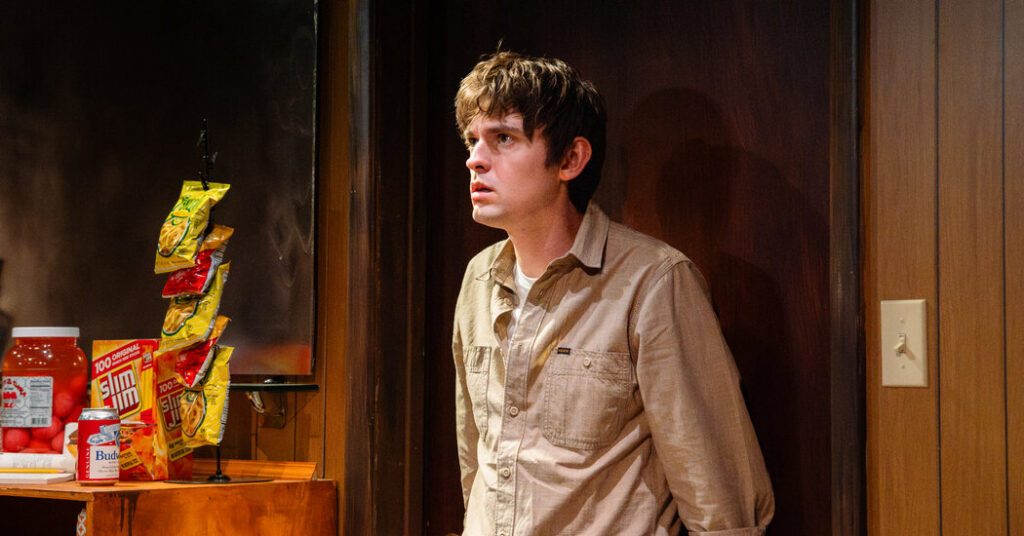
Joey’s family’s business is an undistinguished upstate New York watering hole, with a faded personality if it has one at all. His dreams are elsewhere, but his father is dying, so Joey has returned, resentfully, to take his station behind the bar. The place saps his spirit. It does hold one mystery for him, though: What, precisely, goes on in its back room?
He knows most of the specifics, but he’s never even been through that closed door himself. Long ago, in a way that frightened him, his father made him promise to stay out. Whatever nigh on miraculous peace that men are finding in there — one at a time, very hush-hush — Joey does not know the feeling.
The blissful intensity of that sensation is the gospel news that gains acolytes in Max Wolf Friedlich’s gleefully weird comedy “The Holes,” a tall tale of a play about, pardon the bluntness, manual stimulation as religious experience.
After one of those encounters, in that back room, a wealthy Manhattanite named Wesley (Grantham Coleman) is filled with such overwhelming joy that he’s convinced that it saved his life. Martha (Tina Benko), an acutely eccentric regular at the bar, is equally persuaded that local guys are less violent thanks to the back room’s enigmatic, unknown practitioner, who has worked that signature magic since Joey’s grandfather ran the place.
“You come to the bar angry, ready to hit somebody — your wife probably — and you leave calm,” Martha says, sure that she glimpsed the back-room person once. “That Man’s been molding this community, sculpting better men with his bare hands.”
Friedlich, who set his breakout play, “Job,” in a therapist’s office, ventures back into the wellness sphere with “The Holes,” directed by Michael Herwitz at the Wild Project, where a blue-chip ensemble is delivering performances of fine-grained complexity.
Played by Bubba Weiler with an anxious, prickly intensity, Joey looks at the struggling bar, bereft of much of its former townie crowd, and sees an albatross. But Coleman’s charismatic, smooth-talking Wesley sees dollar signs. He wants to turn this age-worn Hudson Valley spot into a luxury wellness club for men, bring them up by the busload from New York City and usher them into that back room. (The set is by Anna Grigo.)
Joey — who had already started charging for access to the room, which his father and grandfather never did — welcomes the abundant cash infusion. His childhood friend Carson (an extraordinary Jack Mulhern) signs on to provide security: one more part-time gig to keep him afloat in a place where jobs are scarce.
For Martha, this transformation, in service of the tourists and affluent newcomers who are already gentrifying her town, means being shut out of a place that’s been central to her sense of belonging. Plenty of awful men have done her wrong in her life — Joey and Wesley now among them — but in that bar, Joey’s dad always had her back.
The play’s premise makes ample room for contemplation and satirization: of misogyny; economic exploitation; homophobic self-loathing; the barely-to-not-at-all veiled homoeroticism of all-male spaces; and the deliberate, cultish opacity of the men’s wellness niche.
Also a target: the kind of counterfeit authenticity that Wesley envisions in his remade version of the bar.
“Honestly maybe we funk it up a bit,” he says, after Joey has done some sprucing. “Spill some cans on the floor? I’m missing that old beer seeped into wood smell.”
Friedlich’s own grasp of authenticity is particularly striking in a devastating argument between Joey and Carson, revisiting the damage they did to each other back in the day, before they stopped hanging out.
But Friedlich can overindulge when he gives his characters a taste for gut-punch language that ostensibly suggests something about their education or politics or belligerence. If a play uses, as this one does, a slur for intellectual disability four times, might that be the author reveling in transgression rather than telling us things we need to know about a character?
One more caveat: “The Holes” has an ambitious ending that is extremely tricky to achieve. It doesn’t pull that off, either on the page or on the stage. But I’m betting you won’t mind much. This is a strange and surprising yarn, meticulously unspooled. And that is more than plenty.
The Holes Through Oct. 18 at the Wild Project, Manhattan; thewildproject.org. Running time: 2 hours.
The post ‘The Holes’ Review: Benediction in the Back Room appeared first on New York Times.