Before the Nazis rose to power, Sofie Heilbronner knew a lush life. She and her husband, Hugo, a prominent Jewish banker in Bavaria, were driven around in his-and-her limousines, according to family lore. Sometimes they’d throw a party in one of their houses and sleep that night in another so the home could be cleaned.
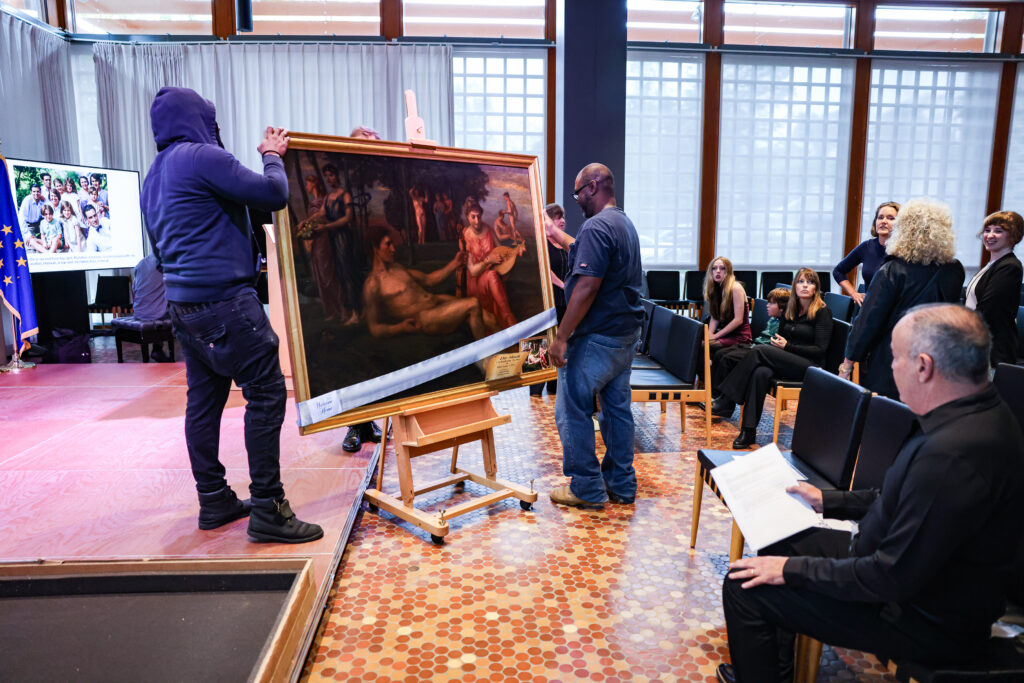
Their primary residence was in Munich, a tony mansion on a tree-lined street a short walk from Nymphenburg Palace where Sofie kept much of her art collection. That expansive assortment included a late 1800s painting by German artist Albert Lang called “Evening Sounds.” It depicted a playful, bacchanal scene portraying music, recreation, plenty — a scene that paralleled Sofie’s life.
But in 1936, her late husband’s bank was expropriated, and in 1938 — sensing the urgent political turn of her city — she fled Germany and made her way to the United States with her adult sons. It was just weeks before Kristallnacht (or the Night of Broken Glass), a violent state-sponsored pogrom across Nazi Germany that was incited in Munich.
Most of their belongings were seized and auctioned by the Nazis, and some of the family’s art was offered to a local gallery to finance the journey. Among the pieces was “Evening Sounds,” which for decades sat in dim back rooms. It is unclear whether it was taken or sold, according to modern researchers, but the Bavarian government has since identified it as looted.
This summer, Sofie’s descendants were reunited with the painting following an eight-year process. They were recognized Tuesday at a restitution ceremony at the German Embassy in D.C.
“It is more than a work of art,” her great-grandson Paul Laporte said at the event. “It is one of the few surviving witnesses to my family’s life in Germany before persecution, dispossession and exile. It connects us not only to what was lost, but to the life that existed before that loss.”
The Holocaust was not only the largest genocide in history, but the greatest theft in history, according to former U.S. ambassador to the European Union Stuart Eizenstat, who spoke at the embassy. While it is difficult to pinpoint how many stolen pieces of art, among other belongings, were pilfered from Jewish families as the Nazis rose to power, he said there have been more frequent restitution cases in the last few decades.
“Too many people think that all of our restitution involves this return of masterpieces,” Eizenstat said. “This is an example of something that is far more valuable to the family itself than its fair market value.”
Restitution claims are often difficult to navigate because of the quantity of information that must be provided. They can sometimes take decades — or generations.
For decades, “Evening Sounds,” unmissable at 4-by-6-feet, languished in a series of storage spots. What is known is that the Heinemann Gallery in Munich declined to purchase the painting in 1938. It was transferred in 1955 to the Bavarian State Painting Collections from a former American army barrack that was by then used as a warehouse.
Laporte believes the painting was never displayed publicly in the Munich museum. For decades it was hidden there, less than two miles from Sofie’s mansion.
Paul Laporte’s family has a story that has traveled down through the generations. His father Johannes Heilbronner (later Laporte) was partly raised by Sofie. But when she fled Germany with his uncles, he stayed back with his Lutheran mother, hoping adopting her last name would hide him in plain sight.
In 1944, as a teenager, he received a draft notice from the German army. Johannes responded that he couldn’t fight for them because he was Jewish.
“I don’t remember hearing [the story] directly,” Laporte said, “but it’s firsthand in the sense that it’s built into my DNA.”
Johannes was sent to, and lived through, two concentration camps in Bavaria before the end of the war. Later in life, when faced with telling his children about his experiences, he was reticent. It’s common among Holocaust survivors, Laporte said, that they don’t speak about what they endured — and his father didn’t before he died when Laporte was in his early 20s.
Decades later, the internet gave Laporte an easy way to start untangling the mysteries of his father’s past. Those searches brought him to a photo of a gravestone: “Hugo Heilbronner,” read an engraving. “Sofie Heilbronner,” read a line beneath it, with the years of her birth and death. Sofie, his apparent great-grandmother, died when Laporte was 10 years old. They never met. Another mystery, Laporte thought.
In 2018, his research led him to uncovering digitized records from the Heinemann Gallery, where Sofie had her art appraised, with her signature. He discovered “Evening Sounds” was still in the state’s possession.
Over nearly a decade, he worked with New York’s Holocaust Claims Processing Office to prove Sofie was the owner; that the museum did not have the artworks by other means; and that he was her legal heir. That last point proved a challenge. For Laporte, it meant contacting unknown distant relatives found through vague recollection or genealogical websites.
The painting is valued between $2,000 and $10,000 today — and cost about $3,000 to ship to Laporte’s home in D.C.’s Chevy Chase neighborhood. He initially wondered whether it was worth the trouble. His son convinced him it was.
“Part of this experience has been a way of me honoring my father’s experience,” Laporte said. “It’s a way of showing respect for him.”
Last month, a large package arrived from FedEx, tracked all along its lengthy voyage by Laporte. (“I had to make sure I was here so they didn’t leave it outside for a porch pirate,” he said.)
Despite all the work, years and challenges that went into the artwork now hanging in his home, Laporte doesn’t actually love the painting itself. He finds it funny, hinting at vulgarity. When he told a friend that it once hung in his great-grandmother’s house, the friend responded, “What, in her bedroom?”
But to Laporte, the painting means something deeper than its classical aesthetics. It was a piece of art that someone chose and hung in her home to decorate a life that existed before she was forced to flee it. He said he brings a lot of people to his house to see it.
“It becomes a place to tell my story,” he said, “and people are kind enough to listen to it.”
Liam Bowman contributed to this report.
The post A woman fleeing the Nazis left behind a painting. Her family just got it back. appeared first on Washington Post.