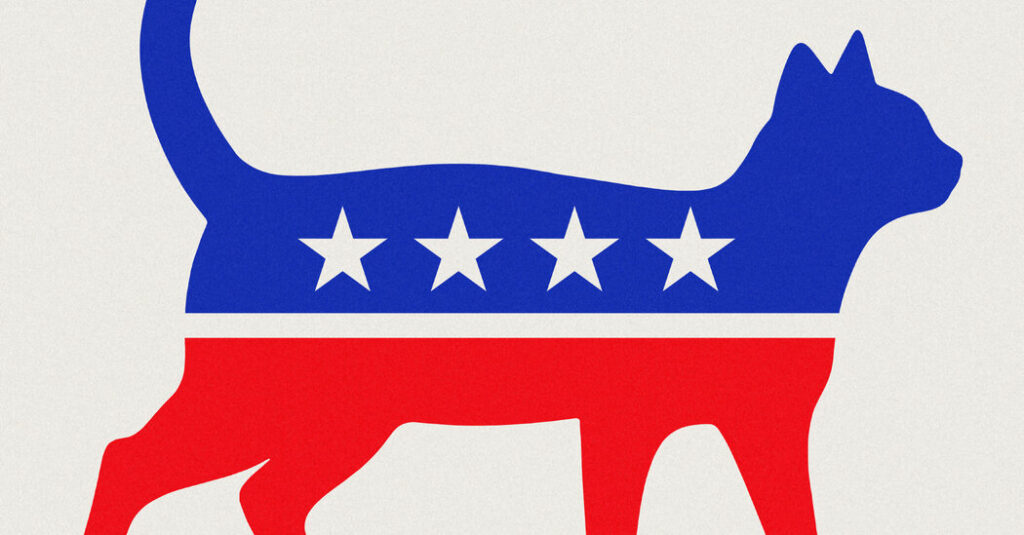
Joe Manchin, the former West Virginia senator, has a new mission. He recently gathered a gaggle of politicians, activists and affluent donors at the Greenbrier, a venerable resort nestled among the Allegheny Mountains. The agenda: support candidates for Congress who have jettisoned their party affiliation and are running as independents.
When Mr. Manchin was in the Senate, he infuriated his Democratic colleagues by bucking the party line, even as his idiosyncrasies helped him to win repeatedly in a deep red state. In 2024, after 12 elections and 38 years in office, he quit the party and decided not to run for re-election.
“The parties have so poisoned politics that having a ‘D’ or an ‘R’ next to your name makes it nearly impossible to collaborate with the other side,” said Mr. Manchin. Not only does polarization make bipartisanship nearly impossible, but polls show that Americans who identify as politically independent constitute the largest bloc of voters. In 2020, 39 percent of U.S. adults described themselves as independent; five years later, that figure rose to 45 percent, Gallup found. Twenty-seven percent describe themselves as Democrats, and the same percentage describe themselves as Republicans.
In short, the time is ripe for an independent movement. “The label ‘Democrat’ is toxic,” Todd Achilles told me. A onetime Republican and a former Democratic state legislator who became an independent in 2025 to run for the Senate, Mr. Achilles is running in Idaho, a state that has been solidly Republican for more than half a century. “The national Democratic Party has taken Idaho off its map, while the national Republican Party has taken Idaho for granted.”
Dan Osborn, the independent Senate candidate from Nebraska, has gotten the most media attention. His campaign offers the clearest test of whether independence can help a personally appealing, blue-collar, center-left candidate win over red-state voters allergic to the Democratic label. In 2024, the former union leader, running for office on a shoestring budget, lost his Senate race by just 7 percentage points, while Donald Trump carried the state by 21.
In Nebraska, as well as in Idaho and South Dakota, the senatorial races are too close to predict. In recent years, a Democratic victory in these states would have been as unlikely as President Trump’s becoming a peacenik. Whether or not any of the independents wind up winning, they represent the seeds of a new movement.
Politicians on both sides of the aisle have reached the same conclusion: The two-party structure is broken. Representative Kevin Kiley, a California Republican, quit the G.O.P. last spring after his district was redrawn to favor Democrats, and is running as an independent.
“Partisanship in D.C. is so much worse than I imagined before I came here, and it keeps getting worse,” he told me. “I don’t represent my party.” He continued: “I’ve tried to serve as a check against policies that aren’t good for my constituents” — a point that would have been obvious in any other era.
Whether these candidates used to be Democrats or Republicans (or, like Mr. Osborn, entered politics as independents), they need financial backers and experienced campaign advisers. That’s the role of Mr. Manchin’s Independent Leadership Council, formed this summer, whose mission is to build a durable independent bloc.
Since its launch in July, the council has secured at least $10 million in funding. While that’s not much in this era of big-bucks campaign spending, Adam Brandon, a co-founder of the council, pointed out that “it doesn’t take a lot of money to run a smart campaign in a state like Idaho.” He added: “What matters is getting a video from a friend who says: ‘I like this candidate.’ The new money in politics is authenticity. It’s ‘Mr. Smith Goes to Washington.’”
Manchin’s council isn’t alone in promoting this movement. Senator Bernie Sanders, the longtime Vermont independent, has been on the hustings, stressing the necessity of more working-class, anti-corporate candidates. In the wake of the 2024 election, Mr. Osborn started the Working Class Heroes Fund to back “truck drivers, nurses, teachers, plumbers, carpenters and other working-class people” running for office as independents.
The Democratic Party, once the home of working-class voters and a brand of politics that championed them, now seems elitist, aloof and out of touch. How did this happen? Why have so many candidates become convinced that working-class, anti-corporate politics doesn’t have a place in it? And why does their message resonate with so many voters?
The Democrats have only themselves to blame. For decades, working-class voters have been telling pollsters that the party doesn’t listen to them. Their resentment has its roots in the 1990s trade deals that cost them manufacturing jobs; the response to the 2008 financial crisis, which rescued banks and billionaires while foreclosures decimated millions of families; and the government’s tepid response to the opioid epidemic.
The party’s attempts to appeal to these voters often fall flat. “Fight the oligarchy” talk won’t convince working-class voters. They may believe the system is unfair without seeing themselves as pawns in class warfare. In the 2024 campaign, Democrats marched to the drumbeat of democracy, abortion and freedom — catnip to the party’s middle-class, college-educated constituents, but not so much to working-class voters.
“Affordability,” the “it” word of the current campaign, is a much better fit. But unless there’s something solid behind it, slogan won’t undo decades of distrust.
Many voters backed Mr. Trump because they were convinced he was on their side. While the MAGA loyalists remain faithful, less ideologically driven Republicans have become disillusioned with the president’s handling of the economy, which they see as benefiting the well-to-do. Half of Republicans say that Mr. Trump has benefited personally from the presidency. And 7 percent of Republicans reported being “very likely” to vote for a third-party or independent candidate, Gallup found in 2025. In a tight election, those votes could be decisive.
Critics of America’s two-party system have long dreamed of a third party — or a fourth or fifth party, as in many democracies. In those countries, the party with a plurality of seats must build a coalition government. Moderation is baked into those systems, so when power changes hands, polarizing shifts are less likely. If the United States relied on that model, we wouldn’t have had to suffer through the convulsions inflicted by Trump 1, followed by Joe Biden, followed by Trump 2.
While a third party is attractive in principle, it isn’t going to fly anytime soon. Our political system, with its winner-take-all rule and crazy-quilt requirements for getting on the ballot, makes it nearly impossible to be more than just a spoiler — recall the 2000 Ralph Nader campaign, which siphoned enough Democratic voters in Florida to install George W. Bush in the White House. Elon Musk learned his lesson after he pitched but quickly abandoned a plan to form a new party in his image.
Some of the independents hope to form a “fulcrum caucus” if they win that could secure changes in how Congress does business, ending gerrymandering, reducing the national debt and restricting congressional stock trading. You can envision them going further — for instance, by promoting an immigration plan that combines strict borders with routes to citizenship for skilled workers, as Canada has done.
This Congress is shaping up to be one of the least productive in modern American history. If the November election results in a closely divided Senate, as seems likely, two or three independent senators could often hold the balance of power. They can use their clout to force Democrats and Republicans to work together more regularly.
It has been many years since we last heard about that kind of compromise. It’s time to bring it back.
David Kirp is a professor emeritus of public policy at the University of California, Berkeley.
The Times is committed to publishing a diversity of letters to the editor. We’d like to hear what you think about this or any of our articles. Here are some tips. And here’s our email: [email protected].
Follow the New York Times Opinion section on Facebook, Instagram, TikTok, Bluesky, WhatsApp and Threads.
The post Voters Hate Both Parties. Some Candidates See an Opportunity. appeared first on New York Times.