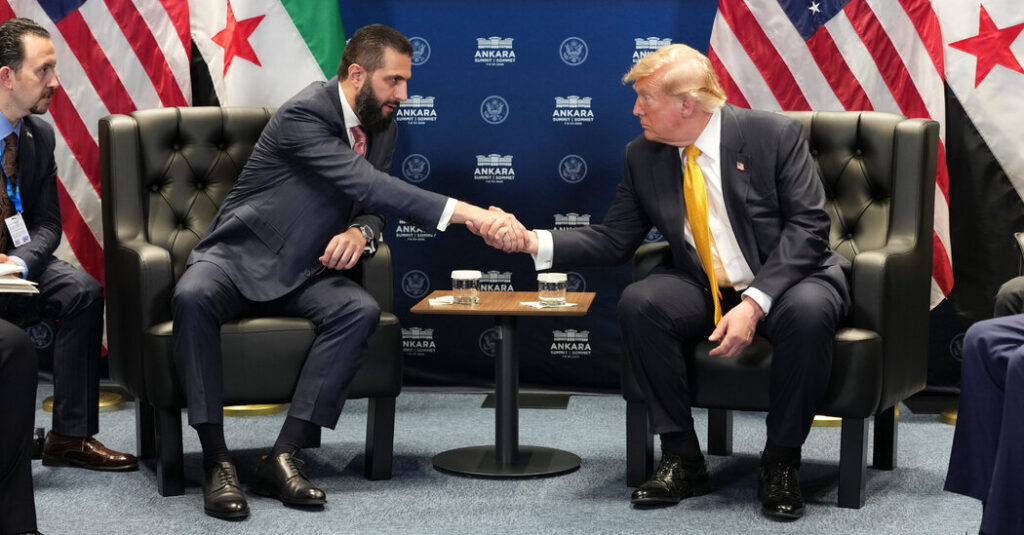
When President Ahmed al-Sharaa of Syria addressed the United Nations General Assembly last year, he was still in the throes of transforming his image from a rebel leader who once had ties to Al Qaeda into a head of state ushering in a new era in a country ruled for decades by dictatorship.
He returns to New York this year in a much stronger diplomatic position, and is scheduled to be the first speaker before the Assembly on Wednesday morning. Mr. al-Sharaa has secured significant sanctions relief, extended his government’s authority across most of Syria and gained international acceptance among a broad spectrum of foreign leaders, including President Trump.
Now, Mr. al-Sharaa now faces a more difficult test: turning those diplomatic ties into tangible gains for Syrians as mounting economic and security challenges threaten to undermine the country’s transition.
Syria’s economy remains in crisis and the flood of foreign investment his government hoped would quickly follow sanctions relief has not yet materialized. The World Food Program estimates that the monthly cost of essential needs for a family of five — including food, utilities and basic services — rose by almost 33 percent between June 2025 and June 2026.
The rising cost of living has deepened public frustration with Mr. al-Sharaa’s government. Last week, government increases in fuel prices triggered the country’s most widespread protests since Mr. al-Sharaa took power nearly two years ago, forcing his government to partially reverse the increases.
Mr. al-Sharaa is also struggling to restore Syria’s sovereignty in the face of Israel’s increasingly entrenched military presence in the south. Earlier this month, a U.N. commission investigating Syria reported that Israeli military operations in southern Syria had deepened, with repeated incursions, patrols, raids and searches disrupting civilian life. It warned that some Israeli actions, including the detention of Syrian civilians, could amount to war crimes.
Israel’s presence in southern Syria reflects its broader shift in defense strategy toward establishing military buffer zones beyond along its borders, including in southern Lebanon and Gaza. But its military activity in Syria is also bound up in a growing rivalry with Turkey, one of Mr. al-Sharaa’s closest allies and a longtime supporter of the rebel movement he once led.
Relations between Turkey and Israel have deteriorated sharply since the war in Gaza began in 2023. Turkey’s deepening military ties with Damascus have heightened Israeli concerns about the prospect of Turkish forces and equipment operating in Syria. Israel has struck Syrian military facilities that Turkey had assessed for possible use, underscoring the potential for Syria to become a flashpoint between the two regional powers.
Mr. al-Sharaa’s government has broken with its predecessors to express an openness to engage with Israel and has taken part in U.S.-mediated talks with Israeli officials in the hopes of easing tension. But that diplomacy has not yielded a security agreement or an Israeli withdrawal from southern Syria. And at a U.N. Security Council meeting last week, Syria’s permanent representative to the U.N., Ibrahim Olabi, also accused Israel of responding to Syria’s efforts at diplomatic engagement with “airstrikes, incursions and violations.”
“Israel penetrated our villages, displaced our people, bombed our facilities while we chose to spare the region further suffering,” Mr. Olabi said.
The post Syria’s Leader, Though Strengthened, Faces Tests as He Addresses U.N. appeared first on New York Times.