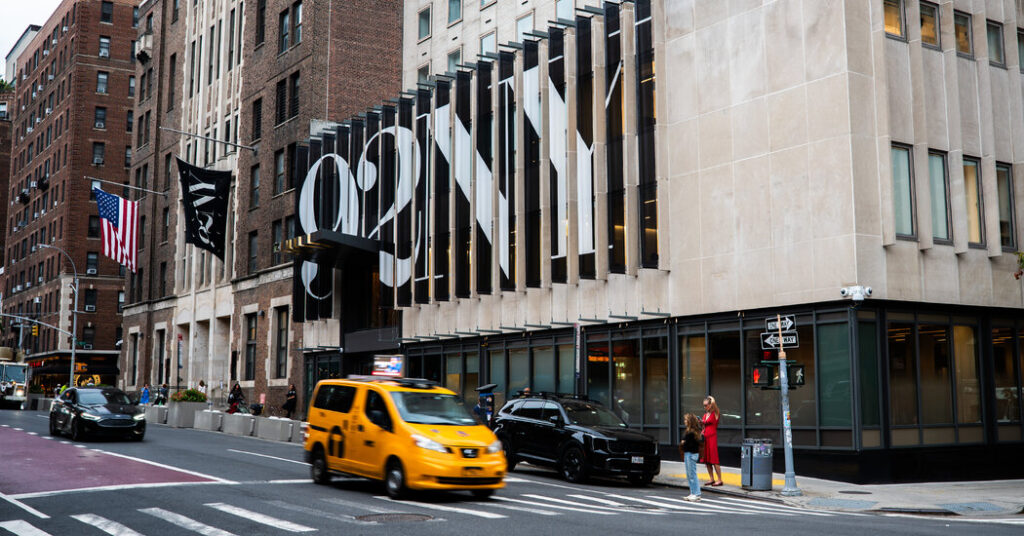
On the Upper East Side of Manhattan, 92NY is an institution that wears many hats.
A temple of high culture, it has hosted literary powerhouses like Maya Angelou and T.S. Eliot, musicians like Yo-Yo Ma and John Coltrane and choreographers like Alvin Ailey.
92NY, long known as the 92nd Street Y, is also a bread-and-butter community center with a nursery school, a senior center, painting classes and nearly 250 beds where students and young people are welcome to stay.
And it is a Jewish cultural institution, with Hebrew classes and services for the High Holy Days.
But for many years, that collection of missions and identities has existed in a somewhat awkward space, in two mismatched, mazelike buildings at 92nd Street and Lexington Avenue. The buildings were completed decades apart — the north building in 1929 and the south in 1968 — and then poorly connected with oddly placed hallways and inaccessible staircases. Seth Pinsky, the chief executive of 92NY, said that for reasons no one had ever been able to explain to him, the floors of the buildings did not line up, even though the structures were built to be one campus.
“What I always said about the 92nd Street Y was that we were a microcosm of New York,” Mr. Pinsky said. “Amazing things happened here, and we made it as difficult as possible for people to access them.”
A $250 million renovation, now complete in most of 92NY’s public spaces, is trying to fix that. The project, which began in 2020, has connected the buildings more smoothly and designed spaces to flexibly serve as many purposes as possible — because in New York City, every square inch of space is needed, ideally for many uses at once.
“It’s especially important at a moment like this, when people are increasingly not coming together in person,” Mr. Pinsky said, “to create a space that makes it comfortable for people to come together in person, and to do lots and lots of different things.”
In an event space on the second floor, a large stage can now fold into the wall like a Murphy bed. Rows of seating retract into what is essentially a giant cupboard, leaving the room open for a banquet or a cocktail party. A sprung floor with give and bounce was installed so dance performances and classes can also take place there.
In a room in the older building, there is now an ark inscribed with golden Hebrew lettering, where Torah scrolls can be kept during Jewish services. Most of the time, the ark is enclosed behind patterned wood paneling. That room also hosts after-school activities and exercise classes for people with Parkinson’s disease.
Before the renovation, there were lobbies in both buildings, which Mr. Pinsky said was “part of the problem.” Now, there is a single entrance through the south building, where visitors walk under brightly colored artwork that says “everybody” in both English and Hebrew.
Nearby, the original 1920s lobby is lined with artifacts from the building’s artistic history, including a flier for a Dizzy Gillespie concert and a “Dances & Mimes” flier from 1949 advertising works by Jerome Robbins and José Limón.
Before the renovation, much of the campus was made up of white-walled hallways and closed doors, said Elizabeth Leber, the managing partner at Beyer Blinder Belle Architects & Planners, who oversaw the project. That made it difficult for visitors to figure out where they were when they got off the elevator. The architects tried to open up spaces and make them feel more distinct, while also giving the campus some visual coherence.
“There was no aesthetic clarity,” Ms. Leber said, “and I can say that with love.”
Old buildings have a tendency to assert themselves, however, and some of the renovation had to be planned around fixtures that could not be moved. Ms. Leber said everything on one floor had to be designed around a hulking gas-powered kiln. (The head of the ceramics program uses the kiln to make a turducken every year for Mardi Gras.)
The renovation also included installing safety features like bollards on the sidewalk and ballistic glass on the ground floor exterior windows. Safety was an important concern, Mr. Pinsky said, but the leaders of 92NY didn’t want the campus to look like a fortress or a prison.
The buildings stayed open throughout construction and about half of the square footage has now been renovated. Mr. Pinsky said 92NY had spent $118 million so far, and will now raise money for the final phase of renovation, which will include the residences, parts of the nursery school and the gym.
“It is up there with the Met and the MoMA and a very, very small number of other institutions as one of the defining cultural institutions of New York,” Malcolm Gladwell, a journalist and author, said of 92NY.
It is also a place, he said, where he has sent his children to a “KPop Demon Hunters”-themed camp. “I don’t know if there’s any equivalent institution in the United States that does so many things for so many people.”
92NY acquired its many hats over the course of a 150-year history. It was founded in 1874 as the Young Men’s Hebrew Association, a place for Eastern European Jewish men arriving in New York to “improve their social, moral and mental condition,” according to early documents. It offered lectures on topics like Ancient Egypt and Shakespeare. The author and poet Emma Lazarus taught English language classes there to immigrants — her sonnet “The New Colossus” is inscribed on a bronze plaque inside the Statue of Liberty. (“Give me your tired, your poor, your huddled masses yearning to breathe free…”)
After bouncing around a few locations, the 92NY moved in 1900 to the Upper East Side, where it became an artistic powerhouse. In the 1930s, it opened a dance center that the choreographer Agnes de Mille once described as “the veritable cradle of the modern-dance movement.”
A few years later, the institution began a poetry series with William Carlos Williams as its first guest. It has since hosted countless luminaries, including W.H. Auden, James Baldwin, Langston Hughes, Tom Stoppard, John Updike and Arthur Miller.
On a warm morning last week, a group of preschoolers at the nursery school trotted through the newly renovated lobby while a woman with a cane and a cup of coffee walked gingerly toward the senior center. Upstairs, a group of women hunched over workbenches to make jewelry out of materials like pewter, silver and beads; a woman with a towel headed to the gym.
Mr. Pinsky described the original building as an “amazing jigsaw puzzle” perfectly designed to fit the institution’s programming when it was completed in 1929. Then almost immediately, he said, the institution’s programming changed and the building didn’t quite work anymore. He hopes the facilities will now be more dynamic for whatever the future holds.
“Our feeling here is that we know our programming is going to continue to change,” Mr. Pinsky said. “And we want to make sure the building can adapt.”
The post 92NY’s $250 Million Renovation Transforms an ‘Amazing Jigsaw Puzzle’ appeared first on New York Times.