In 1970, my father, a shaggy 25-year-old from the Chicago suburbs finishing his Ph.D. in anthropology, traveled with my mother to the Gunayala region of northeast Panama to ask its inhabitants, the Guna people, for permission to study them. The Guna lived on an archipelago of sandy, palm-covered islets along the Caribbean coast and had a reputation as prickly and disagreeable.
My parents went from village to village as my father, James, introduced himself in Spanish. He was not the first anthropologist the group had seen. The Guna had a long history of interacting with wagas, as they called non-Guna. Wagas tended to be struck by Guna independence. According to a U.S. government report in 1964, the Guna’s “chief characteristic has been and continues to be a persistent determination to preserve their cultural and racial structure against pressures from the outside.” That had been evident when, just a few years before my father arrived, an American businessman named W.D. Barton built a resort on one of Gunayala’s more than 350 uninhabited islands. The Guna burned it down. And when Barton tried to rebuild it, they burned it down again.
My father spent much of the 1970s regularly traveling to live with the Guna, joined for several months at a time by my mother, June, and then by me. Digandiggi, our home, was a village of 200 thatched-roof homes built on a coral reef, half a mile from the mainland jungle and the hulking silhouette of the Serranía de San Blas, a mountain range that is an extension of the Continental Divide.
When I think of Digandiggi, I hear the thud of breakers and smell the burning of coconut husks in cooking fires. Our dirt-floored home, which we shared with a village chief, had a roof of palm fronds that crackled and popped in the afternoon heat. There was a fist-size hole in the corner leading to the lair of some nocturnal creature; afraid of snakes, I dared not ask what it might be. We had no privacy. The neighbors, whose roof almost touched ours, could hear every whisper through the cane walls. The only place on the entire island where I could find solitude was the communal outhouse, which stood over shallow water at the end of a narrow plank. I would hide there for hours, studying the mountains as clouds tumbled over the peaks.
Guna villages, hives of activity with dizzyingly high population density, tended to overheat my social circuits. But my father could be out all day and night making house calls, having his ear bent, hearing stories he’d already heard dozens of times. There was chemistry between him and the Guna. They liked to tell him their stories, especially the old shamans, who were running out of apprentices.
And my father liked to listen. Within a year, to the Guna’s astonishment, he became fluent in their language and a natural with their customs. “If you want to work with the Guna,” Dad says, “you have to spend a lot of time traveling around and explaining yourself.” This involved what I regard as heroic self-discipline, for as with human beings everywhere, the Guna currency of trust is food: If they offer it, you better eat it. And the Guna staple, proffered upon arrival in every household, is dulemasi (literally “people food”), a thin gray soup larded with plantains, fish and sometimes river snails. Thanks to dulemasi, I decided early on not to become an anthropologist. My father, as far as I can tell, doesn’t particularly enjoy the dish, either, but he won’t say. To insult it, even in private, would be to insult the Guna.
There were other reasons the Guna liked my father. He was an ally, not only agreeable but also loyal, returning decade after decade. He belonged to a wave of American anthropologists who, in the wake of the 1960s, saw themselves as not simply studying their subjects but standing with them against imperialism and colonialism. They were not simply detached observers; they were advocates and intermediaries, atoning for their predecessors’ misdeeds, if not their countries’.
My father, arriving in Gunayala on the cusp of this change, intended to study kinship, a staple of old-school anthropology. But he soon switched to the study of Guna exorcisms and puberty rituals, as well as their town-hall-style democracy. Above all, my father wanted to understand — and bolster, to whatever extent possible — the aspect of the Guna that has long fascinated outsiders: their resistance to external pressure.
Over the last 500-some years, the Guna have proved uniquely successful at keeping intruders at bay, at times through violence. Since fighting a brief war of independence in 1925, the Guna have enjoyed virtual autonomy, even after pledging nominal allegiance to the Republic of Panama. But Panama’s government has never stopped pressing for access to Guna land. Gunayala contains what may be the most pristine jungle in all of Latin America, and it includes hundreds of uninhabited islands that have been likened to remote parts of the Bahamas before tourism. Most valuable of all, perhaps, it controls land near the Panama-Colombia border, which includes vital access to a potential transit route for migration and commerce of all kinds.
That route goes through the Panama-Colombia border, which is also the border between North and South America — the only continents on Earth connected by land but not a single road. The frontier between the two countries is considered impassable because of the Darién Gap, a notorious wilderness spread across much of the boundary. The gap presents many natural obstacles to development, including the wettest rainforest on Earth, as well as man-made ones, since Panama, Colombia and the United States have historically preferred the way it can deter the spread of disease and unchecked migration.
Not everyone would like the border to remain closed, however, especially people who could benefit from pipelines or electrical wires. And on the edge of the gap sits Gunayala — a sliver of land with one of the few viable transit routes. In 2007, a Panamanian-Colombian commission approached the Guna with a proposal to build high-voltage transmission lines connecting the two countries’ power grids. While the lines themselves would snake underwater off the Caribbean coast, the project would require building a giant penetration road with dozens of bridges to haul in construction equipment straight through Gunayala — a disruption of unprecedented magnitude. The resulting linkage, known as the Interconexión, could integrate countries as distant as Guatemala and Ecuador. It could also bring the world crashing into Gunayala.
The Guna can block the Interconexión — and they have, multiple times, going back more than a decade. The Guna are known as savvy political operators, and I assumed they would slow-walk the project to death. Which is why I was shocked to hear last year that the Guna were giving it real consideration. In fact, members of the community were already building a road themselves — hacking their way through the jungle with machetes, creating a corridor that they hoped the Interconexión would facilitate.
I asked my father what he thought of the proposed project. He said it was hard to predict what effect a highway would have, but he imagined that it would accelerate changes that the Guna have long worried about, like out-migration and deforestation. It was clear, though, that if the Guna wanted the Interconexión, he would support them.
Like a good academic, my father found ways to undermine anything that seemed like moral certainty. Deep down, what both he and the Guna felt was still hard to know. “Don’t treat the Guna monolithically,” he warned.
“So are you in favor of the Interconexión or not?” I asked.
“I don’t know,” he replied. “What do the Guna want?”
“Didn’t you say not to treat them monolithically?”
I kept wondering whether it was possible the tribe had been duped, or that only a faction truly supported the Interconexión and its supposed benefits. In the end, wouldn’t it undo everything they had fought for? It was hard to say. Roads are, after all, one of the most uncontrollable forms of technology humans have ever invented. In a sense, they are autonomous machines, with appetites and minds of their own. They colonize and spread despite efforts at containment, all but impossible to unbuild. And roads want to connect with other roads. The nearest ones to the path of the Interconexión do not lie in Panama but in Colombia, on the other side of the Darién Gap. All you need to do is look at Google Earth to see the lines of orange dirt tracing the edges of rivers and cattle fields. The roads are already there, waiting to connect.
Last February I flew to Panama City and met up with Federico Rios, a frequent photographer for The Times. It was near the end of the dry season, the optimal time for a hike through the jungle. A few days after we arrived at our hotel, my father’s former research assistant helped arrange a meeting with proponents of the Interconexión, or el megaproyecto, as many Guna have begun to call it. The next morning, he picked us up and drove us to a low concrete building in the congested center of the city. I had expected to meet with just a few people; instead I walked into a windowless room with more than a dozen men sitting in a circle. It was an ambush, but a friendly one.
The men belonged to a commission appointed by the Gunayala General Congress, the supreme political authority. They had heard that I was in Panama to write about the Interconexión, to visit the communities that would be transformed by it and to understand why many Guna had embraced the project. They had decided not to wait for me to seek them out.
One of the commission members, a high school teacher and historian named Simón Herrera, shook my hand.
“Welcome,” Herrera said in English, smiling. Like many Guna, he had attended college, including a semester at Tulane. He was married to a non-Guna and lived in Panama City. He invited the other men to introduce themselves while a technician with a camera started filming — within hours, pictures of the gathering would be all over tribal social media. It was all very Guna, from the boldness with which they seized the narrative to the insistence on having a meeting, face to face, and talking things through.
The men in the room were hardly naïve — the Guna had dealt with a road before. While for decades their communities had played host to occasional cruise ships, whose economic impact never spread beyond a few islands, things changed in the 1970s when an offshoot of the Pan-American Highway penetrated the edge of their reserve for the first time, connecting it with Panama City. The zigzagging 19-mile dirt road was all but undrivable; in my 20s, I walked it with several young Guna, a two-day journey that brought me to my knees. In 2011, it was finally paved, and while it remains a light-duty, low-volume road, Gunayala was forever changed. Backpacking gringos and road-tripping Panamanians surged over the Continental Divide, transforming some islands into party spots with pounding reggaeton and bikini-clad influencers posing on white-sand beaches.
Still, the Pan-American Highway’s puncturing of their sanctuary did not modernize the Guna into oblivion. Most of the men in the room were from Sasardi Muladub (population roughly 2,000), a farming and fishing community near the Colombian border. For decades, Mulatupu, as it’s known, had the advantage of a rudimentary airstrip connecting it to Panama City — which enabled residents to travel outside the region for medical treatment, attend university or export products, such as spiny lobster and octopus. However, the planes had stopped coming in recent years, in part thanks to the pandemic. Many Guna had to return to traveling by sea, and accidents were common; emergency services often struggled to reach the boats.
Other communities are even less connected. Urbano González, a school principal sitting in the room, started telling me about Mordí, one of the most isolated villages in Panama. In the 2000s, Mordí residents would hike through the jungle for days to reach Mulatupu, where some would drop off their children at the school and others would exchange smoked iguana and peccary for sacks of rice and sugar.
At the time, Gunayala was changing fast: An enormous number of Guna had left the villages for work and educational opportunities in Panama City, while Gunayala still lacked pharmacies, banks and reliable electricity. Moved by the efforts of the Mordí residents, González urged Mulatupu’s leaders to build a road connecting the communities, through a mountainous wilderness often described as impenetrable. “It seemed like a crazy dream,” González told me. Work crews began building a road from Mulatupu to Mordí with machetes — chain saws are hard to come by in Gunayala — in 2013. The road inched forward year by year, attracting increasing numbers of volunteers, who posted videos of their progress on Facebook as they bore into the jungle. Other villages that had lost air service took notice and began building their own roads.
Yet the men in the room were visibly frustrated. They say they have requested Panama’s support for a modern two-lane highway, estimated to cost more than $100 million, that they would design themselves; without it, their machete work is likely to take another 20 to 30 years. Panama has said it supports the Guna’s road — the country’s energy secretary, Rodrigo Rodríguez, said the 2027 budget includes the funding for it — but has long tried to embed it within ongoing negotiations for the Interconexión. In a statement, a spokesman with Panama’s energy ministry said, “The state sees in this project the opportunity to settle a historic debt with communities that have lived disconnected from development.” And while some Guna denounce the Interconexión as an unacceptable threat to sovereignty, others, especially those in the more isolated communities, welcome the promised improvements. Nothing, meanwhile, has stopped Mulatupu from building its own path.
“This team will move forward, with or without anyone’s support,” said an albino man in dark sunglasses who had been staring at me intently. His name was Rodelick Valdes Richards, the author of multiple articles in the Panamanian press about the Interconexión. Richards was blunter than the other men. “We are looking for financing,” he said, and it didn’t matter where it came from or even whether it was approved by Guna authorities. “We have a commitment to future generations.”
By the end of the meeting, the men in the room had taken control of our trip, planning out a route that would take us from Mulatupu to Mordí — along the route the Guna are carving and that the government could finish and pave. A team of guides had been put together. Permissions were being secured. Things had come together faster than expected, and the next day our trip would begin.
In the morning, Federico and I boarded a 27-year-old Cessna, a six-seater with a single propeller, duct-taped vents and a part-time pilot wearing flip-flops. Next to me sat an ancient Guna woman who still wore, as every Guna woman used to, tight, colorful bindings on her limbs and a thick gold nose ring. Beneath a veil, she talked on a cellphone the entire flight. Her husband, who was frail and had come to Panama City for chemotherapy, asked why we were going to Gunayala. “To hike over the Continental Divide,” we told him. “Oh, you’re taking the path they’ve been clearing,” he said. “I heard about that.”
The flight looks easy on a map: Planes take off from Panama City’s municipal airport, make a U-turn over the Pacific and head back across the isthmus toward Gunayala. Near the Caribbean, they encounter the Serranía de San Blas, paralleling the shore and attracting a perpetual front of thick gray clouds. The serranía is the Guna’s Great Wall, steep and jungle-covered, and there is no way around it.
Bush pilots are often a swashbuckling breed. Yet as a boy, I would always notice that some seemed unnerved by the flight to Gunayala. The planes were as cramped as taxis, filled with as much cargo as they could squeeze in, including live iguanas and roosters, which Guna passengers would carry in their laps. Doors were lashed shut with bungee cords. Windows were cracked.
Once the plane was above the serranía, the cabin would fall silent. I caught glimpses of hidden valleys and uncoiling streams — until we hit the clouds and everything disappeared. Planes crashed frequently on the way. Some airstrips had wreckage pushed to the side. On bumpier flights, some Guna passengers would remove their shoes, preparing to swim ashore. I would press my forehead against the window and scan below. When the earth finally reappeared, there would be nothing but green in every direction, almost as disorienting as the inside of a cloud. Even after I got used to the trip, I would find myself wondering if the pilot had gotten lost.
Eventually the plane would touch down on a gravel runway, and we would voyage between islands in a dugout canoe — the taste of salt in my mouth and my father’s long arms wrapped around me as the boat navigated swells the height of our house back in Boston. By the time we arrived on Tikantiki, where my father did fieldwork, it would feel as if we had entered a lost world. I would be shocked when I got older to realize how short the distance we had traveled actually was: about 75 miles.
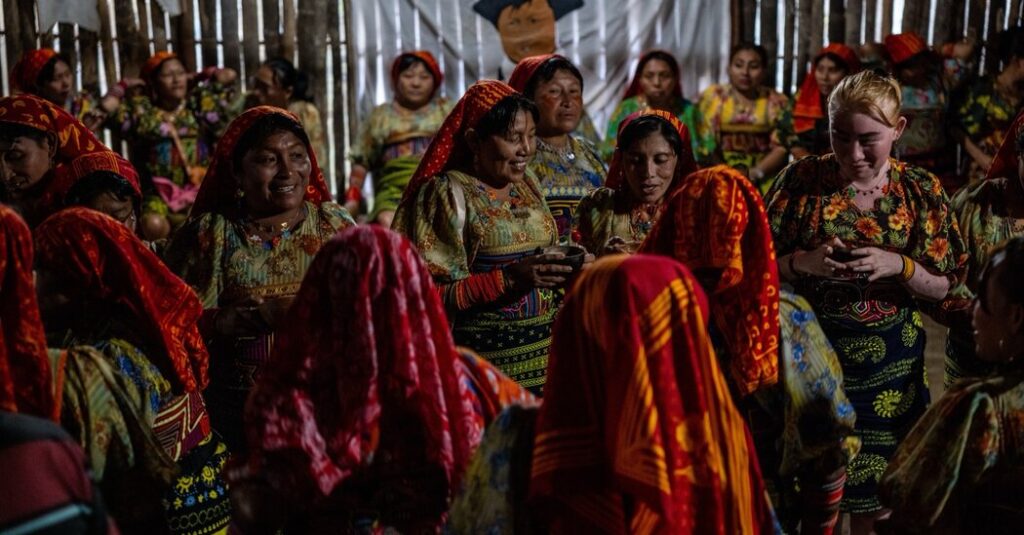
Federico and I arrived successfully on the island on a drizzly morning. As it turned out, we had come on a big day: The village was celebrating a chicha, a female puberty ceremony, and scores of canoes from neighboring villages were pulling up to shore. Chichas are major events that require weeks of preparation and can last for days. Drinking is central: While the Guna are generally abstemious, chichas, at least the way I remembered them, were Bacchanalian eruptions of disorder. (Celebrants consume inna, a sugarcane-based beverage fermented in clay pots.) There would be chanting, wailing and utterances of dangerous, forbidden words. Shamans would flirt with malevolent spirits, provoking them; the danger the Guna felt was no joke.
I assured Federico that none of this would be visible to us. “You won’t be able to photograph anything,” I told him. If my father, the world’s leading non-Guna expert on chichas, took decades to get permission from the Guna to publish his research, I said, we shouldn’t hold our breath. Federico looked crushed.
Just then a man named Emigdio Robinson, who seemed to have been appointed our chaperone, knocked on the door of the house we were staying in.
“Good afternoon,” he said. “The chicha is starting soon. Do you want to come?”
I declined at first, but eventually I joined Federico in the smoke-filled chicha house, where he was dancing and being asked to pose for selfies. The chicha was as I remembered, loud and convivial, but it was hard not to notice that phones had invaded yet another sacred space. I had always thought of the Guna as a force that could push back against such transformations — though maybe I was naïve. Either way, things had changed more than I expected.
Early the next morning, our guides wanted to show us something before we started tunneling into the jungle. Robinson picked us up in a launch, and we sped down the coast toward Colombia, pounding through the heavy surf.
Our destination was Puerto Suggunyaa Inabiginya, a stunningly perfect bay tucked between a jungle-covered promontory and a low point on the Continental Divide. Puerto Suggunyaa Inabiginya used to be called Puerto Escocés, or Scottish Harbor, after one of the most spectacular disasters in the history of colonialism. Here in 1698, the Kingdom of Scotland attempted to found its first outpost abroad. Thousands of well-armed colonists sailed to Puerto Escocés, which was to be the Door to the Seas, a hub of global commerce. But there was a reason it hadn’t already been colonized.
“’Tis a very wet country,” wrote Lionel Wafer, an English pirate who spent four months stranded with the Guna only years before the Scots and published an account of the experience. The rain continued for weeks, Wafer said, and the prevailing winds blew directly into Puerto Escoces, preventing ships from exiting for weeks at a time. Furthermore, the seemingly low nearby mountains concealed taller ones further in. The Scottish colonists faced the same troubles, and within two years, more than half of them would be dead, killed by fever and starvation. The calamity, which had been financed by private investors, helped cause an economic crash and forced Scotland to join the United Kingdom.
The Guna avoided the area for centuries afterward, believing it cursed. (There was also said to be a resident population of aggressive lizards.) In 1914, however, on the orders of Inabaginya, one of the great Guna chiefs, the place underwent a grueling exorcism — an entire month of chanting. When it was done, the area hadn’t just been purged. It had been reclaimed. In the early 2000s, when the Scots returned — this time a group of explorers including no less than Sean Connery himself — to excavate the colony’s graveyard, the Guna staved them off by demanding money for a research permit.
Yet the Guna never quite succeeded in inhabiting the place, either. As we walked the peninsula, the men seemed wary and subdued. We encountered an abandoned Guna village, where we found a single cheerful resident swinging in a hammock. His name was Edgardo Linares, and he was on vacation from teaching high school in Panama City. “Why am I here?” he said, offering us shelter under his lean-to as a squall passed. His backyard was a shallow swamp crawling with iguanas the length of my arm. “It’s paradise.”
“Could you see a hotel here?” one of the men suddenly asked, catching me off guard. A hotel? The other men stopped talking and waited for my response. I looked around, trying to see what they saw. Was this not a sacred site? It seemed like the symbol of everything the Guna had spent centuries fighting for. It was a graveyard of foreign interlopers, and a warning to keep out. Spooky as it was, I wouldn’t have touched it for the world. The men were open to development, however — as long as the Guna controlled it.
The next morning, we began our trek to Mordí. I had some idea of the route, having attempted it once back in 1998 with my father and brother. We had no smartphones then, of course, and no GPS or map. We just filled some backpacks with food, hired a young guide from Mulatupu and started hiking where people said there was a path. Throughout my childhood, when my father would fly down to Panama on his own, he would disappear into the jungle, sometimes for weeks. On that particular trip, however, unnerved by the increasingly challenging terrain and a path that seemed more rumor than reality, we gave up after the first day.
I assumed that our companions would know what lay ahead, but even they were at a loss. Historically for the Guna, the deep forest is a place inhabited by dangerous spirits, and one that many are still happy to avoid. Most interact with the jungle only along the shore, where it has been tamed by centuries of agriculture. As a boy, I loved walking barefoot through coconut groves and bathing in the slow, shallow rivers flowing from the Continental Divide, but I would turn back at the edge of the deep forest. No one seemed to know the uplands except hunters and neles, or seers, and by the time our family arrived in Gunayala, both were in decline.
The organizers of our trek had found a guide for us who was not afraid. His name was Jerónimo Dequía, a 46-year-old farmer and fisherman from Mulatupu. Unusual for the Guna, Dequía was of mixed background — his father was Emberá, Panama’s other major Indigenous group, enemies of the Guna in generations past and forest people through and through. The other three Guna assigned to us — two porters and a cook — seemed to regard him as a bit of a freak. “My friend Dequía is like an ant when he gets in the forest,” said the cook, 29-year-old Eudelio Chiari. “If you aren’t in shape, he will leave you behind. And I don’t know what’s wrong with his stomach, but he never gets hungry.” In reality, all four were absurdly fast hikers, but Dequía was in a class of his own. Even when the jungle thickened and the terrain got gnarly, his momentum never seemed to break, as if he was always moving downhill.
After a brief boat ride through mangroves, we began our trudge up the Continental Divide. Almost immediately we came across a clearing, which I did not recognize although I had seen it several times on Facebook. It was the road to Mordí, the one the men had been cutting by hand for 13 years. In person it was far more impressive. The right of way was clean, wide and contoured to the terrain. It already looked drivable. Federico released a drone and we looked down at our position; this had the opposite effect — from the air, the road was barely visible. The jungle was already closing in.
As Federico operated the drone, I swatted mosquitoes swarming his neck. “Let’s go,” Dequía said. “There will be less insects the higher we get.”
Nominally it was the dry season. Though for the previous 36 hours it had rained as hard as it ever does in Panama. (’Tis a very wet country, I thought.) I was soon drenched in perspiration and struggled to keep my glasses from sliding down my nose. Eventually I gave up and stuffed them in my chest pocket, which meant that combined with the dimmer surroundings, I was becoming blind.
Seeing me hesitate, Chiari smiled, but his concern was evident.
“It’s a very big adventure,” he said.
“When was the last time you were here?” I asked.
“Never,” he replied.
The jungle got quiet, and the odor of peccaries became strong. A troop of howler monkeys seemed to stalk us, hooting from across a ravine. Some of the guides besides Dequía carried machetes, but we had no guns. Chiari’s bag was filled with rice and cans of off-brand Spam, which he would chop open with a machete and serve with potato chips wilting in the humidity. He and the other men were sure-footed in their rubber boots, but I stumbled in the middle of rivers, slipped on rocks and skidded down hills — a terrific way to end up with a handful of poisonous spines. “Use your heels to slow yourself,” Chiari advised me. At one point when Arcelio González, our quiet guide in his 40s, saw me coming and put up his hand to halt, I continued sliding and ended up stepping in what he wanted to show me: a shiny, greenish-brown jaguar turd.
The area we were passing through is considered sacred; it was likely one of the routes by which the Golden People, as the Guna call themselves, made their flight from danger during the colonial era, when they were spread out across eastern Panama and Colombia. Today, in addition to being firmly controlled by Indigenous peoples, the area remains almost completely undeveloped — an ecological time capsule.
Panama has the money and resources to keep it intact, but what might not be manageable are the side effects of increased traffic and development created by the Interconexión, as well as other projects that experts are sure will come in its wake. “We are beginning to see the end of the Darién Gap,” says Indra Candanedo, director of Alianza por Matusagaratí, a conservation group. For decades, the separation of North and South America was maintained through the collective will of Panama, Colombia and, above all, the United States, which underwrote border-control programs and essentially suppressed development. That will has eroded, Candanedo says. “You have bridges going up all over eastern Panama,” she says; some are funded by local governments or private companies, with little oversight. Locals feel the authorities have turned a blind eye.
“You’re not going to see the gap opened because of an official decision to build a highway from Panama to Colombia,” Candanedo says. “It will just happen, because nobody stopped it. I’m not sure you can stop it anymore.” Without intervention, the organic erosion of the north-south divide — by loggers, speculators and other local interests — was just a matter of time. Already the forests of eastern Panama have been pushed back to fragile protected zones and mountains like the Continental Divide. In Gunayala, mountains I used to stare at as a child may now be among the oldest jungles in Latin America.
Later, I also spoke with Catherine Potvin, a professor of biology at McGill University and an expert on old forest. “We are talking about a forest with no comparison,” she said. Potvin has collected data on trees in eastern Panama that “I haven’t dared publish,” she said. Her models tell her they are between 500 and 1,400 years old, which would match the oldest trees in the region. The greatest concentration of such trees outside the Amazon exists in Gunayala and Darién, she believes.
Like my father, Potvin is insistent on deference to the Guna with respect to the Interconexión. “It’s their land,” she says. “And we white people are in no position to make comments about how to care about the environment.” If the project presents stewardship challenges, “the Guna are strong,” she says. “They can certainly control what comes with the road.”
But what if they couldn’t? I wanted to be convinced — not about the Guna right to self-determination, but that anyone, faced with the temptation of roads, could think clearly about the destruction they bring. I once interviewed a Panamanian engineer who helped design the route of Pan-American Highway, the segment built in the 1970s at a time when there were no roads in eastern Panama, just jungle. He burst into tears recalling the damage that could have been avoided. “It’s been a disaster,” he said. Within years, the planners knew they had inadvertently maximized the ecological catastrophe they had unleashed, but it was too late.
The engineer, who had been a famous jungle explorer in his youth, lived in retirement in the hills outside Panama City, where I interviewed him. In the valley below us you could almost see what the highway had done: at first, devastation, empty fields and the perpetual haze of brush fires. To be sure, it hadn’t taken long for the hardscrabble frontier settlements that sprouted early to become flourishing communities. To see them would have been a short drive, but the engineer never had. He couldn’t face seeing what had been lost.
When our group finally pulled into Mordí, the sun had just set. No sooner had I congratulated myself for scaling the village’s towering muddy cliff than an uneasy feeling descended. As we walked down the community’s one crowded street, no one seemed to make eye contact. Stores declined our patronage. “This town is not like other Guna villages,” Federico whispered.
Even my father had never been to Mordí. Perched atop a steep mud bank overlooking a notoriously violent, flood-prone river, the community seems to have always had a reputation as a tough, ill-tempered place. No town had fought harder for survival — against the jungle, isolation and disease. Added to the list of antagonists in recent decades were timber companies. Unlike Guna villages along the coast, Mordí sold its precious supply of mahogany, cedar and almendro. But the contracts were seen as one-sided, exploiting the village’s vulnerability and fueling its anger at the external world. Visitors should not expect to be welcomed, we had been warned.
Guna irascibility seemed alive and well, and in some ways — as someone who wanted to see Guna culture continue to thrive in resistance to external pressure — I frankly found the cold shoulder a relief, even if it made us feel unwelcome. The men from Mulatupu who had cut their way to the outside world seemed wholly ready to integrate with it, but here the old wariness had not gone away. I wondered how it would serve the community in negotiations for the Interconexión.
Mordí is only accessible by water or on foot, via an unmapped ghost path. The first few miles are paved, but as soon as it reaches Guna territory it turns to mud, at which point even the most experienced backroads driver behind the wheel of the most rugged all-terrain vehicle must slow to a crawl. The condition of the road infuriates Mordí residents, who have long demanded improvements from the government. In frustration, they have turned to a timber baron known as El Chino, with whom they have a strained relationship.
El Chino, whose name is Guo Jian Zhang Zeng, began working with Mordí in 2006. His company, International Woodwork Corporation (I.W.C.), which exports wood paneling to China, works only with Indigenous communities, which control the last stands of valuable timber in Panama. This arrangement is encouraged by Panamanian law, which was rewritten in 1994 to give Indians control over their own land. Critics, however, say the reforms foster dependency between vulnerable communities like Mordí and logging companies, and Zeng’s logging concessions have been repeatedly cited for overcutting. Yet he continues to be the dominant timber baron in the region. Mordí residents say he tricked the community into a contrato leonino — a one-sided 25-year contract. (I.W.C. and Zeng did not respond to multiple requests for comment.)
“The Chino gains everything and has nothing to lose,” says Benjamin Goodman, a U.S.-based legal professional who grew up in Mordí with his Protestant missionary parents and today advises the village on legal issues. The contract gives Mordí residents few rights, including an inability to renegotiate prices for trees they fell.
Zeng, who is the sort of merchant the Guna have long avoided, has managed to maintain a relationship with Mordí by building roads and providing other services. When he first arrived seeking permission to cut down trees (according to Goodman, offering $20,000 in cash as an “advancement”), Mordí had no roads and had only recently been exposed to the outside world. It did not have the political protection of being part of Gunayala, which includes only Guna communities along the coast.
Zeng’s bulldozers had recently been to Mordí when Federico and I arrived. He had built the community a log bridge over the Río Chucunaque, which allowed traffic almost all the way to the village. (Of course, the farther Zhang’s roads go, the more timber can be extracted.) We stopped at the bridge, which sits a few miles downstream of Mordí, and watched as the Chucunaque oozed underneath, carrying debris and the occasional car-length crocodile. Three days later, we would learn, a powerful storm swept through, flooding the river and washing the bridge downstream.
From there we boarded an outboard canoe and journeyed back to Mordí, where we encountered the same coolness.
We were preparing to leave when a young man came up to me and introduced himself. His name was Mauselio Kastaña. He said he had heard that I was interviewing Mordí residents about the megaproyecto, and he wanted to explain his view. The people of Mordí have serious reservations about a road being built so close to their community, he said, partly because of the impact the noise could have on animals and sacred sites. But since they assumed that it would be the only benefit they would ever receive from Panama’s government, they were reluctantly in support of it.
“We are the most forgotten Indigenous people in this country,” he said. “We are vulnerable because the government does nothing for us. Of course, the government promises schools, roads and housing for the Interconexión. But once they have what they need — permission to move forward — they’ll forget about us.”
I asked him how the negotiations were going.
“A lot of pressure,” he said. “A lot of pressure.”
That afternoon in Mordí, Kastaña asked if he could tell me a Guna myth. Thousands of years ago, he said, seven brothers and a sister were born in a river. A pair of women, each part frog, approached them and announced, “We are your mothers.” The siblings believed them and allowed them to be raised by them, until one day they came to a clear, tranquil river and saw their reflections for the first time.
“They had been deceived,” Kastaña said. “In fact, the frog women were their enemies.” He continued: “When the government comes to us with sweet words, we compare it to our history. The governments have all been the same. Everything you see here, we did ourselves.”
In the founding myth of ethnographic fieldwork, set by Bronislaw Malinowski in 1922 in “Argonauts of the Western Pacific,” the anthropologist arrives on a tropical beach as the boat that brought him sails away, plunging him into native life. His job is to bring back reports on how different societies construct meaning, organize social life and define right and wrong, potentially undermining our own certainty in the order of the universe.
Today, anthropologists who spend their entire careers studying a single group of people are a vanishing breed, like the Indigenous groups they used to specialize in. Some anthropologists, criticizing the sort of ethnography my father’s generation did as continuing the discipline’s extractive, colonialist ways, use the label “salvage anthropology.”
I kept thinking about this as I struggled with my own wavering thoughts on the Interconexión. What the Guna face is an almost pure distillation of the old Conradian dilemma between progress and tradition. The Mulatupu-Mordí road is a noble undertaking, but it could come at a tragic cost. After our hike through its future path, I went back to my father. Did he believe that tourism would be the death of Guna independence? (“No.”) Did he trust the Guna’s political leadership? (“More than I trust ours.”) Did they have any idea what they were getting themselves into? (“Do any of us?”)
And what about Guna resistance to the outside world — the key to their identity? Had it finally been worn down? Here I realized that I understood the resolve of the Mulatupu commissioners. The Guna do not merely resist the world; they thrive in tension with it, and the way those men were trying to seize control of the project showed they were not letting down their guard.
Still, the Interconexión might be too much for anyone to control. And it’s moving ahead: Last month, the leadership of Wargandí, the inland Guna reserve that includes Mordí, took a significant step toward approval of the project — by voting to enter a critical consultation and consent phase with the government. A similar agreement will be presented in Gunayala in October. Panama, meanwhile, which has long promised to start construction in the fall, is continuing to push forward aggressively.
Critics of modern anthropology argue that interminable self-questioning has caused the field to lose its nerve, and to doubt its own ability to understand anything. At times, I wondered if my father had become resigned — whether he agreed too much with what the Guna wanted rather than worried about what might happen to them. But when, during our conversations for this article, I suggested that anthropology might have gone overboard with its endless discussions about representation, and lost its ability to actually study the world, he reacted harshly.
“You have made quite a few passing remarks which give the impression that you are depicting me as fundamentally different or even opposed to my discipline,” he emailed. “We are in a moment in which anthropology is under attack, just as it has been in the past, and mostly for political motives.” (He was referring to a controversial report on the humanities last spring called “The State of Scholarship,” commissioned by Vanderbilt and Washington universities, which singled out anthropology for “a widespread deterioration in scholarly standards grounded in a pervasive repudiation of ideals of objectivity.”) “I would not want to participate in an article in which I would be seen as opposed to anthropology or as apolitical,” he wrote.
In fact, I hadn’t wanted to portray my father as apolitical; on the contrary, I see him as someone who would do anything for the Guna. After being involved with them for 60 years, it was impossible to say what they meant to him. They were his life.
I wondered if it was possible to show loyalty to the Guna in a different way. I turned to my father’s former colleague Mac Chapin, who is a different kind of anthropologist. Chapin, who also started working with the Guna in the late 1960s, edited a compilation of Guna oral literature that is still widely read, especially by the Guna. But at heart he was an organizer and an activist, with a pugnacious, combative streak. At age 40, he quit the academy.
“I wanted to engage,” Chapin told me recently. “I wanted to get involved with the practical stuff.” His first engagement was with the offshoot of the Pan-American Highway, that early attempt to pierce Gunayala. When Chapin turned to advocacy, it was already facilitating an influx of colonos — slash-and-burn farmers from western Panama. The Guna had kept them at bay haphazardly, but mostly with mere threats.
According to Chapin, who would go on to a long career as an Indigenous land rights advocate, the Guna were different from other groups. Whenever they had an issue with wagas, “they would send delegations to the capital and have meetings with the president. No other Indian group in Panama could do that.”
But a road? That was a different kind of issue — an alien technology the Guna at first failed to recognize as the threat it was. “We felt you really have to pay attention to this thing,” Chapin says.
A group of younger Guna agreed, and in the late 1970s they started pressuring their leaders to fund an organized response. At the same time, Chapin lobbied the international conservation community, which responded with millions of dollars in aid. Soon they had funding to build an outpost built atop the Continental Divide, housing a team of border guards, topographers and biologists.
The most important part of the project was mapping: As it turned out, the Guna “didn’t really know where their borders were,” Chapin says. Thanks to the threat of the road, they became more vigilant. Community mapping initiatives have since spread to Indigenous communities around the world, with resounding success. But at the time they were new. For the first time in Latin America, an Indigenous group had marked off its own nature reserve.
Today the road that alarmed Chapin has become the catalyst that he feared, funneling tourism into Gunayala. But the adjacent adverse effects have been contained. The jungle lining the road is largely untouched, proving that at least some of a pioneer road’s environmental impact can be managed.
When it came to the Interconexión, Chapin had a strong opinion, but it wasn’t the one I expected. He was a pragmatist, and not an optimist, having first engaged with the Guna as a Peace Corps volunteer in the 1960s. He had witnessed the complete arc of environmental tragedy in eastern Panama, and he had a somewhat dark view — one that amounted to, If a road can be built, it will be. This made it paramount for the Guna to embrace the Interconexión and execute it on their terms. “The Guna have to do it,” Chapin said. “If they don’t, somebody else will.”
Ben Ryder Howe is a frequent contributor to The Times.
Federico Ríos is a regular contributor to The Times, known for documenting migration, armed conflict and the environment in Latin America. He is the author of photo books “VERDE,” “Darién” and “White Line.”
The post They Kept Outsiders Away for 500 Years. Their World Is About to Change. appeared first on New York Times.