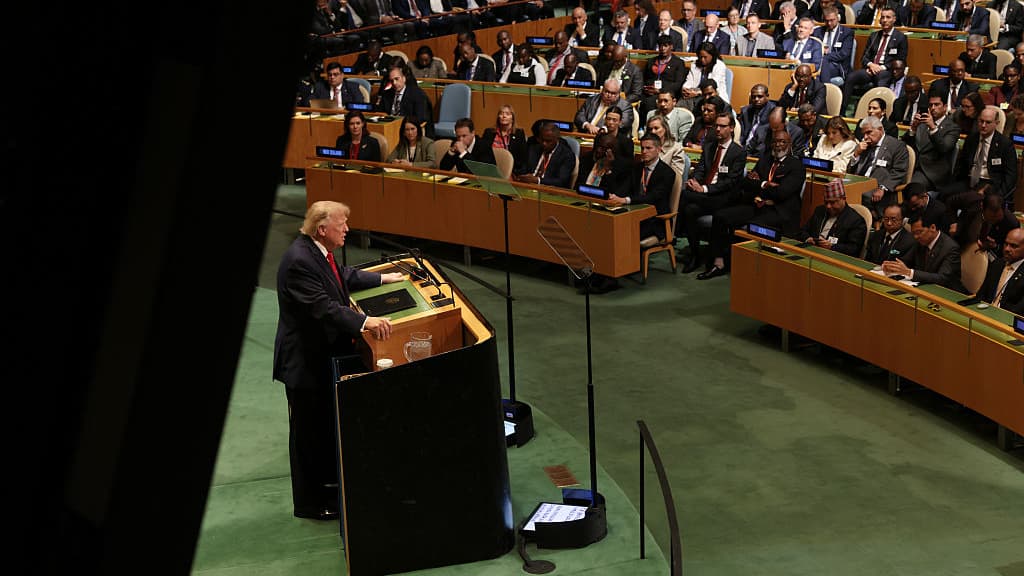
In his speech to the United Nations General Assembly on Tuesday, President Donald Trump spun a familiar web of rhetoric regarding U.S. foreign policy—one that highlights force as a method of achieving peace.
In a speech that moved from Iran to Venezuela, Cuba, and beyond, Trump presented something approaching a foreign-policy doctrine: American military might is not the alternative to diplomacy but the leverage that makes it possible.
Read More: Iran War Has Cost U.S. Nearly $40 Billion and Fueled Inflation, CBO Finds
David Satterfield, Director of Rice University’s Baker Institute for Public Policy, tells TIME that the speech Tuesday demonstrates a position held by the Trump Administration that “force is the only currency of value.”
“The strong do as they will and the weak suffer as they must,” he says, further characterizing the approach.
In Trump’s telling, strength is not merely a deterrent. It is something to be used—through military action and economic isolation—to force negotiations or impose an outcome.
How Trump defines ‘peace through strength’
Trump has repeatedly distilled his foreign policy strategy into three words: “peace through strength.” The examples he gave of this policy in action illustrate how he may see the U.S. functioning as a global enforcer going forward.
His definition of the phrase has previously been suggested by its use in Department of Defense ads and in his online endorsements of fellow Republicans. He recently credited this approach for the joint U.S.-Israel strikes that initiated the current conflict with Iran, posting to Truth Social in March: “PEACE THROUGH STRENGTH TO PUT IT MILDLY!!!”
Trump’s approach also encompasses economic coercion. In the case of Iran, he said the U.S. had initially offered economic cooperation, turned to military action when Tehran refused, and was now seeking its “complete economic isolation” to push it back toward negotiations.
Trump grouped Cuba among those affected by U.S. economic pressure campaigns on Tuesday. He described a government under mounting strain and predicted political change, declaring that Cuba was a “failed” nation but that “freedom will be coming.” Cuban delegates departed in protest.
Yet Trump presented such coercion as compatible with his role as a global peacemaker. He claimed credit for resolving eight wars since returning to office, although that claim has been widely disputed.
In tandem, these elements suggest that Trump sees taking action as a superior means of enacting change. He proposes the approaches as being almost diametrically opposed: While others only speak of making a difference, he acts.
“While others have spoken of peace, I have made peace. While others have ignored threats, I have confronted them,” Trump said in front of the General Assembly. “While others have talked of courage, America has shown it.”
Satterfield says that this speech is mostly “old wine rebottled” for Trump. But it clarified how the President is applying his longstanding ideas today: using military action and economic coercion not merely to deter adversaries, but to force negotiations and shape political outcomes.
Trump defends military force against Iran and drug cartels
While Trump sees Iran as an example of his “peace through strength” ethos, the conflict is ongoing, and it remains to be seen how it fits into the pattern that he is hoping to establish.
Addressing the topic seemed all but unavoidable heading into the General Assembly. In doing so, Trump said that he had a choice ahead of him: Move forward with a peace deal or “annihilate the Islamic Republic.”
The comments came amid stalled negotiations in the war that the U.S. and Israel launched in February.
“Will a deal be made with Iran that lets them rebuild and create a far greater country than it ever was before, maybe one of the greatest in the Middle East or even the world?” he asked. “Or do I annihilate the Islamic Republic, and do it quickly, never giving them a chance to kill and destroy people and countries again?”
Members of Iran’s delegation walked out during Trump’s remarks, an immediate demonstration of the gulf between his coercive message and the adversary that he may hope to persuade by it.
In his speech, he also issued threats against cartel leaders, defending his campaign of drone strikes against suspected drug boats in the Caribbean. These strikes have been criticized by international organizations, legal experts, and human rights groups, which state that the military actions violate international law and constitute extrajudicial killings.
“The cartels are the ISIS of the Western Hemisphere—not good people,” he said. “Like ISIS, they should be killed, exiled, or detained as enemy combatants without the possibility of release, which is what we’re doing.”
But while these messages are largely meant to promote the very strength that Trump relies upon in his endeavors, the potency of his remarks may be dwindling amid contested claims of success.
Venezuela is Trump’s ‘peace through strength’ model. But Iran is testing its limits
Kristian Coates Ulrichsen, a fellow for the Middle East at the Baker Institute, tells TIME that Trump’s speech seems “consistent with the narrative of American dominance” that he has long used to justify military action.
Trump suggested Tuesday that he considers Venezuela a leading example. In January, the U.S. military launched Operation Absolute Resolve—a nighttime raid in Caracas that captured Venezuela’s president Nicolás Maduro and his wife, Cilia Flores. Both were transported to New York City to face federal drug-trafficking indictments.
The move paved the way for a transition of power in Venezuela, with former Vice President Delcy Rodríguez ascending to the role of acting President. It also led to an August agreement giving a U.S.-linked venture a controlling stake and long-term development rights in fields containing an estimated 65 billion barrels of oil. Trump said the deal “more than doubles” American oil reserves.
“We’re working closely with the leaders of Venezuela to forge a much better future for the Venezuelan people,” Trump said in his speech. “Last month we signed the largest oil deal in history, covering 65 billion barrels of oil, which will benefit both Venezuela and the United States enormously.”
Trump also suggested that U.S. actions had established peace and a route to prosperity for Venezuelans. However, with an acting President who is yet to be elected making deals that may take years to reach fruition, and are likely to draw legal challenges in the meantime, the full picture remains to be seen.
But there is one thing the Venezuela operation might have helped accomplish, which is to establish a potential pattern of a U.S. foreign policy that is defined by unilateral intervention. Following a large show of force, Trump has been quick to claim victory, even while the impact of U.S. involvement is still playing out for the people whom it directly affects.
Another example is the conflict between Israel and Hamas. In his remarks, Trump gave himself credit for ending the war in Gaza, even though key aspects of the peace deal Trump helped broker in October 2025—including Hamas’s disarmament, a long-term governance plan, and the delivery of needed humanitarian aid in Gaza—are largely stalled.
Perceived success in Venezuela “arguably triggered the overreach that we saw in the decision to begin military operations against Iran without a Plan B if initial objectives were not achieved,” Ulrichsen says. But the limitations of such rhetoric are most “visible” in the Iran conflict, according to Ulrichsen, who says the U.S. has not been able to “translate rhetoric into gains on the ground.”
Trump has repeatedly predicted that the war would end after the November midterm elections, saying last week that it would end “immediately after” them. He endorsed this belief on Tuesday, as well. Trump initially told reporters that U.S. envoys had held a “very good” three-hour meeting with “mediators of Iran.”
“They had a very good meeting, and we’ll see how it turns out. But certainly, it’s to their advantage to make a deal, and we can do that,” he said.
Negar Mortazavi, a senior nonresident fellow at the Center for International Policy, emphasized the point that concrete outcomes in the Middle East may prove critical for Trump.
“President Trump’s ‘peace through strength’ approach has yet to produce the agreement he wants with Iran,” Mortazavi says. “Trump’s argument leaves a central question unanswered: How does further destruction secure an agreement on Washington’s terms when the pressure so far has not?”
“For now, Trump can point to the damage U.S. forces have inflicted, but the war’s central political disputes remain unresolved,” she adds.
The outcomes of these most recent efforts—and whether they moved the needle on peace efforts—remain undetermined. Subsequently, Trump turned to the same takeaway that he shared in his speech, which is that Iran is facing either “potential greatness or obliteration.”
“It does seem as if such rhetoric is producing diminishing results as his tone gradually loses its shock value,” Ulrichsen observes.
The post Trump’s U.N. Address Offers a Doctrine of Peace Through Force appeared first on TIME.