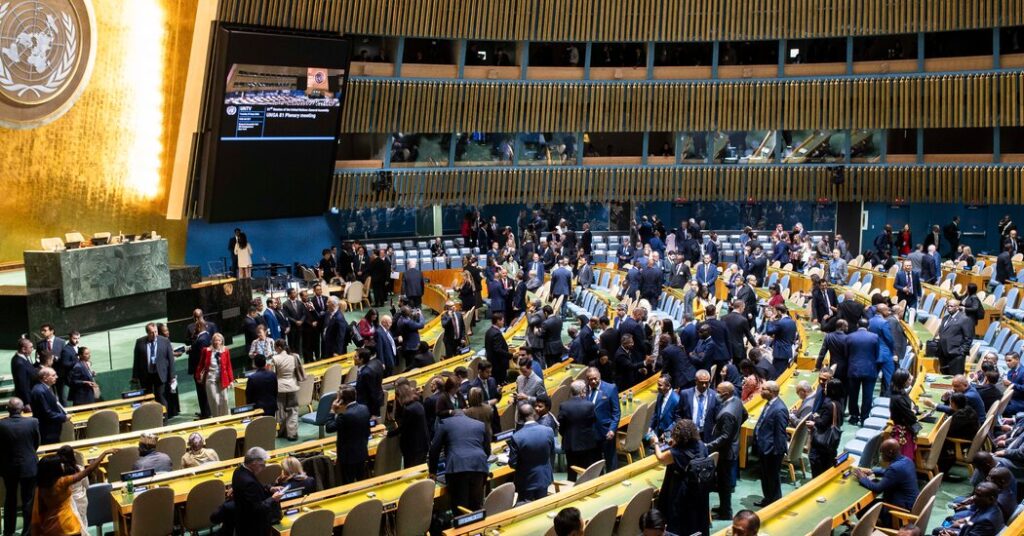
The podium of the United Nations was an unusual setting for the leader of a global superpower to threaten to “annihilate the Islamic Republic” of Iran or to declare that, in another conflict, “to the victor belong the spoils.”
Yet that was exactly what President Trump did on Tuesday, in threatening Iran if it failed to make a deal to end a war that had stretched far longer than Mr. Trump anticipated, and justifying his claims on Venezuelan oil reserves after American forces deposed its leader.
Mr. Trump has long made clear that he has little use for the United Nations, one of the post-World War II institutions that he has dismissed as outdated and ineffective. But his speech at the annual opening of the General Assembly amounted to a pure American rejection of the concept behind the U.N.’s founding in 1945: to “save succeeding generations from the scourge of war.”
The global body’s charter, written largely by the United States, expressly prohibited members from threatening or using force against a country’s territorial integrity unless acting in self-defense, or with the U.N.’s authorization.
On Iran, Mr. Trump made it clear that he, and he alone, would decide whether to strike a deal with Tehran’s leaders or “annihilate the Islamic Republic.”
It may have been largely a negotiating tactic. A little later in the morning, American officials quietly met with Iranians who were also in New York for the opening session, though it was unclear whether any progress was made or whether Mr. Trump himself would meet top Iranian officials.
But his threats were not limited to the war that has consumed his presidency for months since the United States and Israel launched attacks on Iran. He promised that Cuba’s government would fall, one way or the other. And if his “to the victor belong the spoils” line seemed drawn from the days of American gunboat diplomacy more than a century ago, that did not seem to bother the president. Mr. Trump has made it clear that he is willing to use the power of the U.S. military not only for the benefit of securing critical resources, like Venezuela’s huge oil reserves, but also to turn a profit.
Mr. Trump’s comments came at a moment when he appeared more isolated than ever from traditional allies, and when Americans were telling pollsters they overwhelmingly disapproved of his foreign policy. But none of that seemed to lead Mr. Trump to back away from the fiery threats that he has combined with military action in his second term.
Even by Mr. Trump’s standards, the speech seemed to disregard the foundational purpose of the U.N., an institution he has long derided as ineffective and unsuited to deal with the contemporary issues of the world.
It echoed a social media post earlier this year in which he threatened to wipe out Iranian civilization. But it was startling to hear such explicit threats from the podium of the United Nations. That seemed to be the president’s intent, as he celebrated taking actions that past presidents and the U.N. itself shied away from.
“Will a deal be made with Iran that lets them rebuild and create a far greater country than it ever was before, maybe one of the greatest in the Middle East or even the world?” Mr. Trump asked, before raising a far different prospect, with no apparent effort to differentiate between the country’s leadership and military and its civilians. “Or do I annihilate the Islamic Republic and do it quickly, never giving them a chance to kill and destroy people and countries again?”
“Do I drive them into hell with no chance of survival and no hope of future greatness or generations?” Mr. Trump said from the General Assembly podium, where world leaders typically present themselves as champions of peace. He made no mention of his frustrations that a war he boasted would last only days or weeks had now stretched to just shy of seven months.
His speech, in short, seemed to embrace the core doctrine of his second term: that the United States would use a combination of overwhelming military and economic power to suit its own ends — and to bolster the national economy — rather than work through the painful, often slow diplomacy of deal-making and economic coercion. But he made no acknowledgment of the role of international bodies like the U.N., and seemed to suggest that they should simply line up behind the United States.
Later in the speech, he changed course, ticking off the list of conflicts claimed he personally resolved, boasting that he saved millions of lives by intervening to prevent a war between Pakistan and India. And shortly after Mr. Trump threatened Iran with annihilation, his own aides met for three hours with Iranian officials. It was unclear what, if anything, was accomplished.
This celebration of power over principle built upon a belief that Mr. Trump talked about in an interview with The New York Times earlier this year, when he dismissed international law as a constraint on his actions. The only limit on his power, he said, was “my own morality, my own mind — it’s the only thing that can stop me.”
Venezuela was perhaps the most conspicuous example. He celebrated the swiftness with which Special Operations forces swept into Caracas, seized Nicolás Maduro and his wife from their bed, and delivered them to a detention center in Brooklyn, just a few miles from where Mr. Trump spoke.
Senator Andy Kim, Democrat of New Jersey, criticized Mr. Trump for promoting himself as both a president of peace and one that could wipe out a nation.
“Trump never misses a chance to humiliate himself in front of the world,” Mr. Kim said in a post on social media. “His war in Iran is a complete failure, and the American people are paying the price.”
And from the podium, other world leaders criticized Mr. Trump without mentioning his name. President Emmanuel Macron of France, a nation allied with the United States since the American Revolution, denounced a global retreat to the “law of the jungle.” President Luiz Inácio Lula da Silva of Brazil, the first world leader to speak on Tuesday, said that democracy was “once again under threat” and — without mentioning the U.S. operation against Mr. Maduro — insisted that the Venezuelan people had the right to self-determination. Mr. Trump has insisted that it is not the right time for an open election in the country.
Recent polling shows Americans are not on board with Mr. Trump’s approach. A CNN poll conducted last week showed that 29 percent of American adults approved of Mr. Trump’s handling of foreign affairs; 71 percent said they disapproved — reaching or exceeding levels of disapproval President George W. Bush faced in 2006, when the Iraq war was unraveling.
But to Mr. Trump, actions like seizing Venezuela’s leader and making claims on its oil were clear victories. “It was a war, but it’s perhaps the biggest deal ever made,” he said. “If necessary, we will use our unmatched military might to secure the vital national interests of the United States.”
Mr. Trump also described Cuba as a “failed state” that would soon fall. “We’ll not allow a haven for foreign adversaries to threaten America on our own doorstep,” Mr. Trump said, prompting Cuban officials to walk out of the General Assembly.
“The US government proves incapable of accepting that #Cuba is, and has the right to be, a fully independent and sovereign country,” Bruno Rodríguez Parrilla, Cuba’s foreign minister, later said on social media. “Cuba is not a threat to the US nor to any country.”
Mr. Trump also celebrated his administration’s recent deal on Greenland. Earlier this year he threatened to a total takeover of the huge island, which is believed to have large underground reserves of rare-earth minerals used for making batteries, electric vehicles and other high-tech products.
Yet the prospect of the U.S. seizing a semiautonomous territory spurred intense backlash from European leaders and nearly upended the Western alliance.
After reaching a deal with Denmark and Greenland over the territory, Mr. Trump told the gathered crowd he planned to build two new military bases on Greenland — something the United States could have done in previous decades under an existing treaty.
Mr. Trump’s speech was also a pivot from his past remarks to the U.N., which were spent insulting world leaders and scolding them on their own policies. “Your countries are going to hell,” Mr. Trump said from the podium last year.
But now faced with a war in Iran with little sign of ending soon that has fueled discontent among his own supporters in the United States, Mr. Trump shifted from lecturing the international body to effectively selling them on his own actions — which have proved to be deeply unpopular with many Americans and allies overseas.
“I hope the Europeans realize that Iran’s goal was to complete their mad dash to a nuclear bomb,” Mr. Trump said in what amounted to a response to some of the world leaders that had criticized the war in Iran. “If they had succeeded, that wicked regime would have been free to spread terror and death forever.”
The declaration that Iran was building missiles that could reach Europe didn’t square with his earlier boasting of obliterating Iran’s nuclear program.
Mr. Trump claimed credit for ending the war in Gaza, even as humanitarian conditions there remain dire and a plan for disarming Hamas and withdrawing Israeli troops has been stalled for months.
Mr. Trump also attacked the International Criminal Court, which has issued an arrest warrant to Prime Minister Benjamin Netanyahu of Israel over the war in Gaza, as a “rogue institution.”
The I.C.C. was established in a 1998 treaty to investigate and try people for war crimes, genocide, crimes against humanity and the crime of aggression. The court cannot enforce its rulings and relies on its member states to detain people who are accused of crimes.
Mr. Trump called on all members of the International Criminal Court to resign immediately.
While the U.N. has said climate change is an existential threat and propelled the issue of artificial intelligence to the top of its agenda, Mr. Trump once again took a different approach. Climate change was nothing more than a “hoax,” Mr. Trump said.
And the United States rejected “any attempt to construct a globalist scheme to control” artificial intelligence.
Mr. Trump did have one suggested change to the way the world approached A.I., one that made use of his penchant for branding.
“From this point forward, all of United States documents and hopefully the world’s will be changed to use the much more accurate term ‘super’ as opposed to ‘artificial,’” Mr. Trump said. “So it’s super intelligence.”
Mr. Trump then appealed for the leaders to refer to the rising technology as “S.I.” Whether they did, he said, would be a test of influence on the world stage — a question that has appeared to be consistently on the mind of the president.
“Let’s see if I have any power,” Mr. Trump said. “Maybe I do and maybe I don’t. We’re going to find out pretty soon.”
The post At the U.N., Trump Lays Out a Winner-Takes-All Vision of U.S. Power appeared first on New York Times.