This year, artificial intelligence models have been mowing down open problems in mathematics, one after another, with brutal efficiency. The carnage escalated in early September, when OpenAI unleashed 10,000 agents on the Navier-Stokes problem, cracking it in just 88 hours. Just yesterday, the company announced that the same internal model had now “resolved more than 100 longstanding problems across most areas of mathematics” — results that OpenAI was waiting to release until it had figured out “the best way to inform the community of the rapid progress to prepare and adapt the field.”
Some mathematicians, however, are now drawing a line: To “adapt the field,” they believe, could hollow it out. This month, 27 Fields medalists — winners of mathematics’ highest honor — have signed a joint declaration stating that solving famous open problems is not, in itself, the goal. Such problems are “landmarks and lighthouses,” they write, whose deeper purpose is to guide mathematicians toward conceptual understanding and insight.
Terence Tao, one of the signers and among the most celebrated mathematicians alive, has put the concern more gravely. He has described what’s happening as “strip-mining” mathematics. Good problems, he argues, are like nonrenewable resources. Some of them — the smaller, easier ones — can help train the next generation of mathematicians. Young researchers try their hand on them, learning what they will need to push the field forward. If A.I. strips away the big problems and their satellites, it could destroy the entire mathematical ecosystem. Tao has suggested that some questions may even need to be fenced off from automated solvers, as if they were national parks for math problems.
Among A.I. enthusiasts, the declaration was met online with a great deal of eye-rolling. Aren’t mathematical problems supposed to be solved? If A.I. can solve them faster and better than we can, isn’t that progress? From the outside, mathematicians’ insistence on human understanding looked like guild protection — an attempt to save something for themselves now that machines are starting to beat them at their own game.
What this skeptical reaction misses is a distinction within mathematical culture. The Fields medalists are, by and large, “pure” mathematicians, scholars who look inward at mathematics itself, seeking beauty, coherence and a deeper understanding of its conceptual structures and abstractions.
By contrast, “applied” mathematicians — like the two of us — tend to look outward, drawing inspiration from problems in the real world and using mathematics to help solve them. And the long history of that pursuit, we believe, shows how costly it could be to cede our understanding of mathematics to machines.
From Equations to Applications, and Back Again
For centuries, science and technology have advanced through a gradual but remarkably successful process: Observe patterns in nature, uncover the principles beneath them, express those principles mathematically and then use them to predict what happens next. Isaac Newton showed what that process could achieve. With a handful of mathematical laws, he explained both the fall of an apple and the motion of the planets. Three hundred years later, those same laws helped guide astronauts to the moon and bring them safely home.
Again and again, it was a slow back-and-forth between equations and applications that pushed math and engineering forward in tandem. Take the story of wireless communication. In the 1800s, Michael Faraday discovered empirical laws about magnets and electrical currents; James Clerk Maxwell then translated them into mathematics and predicted the existence of electromagnetic waves. Follow that understanding forward and eventually you get radio, television, wireless communication and cell phones.
That long process of trial and error, and the human understanding it led to, drove every revolution in physics that followed. Relativity eventually made GPS possible. Quantum mechanics led to lasers, transistors and much of modern electronics. With understanding came prediction, and with prediction came power.
By the middle of the 20th century, scientists and engineers were confronting problems of staggering size — too many variables, too many interactions, too many calculations for any human being to keep up with. World War II brought the issue to a head. Calculating artillery trajectories, breaking codes, predicting shock waves from explosions and designing atomic weapons demanded mathematics applied on a gigantic, unprecedented scale. People needed help.
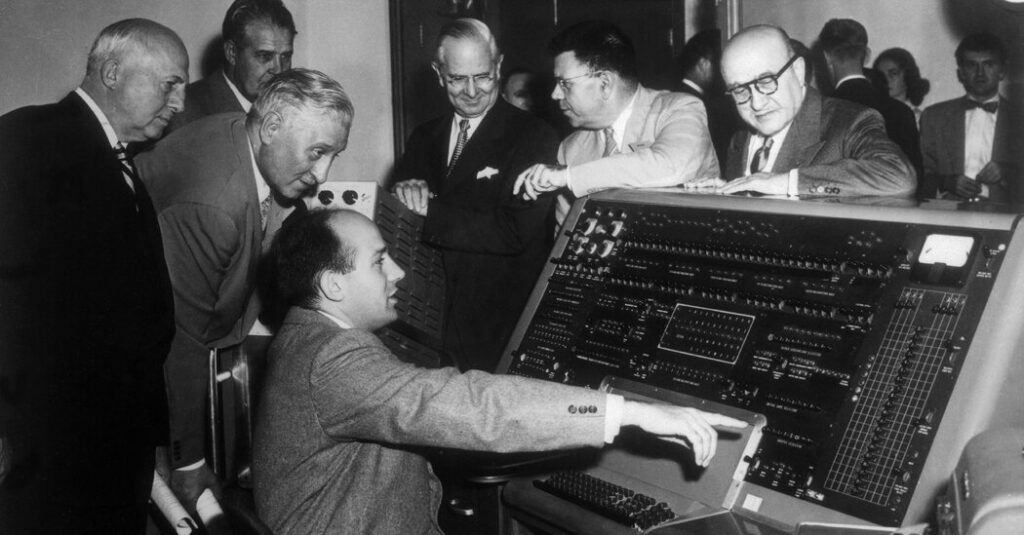
Modern computers arrived just in time. At first there was nothing philosophically threatening about them. They were glorified adding machines: fast, indefatigable servants that obediently ground through calculations too arduous for any human to manage.
After the war, computers spread into civilian life, helping businesses with bookkeeping, databases, airline schedules and countless other chores. Along the way, their role began to broaden. Once almost anything could be represented as numbers, computers became handlers of data, giving us the everyday miracles we now take for granted: digital photographs of our children, the songs in our pockets, the messages we send around the world.
The Road to ‘Compressed Sensing’
Before we knew it, computers were transforming medicine as well.
Consider magnetic resonance imaging, or M.R.I. These scans reveal the body’s soft tissue in extraordinary detail, something X-rays can’t do, and they do it without exposing patients to harmful radiation. Doctors use them to diagnose everything from brain tumors and multiple sclerosis to ligament injuries and cancer.
But M.R.I. has its drawbacks. A typical scan lasts 30 to 60 minutes, sometimes more. Move too much, shift a foot or take a deep breath, and the technician might have to start the scan all over again. Children who can’t keep still often need sedation to get through it.
M.R.I. scanning is slow because it collects an immense amount of data. Unlike an X-ray, which snaps a picture in a single flash, an M.R.I. machine works gradually. It builds up an image one piece at a time.
But what if the M.R.I. didn’t have to collect all that data to get a usable scan? What if a fraction of the data were enough to construct the whole image, as if filling in the blanks?
That’s the leap behind a mathematical breakthrough known as “compressed sensing.” The key insight is that an M.R.I. image contains much less information than its enormous number of pixels might suggest. Neighboring parts of the image tend to resemble one another, and many of its details are mathematically redundant. That means you don’t necessarily have to measure everything. With the right mathematics, a surprisingly small number of measurements can be enough to reconstruct the whole image.
But where did this breakthrough come from? For decades, mathematicians, scientists and engineers had been wrestling with a basic fact about the real world: Its signals and images are full of structure. They’re not random jumbles of numbers; they’re intricately patterned. A photograph of a landscape, a piece of music, the sound of a voice — each harbors mathematical regularities that allow it to be summarized economically. The trick is to find the right building blocks. Expressed in those terms, a natural data set that seems to require millions of numbers can sometimes boil down to just a handful of ingredients.
As people learned to exploit this feature of natural images and signals — a feature known as “sparsity” — the mathematics around it kept mutating and migrating. Fourier analysis showed how complicated signals and images could be built from simple waves. Wavelets gave a new way to pick out the most important building blocks. Work in statistics and optimization showed how to identify the most informative components among a host of possibilities.
And cross-fertilization from an unexpected source helped too. In the 1970s, geophysicists were trying to make sense of seismic waves traveling through the earth, either generated by earthquakes or deliberately deployed in the search for oil and gas. Like radiologists peering inside a human body with M.R.I., these earth scientists were trying to reconstruct something hidden but important — in their case, structures deep underground.
By the early 2000s, these once-separate streams of thought were ready to come together. Compressed sensing was their offspring. The breakthrough came when mathematicians, including Emmanuel Candès, Terence Tao (yes, the same Terry Tao) and David Donoho, proved rigorously that, under the right conditions, compressed sensing could reconstruct an image accurately from shockingly few measurements. These mathematical guarantees turned doubt into action, and soon, Donoho and his collaborators Michael Lustig and John Pauly translated the theory into a procedure that doctors could use.
The benefits were dramatic. In pediatric imaging, a scan that once took eight minutes and required sedation could now be done in just over a minute while the child was awake.
The Cost of ‘Strip-Mining’ Understanding
This, to an applied mathematician, is why human understanding matters. It lets us take a brilliant idea developed in one setting and confidently wield it as a tool in another. This is mathematics doing what the public rightly expects of it: making a difference in the real world.
Now, for the sake of argument, imagine that an A.I. model could bypass all of this hard-won understanding and skip straight to a much faster way of doing M.R.I. scans, without shedding any light on how it got there. That would be a wonderful advance, medically speaking.
But the history we’ve just told gives us reason to hesitate before declaring human understanding dispensable. We wouldn’t know what we might be missing — what new ideas, unexpected connections or applications might have emerged from our understanding of why the method worked.
Seen in that light, Terence Tao’s strip-mining concern looks less like mathematicians trying to save problems for themselves and more like a worry about what humanity as a whole might lose. Understanding has always been a mathematician’s private pleasure, yes. But again and again, it has also given humanity gifts that it never knew to ask for.
Steven Strogatz is the Susan and Barton Winokur Distinguished Professor for the Public Understanding of Science and Mathematics at Cornell University. Alex Townsend is an associate professor of mathematics at Cornell. Their book “Big Math: The Hidden Codes That Run Our World” will be published in November.
The post Mathematics Isn’t Just a Game to Let A.I. Solve. History Shows Why. appeared first on New York Times.