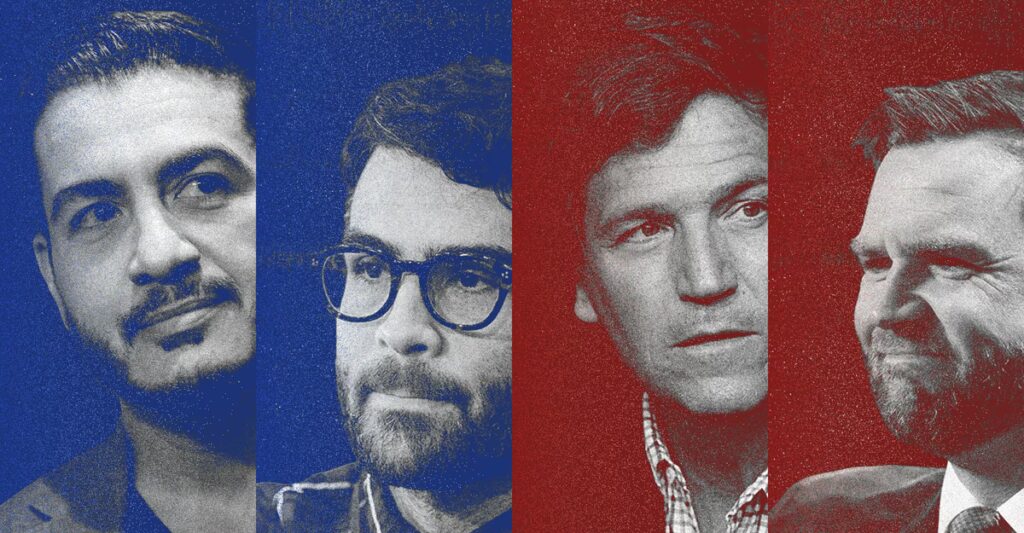
J. D. Vance and Abdul El-Sayed have very little in common ideologically and seem to like each other even less. As part of a nasty exchange of personal insults last month, the Democratic nominee for Senate in Michigan implied that Vance’s grandfather would disapprove of the vice president’s Indian American wife. In response, Vance called El-Sayed “very, very evil” and warned him to “keep my wife’s name the hell out of your mouth because she’s way out of your league.” Yet even as Vance and El-Sayed are happy to trade schoolyard taunts, they can agree on at least one thing: that guilt by association is a contemptible means of scoring cheap political points.
“I’m tired of this guilt-by-association thing,” El-Sayed complained earlier this year, when he was asked about his decision to campaign alongside Hasan Piker, an internet shock jock who has said that “America deserved 9/11,” described allegations of sexual violence on October 7 as “rape fantasies,” and praised Mao Zedong as “one of the great leaders of the world,” among many other charming bon mots. Despite repeated calls from within his own party to renounce Piker, El-Sayed refuses to do so.
Vance is facing a similar situation with his friend Tucker Carlson. Vance “doesn’t believe in guilt-by-association cancel culture,” a spokesperson said in September 2024, after the then-senator appeared onstage with the conservative podcast host. In the years since his firing from Fox News, Carlson has lauded a Holocaust denier as “the most important historian in the United States,” accused a small Jewish sect of orchestrating the war in Iran, and praised Vladimir Putin as “the most effective leader in my lifetime.” Carlson, whose show returns again and again to the supposed perfidy of the Jews, has become the country’s highest-profile promoter of anti-Semitism. He recently held a friendly conversation with a guest who claimed that algebra was “fake math” created for “goy slaves.”
Vance was asked directly about his relationship with Carlson at a White House press conference earlier this month. “Tucker is a friend, despite the fact that we disagree on a number of things,” the vice president said. “And I’m not going to play the game where I throw friends under the bus because I have political disagreements with them. I think that is a terrible place for the United States to go.”
[Jonathan Chait: J. D. Vance’s disingenuous defense of Tucker Carlson]
El-Sayed and Vance would have us believe that their troublesome friends are no different from the people in our own lives whose political views we abhor but whom we nonetheless love and appreciate. “If I had to choose between betraying my country and betraying my friend, I hope I should have the guts to betray my country,” the English writer E. M. Forster wrote in 1938 as Europe hurtled toward war. It’s a noble sentiment, a paean to friendship over tribe. But Piker and Carlson are not the equivalent of your crazy uncle. And El-Sayed and Vance are not regular citizens; they’re political figures whose judgment and choices affect other Americans’ lives. One’s choice of friends is in fact an excellent sign of character, and in this respect, both Vance and El-Sayed have demonstrated a conspicuous lack of it.
The tactic known as “guilt by association” evokes the legacy of Senator Joe McCarthy, whose feral zeal for exposing Communists, real or imagined, was so era-defining that it inspired the attachment of an ism to his surname. McCarthy’s sin wasn’t his anti-communism, however—there were indeed highly placed Soviet agents in the federal government. It was his recklessness and lack of concern for the truth. There has to be a reasonable middle ground between conducting a witch hunt and blatantly ignoring someone’s willingness to fraternize with genuinely disreputable people.
Now that their associations are in the spotlight, El-Sayed, Vance, and their respective ideological compatriots are eager to minimize them. In a softball interview with Piker several months ago, the Pod Save America host Jon Favreau, a prominent liberal opinion-shaper, said that he wants Democrats to take the “Don’t Talk About Hasan Piker For A Day Challenge.” Asked about Piker’s remarks concerning 9/11, El-Sayed tried to depict himself as a victim of the “cancel culture that all of us agreed was a bad idea back in 2020, but we seem to want to bring back.” A “Vance ally” echoed a similar sentiment to The Washington Post about the vice president’s relationship with Carlson, saying, “We’re done with the canceling, period.”
No one should accept these evasions. In April, El-Sayed deployed Piker to boost support among young voters at Michigan State and the University of Michigan. In the final hours before polls closed, El-Sayed appeared at a pool party with Piker and other internet influencers in Detroit.
Vance’s association with Carlson goes much deeper. In a 2021 interview recalling the time they first met, Vance described their immediate recognition of each other as “the guy who’s exactly right about what’s going on in the country.” Carlson helped persuade Donald Trump to select Vance as his running mate; Vance hired Carlson’s son as his deputy press secretary. When Vance guest-hosted Charlie Kirk’s show after the conservative activist’s assassination, one of the first people he invited into the vice-presidential suite was Carlson. (At Kirk’s funeral six days later, Carlson delivered a eulogy that seemed to imply that the Jews had murdered Kirk just as they had Jesus Christ.)
The most obvious reason El-Sayed and Vance haven’t disowned their noxious friends is that both Piker and Carlson command large audiences. Politics is about winning votes, and a moral miscreant’s is worth the same as a saint’s. Other politicians have done much worse than associate with the likes of Piker and Carlson.
What’s more troubling is that El-Sayed and Vance each appear to sympathize with at least some of what their influencer friend espouses. On multiple occasions, Vance has shown that he either doesn’t understand or doesn’t care about anti-Semitism. He once dismissed outrage over a group of Young Republicans joking about gas chambers as “pearl clutching” and characterized attempts to sideline bigots from the conservative movement as “endless, self-defeating purity tests.” One might think that Carlson’s frequent attacks on Vance’s boss, up to and including that Trump “should be removed from office immediately,” would have persuaded Vance, purely out of his own self-interest, to disavow Carlson. That he hasn’t done so indicates the high value he places on his association with him.
If not for such data points, Vance’s friendship with Carlson would be easy to dismiss as misplaced affection for someone who helped advance his career. But Vance is on the record stating otherwise. Late last year, he said,
I find the idea that Tucker Carlson—who has one of the largest podcasts in the world, who has millions of listeners, who supported Donald Trump in the 2024 election, who supported me in the 2024 election—the idea that his views are somehow completely anathema to conservatism, that he has no place in the conservative movement, is frankly absurd.
This implies that Holocaust denial, claims of Jewish disloyalty to the United States, veneration of Putin, and a host of other poisonous ideas are welcome in the conservative movement. Even the white-nationalist influencer Nick Fuentes is fed up with Vance’s disingenuousness. “JD Vance panders to the far right but simply doesn’t want the baggage of associating with the far right,” Fuentes told The New York Times. “If he has a problem with ‘antisemites,’ then he should start by disavowing his best friend Tucker Carlson.”
[Read: The Hasan Piker question]
A similar ideological affinity appears to exist between Piker and El-Sayed, whose past statements on 9/11 and terrorism more broadly have a way of creating a moral equivalency between the United States and its Islamist enemies. “Today, I mourn the 3K lives, 6K injuries, & infrastructural devastation in NYC, perpetuated ignorantly in the name of my faith,” El-Sayed tweeted five years ago on the 20th anniversary of the attacks. “Tomorrow, I’ll mourn ~1M lives, millions of injuries, & infrastructural devastation in 3 countries, perpetuated ignorantly in the name of my country.” Earlier this year, after a Hezbollah-inspired terrorist rammed his car into a Detroit-area synagogue where 140 preschool-age Jewish children were playing, El-Sayed said that “hurt people hurt people,” a reference to the fact that the attacker had lost four relatives in an Israeli air strike. (In a clumsy attempt at an apology, El-Sayed stubbornly refused to acknowledge the odious logic of his remarks, allowing only that he had chosen to administer “the right medicine at the wrong time.”)
Like Prince Hal banishing Falstaff from the royal court, sometimes ending a friendship is a sign of the maturity necessary to lead. Barack Obama made just such a choice in 2008 after the hateful and conspiratorial remarks of his longtime pastor, Jeremiah Wright, were exposed to the world. Obama’s relationship with Wright was much more intimate than that between El-Sayed and Piker or Vance and Carlson; he had sat in Wright’s pews for decades, and Wright had baptized his children. And yet Obama ultimately turned his back on Wright, saying that the preacher’s divisive, anti-American “rants” were “an insult to what we’ve been trying to do in this campaign.” Obama understood that as long as he was associated with a character like Wright, he could never be a credible advocate for the national unity he claimed to seek.
J. D. Vance and Abdul El-Sayed each face a much easier decision—and each has failed to make the right one. It’s a testament to Americans’ increasing tolerance for extremism that both men seem to be getting away with it.
The post In Defense of Guilt by Association appeared first on The Atlantic.