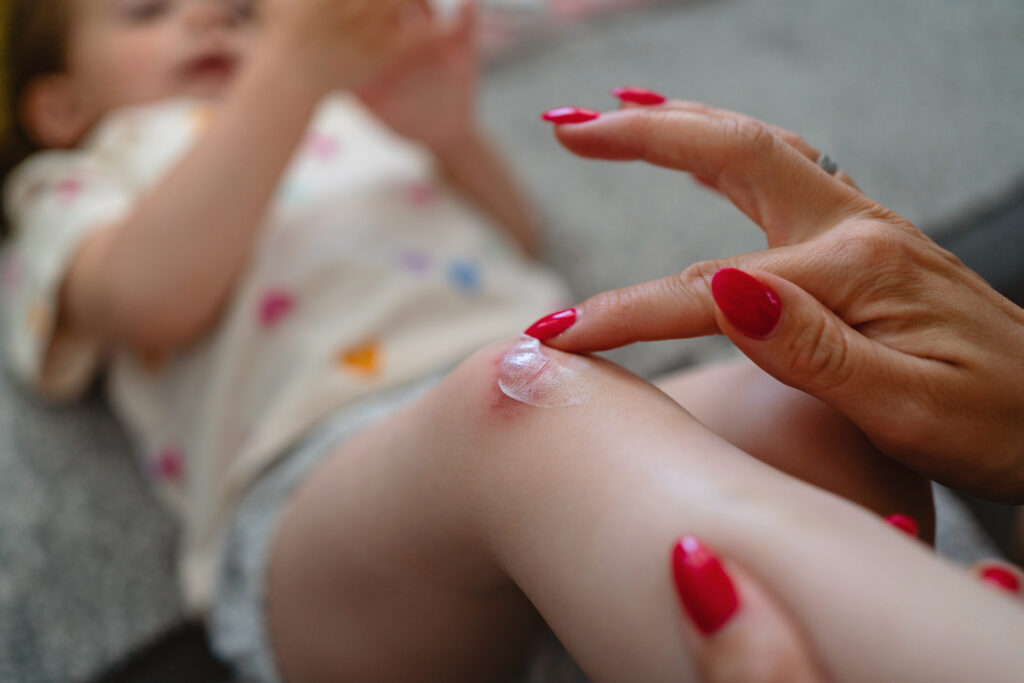
I saw online that we actually shouldn’t be applying topical antibiotic ointments for minor scrapes and cuts. What’s the harm? Don’t they help prevent infections?
Parents of tiny playground warriors often carry antibiotic ointments everywhere they go — after all, scrapes are inevitable, and the ointment helps everyone feel like they’re doing something (beyond, of course, the therapeutic application of a colorful bandage).
The problem: In many cases, these topical antibiotics don’t work any better than plain old petroleum jelly.
That’s what a large randomized controlled trial of almost 1,000 patients who had undergone minor skin surgeries concluded 30 years ago in a paper published in JAMA. The researchers cleaned the patients’ wounds, then randomized them to either topical antibiotic bacitracin or petroleum jelly, before covering the wounds with gauze and a bandage. A month later, both groups had similarly low rates of infections — and both groups’ wounds had healed just as well. Since then, those findings have been replicated in similar studies.
You could argue there’s no harm with the antibiotics, but there’s another issue: skin allergies. Allergic contact dermatitis due to topical over-the-counter antibiotics like neomycin shows up in around 5 percent of children and 2 percent of adults. These allergies can make the skin red and itchy. They may also require other medications, such as steroid creams, to help resolve them.
In fact, the inflammation caused by an allergy to the topical antibiotic can sometimes be mistaken for a wound infection, said Shoshana Marmon, an assistant professor of dermatology and director of clinical research at New York Medical College.
Combine that with the fact that petroleum jelly is cheap and well-tolerated, it’s no wonder that many dermatologists are speaking out.
“People often assume that adding an antibiotic ointment automatically makes a minor wound safer,” Marmon said. “For most clean, uncomplicated cuts and scrapes, good wound care — cleaning the wound, keeping it moist with petroleum jelly and keeping it covered — is usually enough.”
Antibiotic ointments aren’t necessary for every cut
The American Academy of Dermatology recommends topical antibiotics only for surgical wounds showing signs of infection — and not as a preventative default.
To be clear, most clinical trial data have looked at what happens to clean surgical wounds or — on the other end of the spectrum — wounds that are gnarly enough that someone has gone to the emergency room. And while most of my own minor scrapes in daily life are fairly clean, research directly studying household or playground wounds is limited.
Still, most dermatologists agree that antibiotics should be used sparingly.
“Use a topical antibiotic only if there is redness, red streaks surrounding the scrape, warmth, pus, fever or chills,” said Adelaide Hebert, chief of pediatric dermatology at UTHealth McGovern Medical School in Houston.
On a public health level, antibiotic resistance is already a problem, she added, so reducing your use if you can is a good idea.
And if you do have any of the symptoms listed above, be sure to check in with a health care provider.
How to heal minor cuts and scrapes
Wounds need two things to heal: moisture and coverage. Here’s how to give your cut or scrape what it needs.
- Clean it. Start by washing your hands with soap and water, then rinsing the wound with cool water — soap, too, if things got muddy — to flush out debris. As for that hydrogen peroxide your parents swore by when you were growing up? There’s little data that did much beyond sting — and antiseptics like these may actually damage healing tissue, Marmon said. Afterward, pat dry with sterile gauze or a soft clean towel.
- Hold pressure to stop bleeding. Just for a few minutes, until bleeding stops.
- Apply a layer of petroleum jelly. This creates a clean, moist barrier between the wound and the outside environment. It helps wounds heal better than if they’re left to dry out and scab over. You may want to dedicate a tub of petroleum jelly just for wounds — and not dip into the same tub you might use for, oh, say, diaper rashes.
- Cover it. A bandage — yes, even the ones with glittery puppies — keeps the area protected and retains moisture. Change the bandage daily and apply a fresh layer of petroleum jelly each time you do. Covering the skin can also protect from sun exposure, which could make skin discoloration in healing skin more likely, said Hebert.
How to know if you need stitches
A few years ago, I walked right into a sculpture in the middle of a courtyard at Harvard University. I was talking to a mentee and wasn’t watching where I was going. I arrived home with a gash about a centimeter long and two millimeters deep — and it was still oozing.
Even as a doctor, I waffled: Did I need stitches? Or just more time and pressure? I did finally go to an emergency room, and it turns out, I had plenty of red flags that I actually did need stitches.
Here’s how to know:
- The wound doesn’t stop bleeding within 10-15 minutes of holding pressure. In my case, at least half an hour had gone by, and it kept on trickling.
- It’s deeper than about a quarter of an inch. If you can see yellow fat, muscle and certainly bone, go to the ER. I couldn’t quite see fat or muscle, but I could tell my cut was deeper than usual, so it helps to bring those layers of skin together with stitches.
- The cut is jagged. If the wound isn’t a clean line and doesn’t stay together when pinched closed, stitches can help ensure that it closes as cleanly as possible. And, in general, cuts that are longer than ¾ inch are worth a professional look.
- It’s somewhere you care about scarring. Especially for hands, face or joints (like knees or fingers), stitches help ensure a cleaner, potentially smaller, scar.
- It was caused by contact with an animal or any rusted metal. You may need antibiotics or a tetanus shot.
- If there’s any dirt, glass or other materials stuck inside. Please proceed to the ER.
What I want my patients to know
If you don’t moisten and cover your wounds properly, scabs form. Scabs aren’t inherently bad; it’s your body trying to do the job of the bandage for you. But they’re itchy and constantly tempt you to pick at them prematurely (cover them with a bandage if it’s too tantalizing). If a scab is still stuck on, it means the area has not yet healed. Leave it alone.
And if you tend to form keloids — a type of raised scar — Hebert suggests a silicone-based over-the-counter dressing once the skin is closed (don’t apply to a fresh open wound).
The post As a doctor, here’s one drugstore medication I tell people to rethink appeared first on Washington Post.