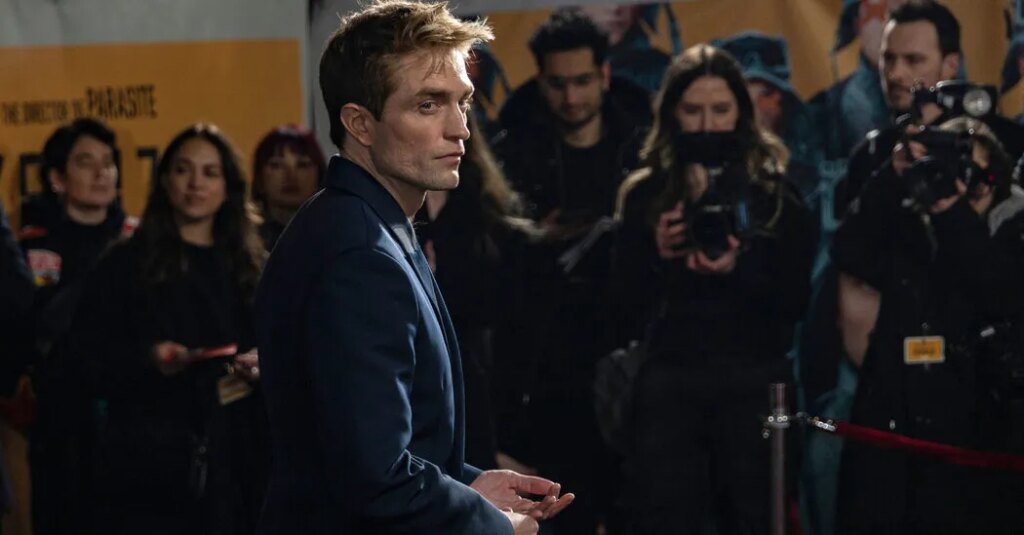
Movie studios and directors seem to have him on speed dial.
Those suitors have come bearing a host of tantalizing and lucrative roles in Hollywood blockbusters, wanting a bankable leading man for “The Batman” or looking to add to the constellations of stars in epics like “The Odyssey” and “Dune: Part Three.”
Their go-to? The British actor Robert Pattinson, 40, who this week landed one of the silver screen’s most coveted roles when Amazon MGM Studios named him the next James Bond.
But his ascent to being the seventh man to play 007 in a series that has spawned 25 official films so far raised a burning question for Pattinson’s fans: How much will he be able to moonlight outside of Bond?
An online debate quickly erupted about Pattinson’s career arc and future opportunities, spilling over to the social media feeds of Steven Jay Rubin, author of “The Complete James Bond Movie Encyclopedia.”
“They were saying that he’s Batman,” Rubin said. “How can he be Bond?”
Rubin said Hollywood had made allowances for its biggest stars for decades, a practice he expects to continue for Pattinson.
“Well, there’s precedent all over the place,” he said. “Indiana Jones. I mean, Harrison Ford was Han Solo, and then he’s Indiana Jones. Does anybody squawk and say, ‘You can’t play Indiana Jones, you’re already Han Solo’? Stallone does ‘Rocky’ and then he’s Rambo.”
For some of Pattinson’s predecessors, the demands of playing 007 became inhibiting over the decades and created some notable rifts that changed the course of the Bond franchise and the actors playing Ian Fleming’s suave spy.
In the mid-1980s, when studio executives were zeroing in on a successor to Roger Moore as Bond, one of the leading contenders was Pierce Brosnan, the Irish actor who at the time was playing the romantic private detective Remington Steele on television.
When NBC got wind that Brosnan was the pick, it reversed its plans to cancel “Remington Steele,” said John Cork, a founder and the executive director of the Ian Fleming Foundation and a James Bond historian. NBC would not release Brosnan from his contract.
But network executives offered to arrange the show’s shooting locations and schedule around the movie productions, something that Cork said the longtime Bond producer Albert Broccoli, who was known as Cubby, opposed.
“Cubby Broccoli said, ‘Our Bond is not going to be Remington Steele,’” Cork recalled.
It was the ultimate power play, he added.
“And Cubby said: ‘Go take a flying leap. No, thank you.’”
Timothy Dalton, a Shakespearean actor who was born in Wales and had appeared in 11 films at the time, was chosen for the role instead and received mixed reviews for his portrayal of 007. His turn as Bond lasted for two movies before the producers returned to a familiar name: Brosnan, who got his shot at the role starting with “GoldenEye” in 1995.
Molly Lopata, a casting director for “Remington Steele,” said Brosnan’s situation was unique because most of the actors on the show did not have recurring roles. While she no longer works on movies, she, too, was following the frenzy over Pattinson’s selection.
“I think he’ll make a great Bond,” she said.
Over the decades, the actors at the center of the opening gun-barrel sequence of Bond movies have racked up notable movie credits while moonlighting.
Between “From Russia With Love” (1963) and “Goldfinger” (1964), Sean Connery, the first actor to play Bond and the one by which all others have been judged, appeared in the Alfred Hitchcock suspense movie “Marnie” alongside Tippi Hedren, Rubin said.
“He enjoyed that experience, broadening his horizons, and he was kind of tired of Bond anyway,” Rubin said.
After starring in the first five official Bond movies, Connery stepped away from the role and was replaced by George Lazenby, a relatively unknown Australian actor and model, in “On Her Majesty’s Secret Service” in 1969. In 1971, Connery, lured by a record salary at the time, returned to the series in “Diamonds Are Forever.”
While Moore played the role, he appeared in a host of other movies, many of them British productions, Cork said. He also played a wealthy Aston Martin-driving sendup of his James Bond character in the 1981 comedy “The Cannonball Run,” which was released the same year as “For Your Eyes Only,” the 12th Bond movie.
During Brosnan’s four-movie tenure as Bond, he appeared in the remake of “The Thomas Crown Affair,” “The Mirror Has Two Faces” and “Mars Attacks!”
Daniel Craig, who succeeded Brosnan as 007, starred in “Knives Out,” “The Girl With the Dragon Tattoo” and “Defiance,” overlapping his time as Bond.
Rubin said the choice of Pattinson to reboot the franchise was a savvy one by Amazon MGM Studios at a time of intense competition for eyeballs.
“Picking a relatively unknown actor would probably have been a tactical error because the world’s changed a lot since Bond was introduced in the ’60s,” he said.
Pattinson’s marketability, he said, was undeniable.
“How do you reach a new generation of Bond fans?” he said. “You know what gets them driven? Now, they see this guy is from Batman. He did ‘Twilight’ back in the day. He’s in ‘Dune.’ I know this guy adds some intrigue factor.”
The post How Much Can James Bond Moonlight? Robert Pattinson Will Show Us. appeared first on New York Times.