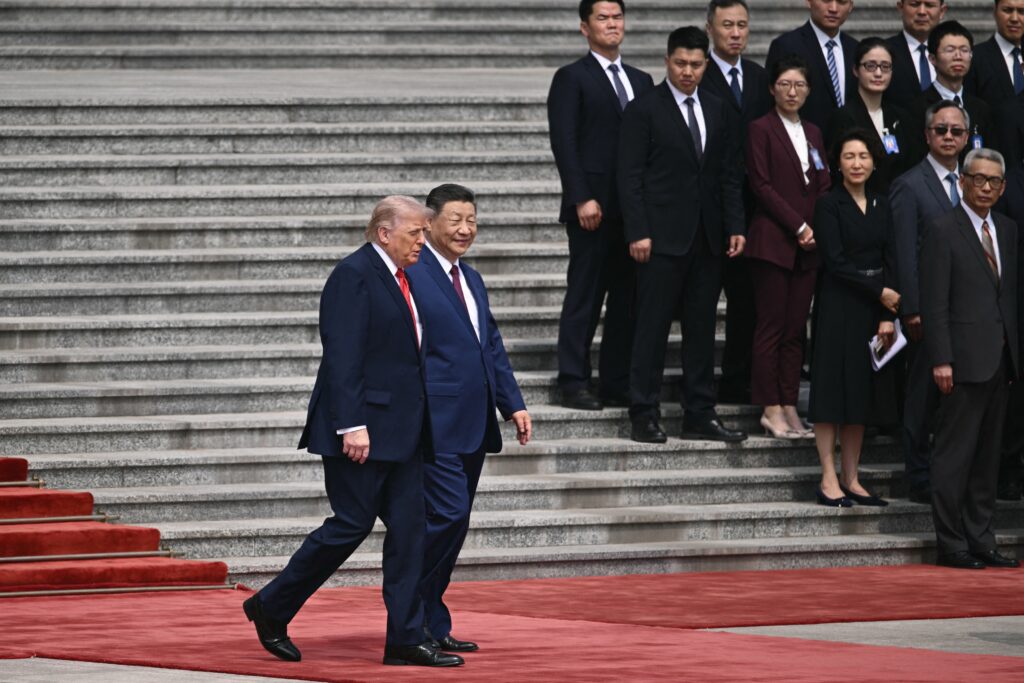
When President Donald Trump treks out to Joint Base Andrews to greet Chinese President Xi Jinping on Wednesday, it will be as a leader who increasingly stands alone as he engages with his biggest geopolitical counterpart.
A decade ago, Trump swept into his first term with a sharp approach to China. He abandoned years of a strategy in which Washington and its allies deepened trade with Beijing and hoped that greater political openness would follow. Trump said China was a strategic rival and needed to be confronted more directly, and Europe and other allies moved in his direction.
In his second term, though, Trump has eased his rhetoric on China while setting his sights on allies. Canada is unsettled about his rhetoric about turning it into the 51st state. Europeans rushed troops to Greenland this year amid fears of a potential U.S. effort to take the Danish territory by force. Taiwan has worried about a possible shiftin long-standing U.S. policy supporting it.
Those allies have been forced to change their calculations about Washington. And as Trump has alternated between wooing Xi with trade deals and blasting him with tariffs, he has found few countries lining up to join him.
Those strains will be very much at the center of attention as Trump dives into a week of international engagement capped by a day of meetings with Xi on Thursday.
“We get along well. We’re doing very well with China,” Trump told reporters Friday. “I would say others maybe not so well, but we’re doing very well with China. And President Xi and I have a good relationship.”
The diplomacy will begin in New York, where he is scheduled to speak Tuesday to the annual gathering of world leaders at the United Nations. While there, he plans to meet Venezuela’s interim president Delcy Rodríguez for the first time since she came to power this year after a U.S. raid that captured her former boss, Nicolás Maduro. He will also meet British Prime Minister Andy Burnham, Gulf leaders and others. He may meet Ukrainian President Volodymyr Zelensky, who has been facing escalation from Russia even as White House envoys have been pushing him to cede territory.
Both Ukraine and Venezuela highlight Washington’s inclination to leave allies aside in the Trump era. On Ukraine, the U.S. has backed off European efforts to keep Kyiv supplied with weapons. And Trump kept other leaders in the dark about his plans to invade Venezuela, as well as his efforts to secure a U.S. stake in the country’s oil reserves.
Trump is also scheduled to sign a dealwith the leaders of Denmark and Greenland that will give the U.S. expanded security rights over the Arctic territory — an agreement that comes at the cost of deeply strained relations with some transatlantic allies.
As erstwhile allies confront a world where Washington isn’t their preeminent partner, the president has lashed out at them.
“I have China coming here,” Trump told reporters this month. “A lot of people say, who’s the toughest one to deal with? Is it China, sir? Is it China? Is it Vietnam? I said, no. Actually, it’s Canada. Canada has felt emboldened.”
Still, senior Trump officials say there’s a role for diplomacy and the U.N. meetings.
“It’s one week that you have presidents, prime ministers, foreign ministers, finance ministers, CEOs, diplomats from every country on earth, are packed into a few square miles of Manhattan,” U.S. Ambassador to the U.N. Mike Waltz told reporters Friday. “And despite the traffic, that concentration of people creates an extraordinary diplomatic opportunity.”
Trump’s confrontational approach to allies has opened a gulf between Washington and countries that might otherwise be sympathetic toward U.S. efforts to promote fair trade and manage Beijing’s rise, analysts said. European economies are being buffeted by Chinese manufacturers undermining their industries. Asian powers such as Japan and South Korea want to avoid a more aggressive Chinese military in their neighborhood. But they are being forced to manage Trump’s shifting demands on trade and defense spending in ways that hamper any coordinated strategy against Beijing.
“Trump just doesn’t seem personally at all interested in working with traditional U.S. allies. And the first time around, that came as a surprise. This time around, that has come as a profound opportunity for Beijing,” said Julian Gewirtz, who worked on China policy under President Joe Biden.
“Beijing can deepen and expand its influence across Eurasia and across the Global South, and can build institutions around its own priorities, and then arrive in Washington to have the American president throw him a lavish reception,” he said.
Xi has embraced the moment. In recent weeks he has crisscrossed the globe, paying visits to Egypt, India and others — countries that have long been contested terrain between Washington and Beijing but that increasingly look to China for assistance and stability.
Trump’s goals appear narrower: promoting U.S. businesses, maximizing trade deals and investments on U.S. soil, and minimizing Beijing’s assistance to Iran and Russia.
One result is limited expectations for Thursday’s and Friday’s meetings, which are scheduled to include a state dinner that will host top business leaders from both countries. Trump oversaw a rush of renovations to the White House to prepare for the visit, including the construction of a helicopter landing pad on the South Lawn and a refresh of the columns of the North Portico.
Trump is expected to host Xi and his wife at the White House for tea on Friday — the Chinese leader did the same in Beijing in May — and take the pair to the National Archive to look at U.S. foundational documents, officials said.
Beyond the pageantry, concrete achievements may be more modest. Even on issues that have shot to the top of voter priorities, such as managing risks around artificial intelligence, U.S. and Chinese officials are more focused on hammering out the structure of future talks rather than sitting down for substance now. White House officials say that greater engagement with China is inherently useful for advancing Trump’s priorities, as the president and Xi pick up the pace of their face-to-face meetings.
The U.S. leader visited Beijing in May and is likely to go to the Chinese city of Shenzhen in November for a summit of Asia-Pacific leaders, the most rapid return to China by a president since George W. Bush in 2002.
“The fact that the top-level meetings are happening gives the Chinese side a way to communicate to Trump himself where their red lines are and what kinds of actions, what kinds of restrictions the United States might take that would be unacceptable,” said Jake Werner, a China expert at the Quincy Institute for Responsible Statecraft, a think tank that advocates U.S. military restraint. “And then Trump can find out what’s going on in his administration and then impose some discipline on lower levels.”
Trump’s focus on ensuring smooth talks has put him in awkward positions in recent months. The president has been careful not to criticize Chinese actions or send Taiwan a major arms assistance package that Congress has approved but which would draw Beijing’s ire.
Asked last week about reports that China may have contributed to the deaths of U.S. soldiers by sending intelligence to Iran that helped it target U.S. bases in Jordan, Trump said that “they do what we do,” and that China had behaved “reasonably well.”
The comments echoed what Trump has sometimes said about Russian and Chinese spying activities — that the United States spies on them too — but went beyond. The United States isn’t known to have supplied intelligence to a Chinese adversary that led to the deaths of Chinese military personnel.
“When China throttles us on rare earths, the president says everything’s going according to plan. When China rolls out new highly disruptive economic measures, the president’s largely silent,” said Rush Doshi, who worked on China in the Biden White House and is now director of the China Strategy Initiative at the Council on Foreign Relations. “I don’t think we’re getting the kind of pushback on China that you would have expected from the first term, and that’s because really his objective is to just avoid too much tension in the relationship.”
Much of the administration’s China strategy — including tariffs on Chinese goods and decreasing reliance on Chinese manufacturing — is in service of Trump’s “deep-held domestic priority” of bringing manufacturing back to the United States, said a former foreign policy staffer who served in the second Trump administration and spoke on the condition of anonymity to discuss White House thinking.
The White House’s China strategy “comes down to things that the president has believed for 40 years,” the former official said.
Promoting fair trade and American manufacturing “are informing the vast majority of the actions [the president] takes when it comes to China,” the staffer said. “If something doesn’t advance that goal, that’s why we don’t see a lot of [it].”
Trump may wade into other controversies while at the U.N. The international body is seeking a new secretary general for a five-year appointment. Trump has blasted the institution for what he says is taking advantage of the United States. Last year, he claimed sabotage when the escalator on which he and first lady Melania Trump were riding at U.N. headquarters suddenly stopped as they were between floors.
Some leaders will be absent from the U.N. meeting in part because of the long tail of Trump’s foreign policy decisions. German Chancellor Friedrich Merz, for example, canceled his trip to New York to manage a growing political crisis for his Christian Democratic party. Rising energy prices caused by the Iran war are contributing to a string of electoral defeats in state elections as the anti-immigrant Alternative for Germany party gains victories.
French President Emmanuel Macron, meanwhile, is making his final appearance in front of fellow world leaders with the far-right in France in good position to win the presidency next spring.
Joshua Yang and Isaac Arnsdorf contributed to this report.
The post Trump heads into a week of diplomacy, hampered by a lack of allies appeared first on Washington Post.