Tyler Hassen’s initiation into Elon Musk’s Department of Government Efficiency, or DOGE, started as a series of tests.
The Houston oil executive says he was given vague instructions to show up at an unfamiliar D.C. address. He hastily packed three suitcases and flew east, taking an Uber to a building that he soon learned belonged to Elon Musk’s SpaceX. He was whisked to a private office, acutely aware that his tailored suit stood out among the hoodie-clad engineers “too locked in” to their laptops to look up. He was ordered to go through the website of the Department of Commerce and, within days, find two to five ideas to present to Musk.
He checked into a nearby J.W. Marriott and told his wife he didn’t know how long he would be gone.
Thus began an 11-month stint at the center of a national firestorm — an exhilarating, chaotic, and sometimes scary experience, Hassen told The Washington Post, in his first major interview detailing his forthcoming memoir and plans. The memoir, “Inside DOGE: The Real Story from a Senior Insider,” which recounts his time working for the secretive cost-cutting group, is the first tell-all to emerge from one of the most controversial periods of President Donald Trump’s time in office — a moment Hassen said he would gladly live through again.
“There’s this misconception that we all just went in there and didn’t really think about what we were doing,” Hassen said, speaking virtually from a hotel room in San Diego. “I spent 24/7 thinking about it, waking up at three in the morning thinking, ‘Am I doing the right thing?’ … And I know I did.”
At the heart of the book is a split screen: For many Americans, Musk’s project was a callous showcase of bending government to a billionaire’s will, associated with tens of thousands of federal layoffs, reams of lawsuits, an AI-enabled effort to kill off wasteful contracts, and the gutting of the U.S. Agency for International Development.
But Hassen’s memoir enters a different vision into the historical record: He portrays a period marked by a clash in worldviews, in which hardcore capitalists are granted unprecedented power to change a system that they argue operates under completely different incentives, logic and norms.
To Hassen, whose pre-government career involved turning around distressed companies, “DOGE was not radical,” he writes in the book. It was “not a wrecking ball, but a catalyst.”
In conversation, Hassen comes across as mild-mannered, a distant temperament from Musk, who famously brandished a red metallic chainsaw as a metaphor for cutting government waste. A 43-year-old dad with Boy Scout energy, he doesn’t cut the image of the nerd-engineer DOGE bro. He spent his entire adult life “hiring, firing, reorganizing and rescuing failing businesses” in industrial manufacturing and the energy sectors — a skill set that appealed to Musk, his longtime deputy Steve Davis, and Baris Akis, a venture capitalist who served as a volunteer recruiter.
But for years, he seethed with rage over the national debt, now at $40 trillion. He felt angry that the amount the U.S. spends annually just to service that debt is more than the government spends on national defense and many other public benefits.
So he raised his hand — making a cold outreach to Musk through a network of business world connections, he said in the interview, and pressed the point.
“I’m staring at my daughter, who is 5, and thinking about her at 25 with $100 trillion of debt. And I know if we don’t do something about it now, we’re going to be there,” he said. “We’ve got to fix it now.”
By its own accounting, DOGE fell far short of the $2 trillion Musk claimed he would save , and an independentreport from the Government Accountability Office has found DOGE’s own savings figures to be flawed. But Hassen told The Post he believes the effort was a success.
“Did we eliminate the deficit? No. Of course not,” he said. “But we made it on the top of everyone’s minds, albeit briefly, for a few months, that this deficit is something that we need to fix.”
In the book, he argues that “DOGE fit squarely” within a tradition practiced by some Democratic presidents, from Bill Clinton to Barack Obama, who also sought to shrink bloated government. DOGE was different, he goes on to concede, because of its speed, “faster than Washington was ready for and faster than its defenses could absorb.”
But Hassen insists that DOGE was not cruel, a word that appears six times in the memoir, often in relation to laying off federal workers. The refrain can read as a plea for reconsideration of an effort he argues was poorly understood.
“In the private sector, there’s an understood bargain,” he writes. “You’re hired to create value. If the value disappears, so does the job. It isn’t personal. It isn’t cruel. It’s the operating system of capitalism.”
Government, he argues in the book, runs on a different logic. Value is “presumed,” “permanence is the default,” and “the moral burden of proofs falls on anyone who questions headcount — no matter how bloated the system becomes.”
After the screening process, Musk and Davis deployed Hassen to the U.S. Department of the Interior, a sprawling agency that manages roughly 500 million acres of federal land and property, national parks and tribal territories. He took the assignment, he wrote, because he knew “very little” about the agency and the challenge was appealing.
Hassen was eventually promoted by Doug Burgum, the wealthy businessman who heads the agency, and who Hassen described as something of a kindred spirit. He became acting assistant secretary of policy, management and budget and stayed on until November — months after Musk himself had left Washington.
During his tenure at DOGE, Hassen says he put in 14 hour days, working nights and weekends. During the chaotic period he only saw his then-four-year-old daughter a handful of times. He said he relished the minutiae of the job: pouring through grants written in what appeared to him to be bureaucratese, dissembling bloated org charts and consolidating departments.
He says he encountered a bureaucracy more labyrinthine and redundant than he could have ever imagined. He caught spelling errors in a project description written by a vendor charging hundreds of millions of dollars, which he saw as proof of a systemic malaise. The contract, he writes, “stopped me cold.” (To drive home the point, a photo of the paperwork with the spelling error is published in the book).
He told The Post he was exhilarated to get deep into the bowels of the bureaucracy and deploy his corporate-honed skill sets to attack a problem that had long troubled him.
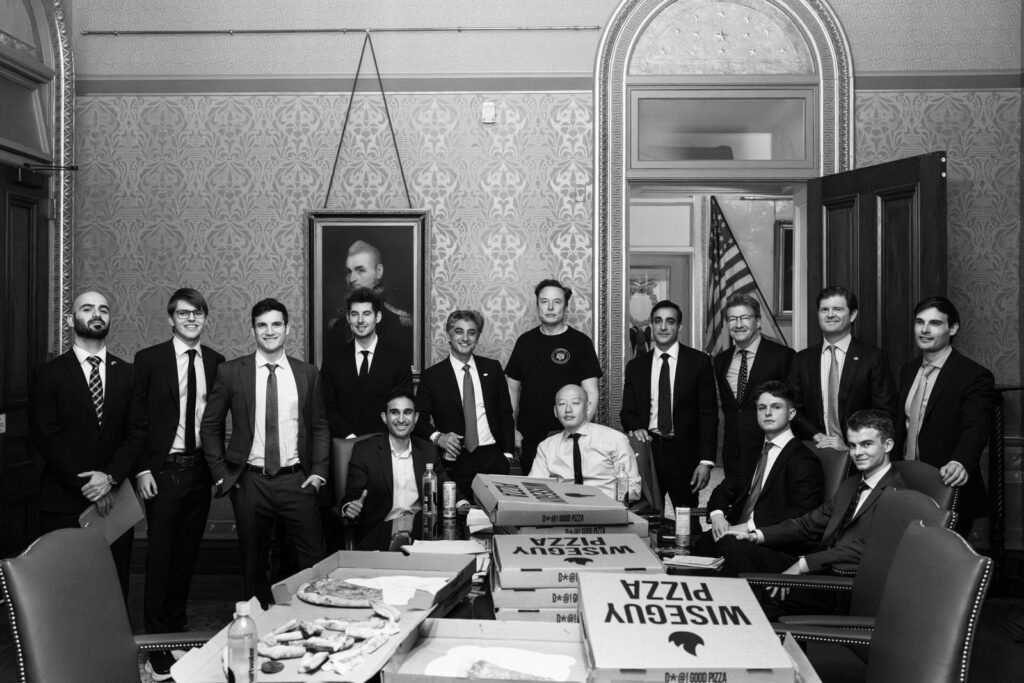
During his first week at DOGE, the team met in a sparse conference room on the top floor of the SpaceX offices — empty except for a giant American flag on the wall, “because it reminded us why we are here,” he told The Post. “We had billionaires to 22-year-olds who had dropped out of Harvard, all sitting there on our laptops working with public information — trying to figure out how we can help solve this deficit, this crisis that we’re in.”
As the group grew, the meetings moved to the Eisenhower Executive Office Building. There, he told The Post that he would present to Musk on a weekly basis, receiving the world’s richest man’s undivided attention. “He has this ability to grasp so many things, from California water, to certain contracts,” he said. “We would talk about certain departments for 45 minutes — and how can we fix this — and we’d stay until two in the morning.”
One time, after a particularly grueling session, Hassen said he had to sneak out of the White House grounds to sleep. “I was so tired,” he said.
During his time at Interior, Hassen was almost like a Where’s Waldo character, popping up in key moments that caught the country’s attention. When wildfires struck California, Hassen made an unusual decision to fly to the state to grill local officials about why the state’s largest water plant wasn’t running at full capacity.
The image of him at the Jones Pumping Plant in California became one of the first posts from the DOGE X account identifying its members — prompting a flood of hateful messages and threats to Hassen and his family, he said.
When Trump renamed the Gulf of Mexico, it fell to Hassen to officially register the rechristened Gulf of America in the Interior Department’s Geographic Names Information System — a move that then triggered a broader recognition of the name change on Google Maps and other online directories.
Hassen says he felt the difference in mindset between the public and the private sector every day. “It showed up in the way career staff spoke about ‘the workforce’ as something apart — almost sacred,” he writes. “Until we can say out loud that government is a workforce like any other — noble in purpose, human in composition, and subject to reality like everything else — reform will look like cruelty before it looks like competence.”
There is a clear cognitive dissonance between DOGE insiders like Hassen, who saw himself taking on a deeply patriotic project, and many Americans, who according to polls viewed DOGE disapprovingly.
Not surprisingly, Hassen believes the media is one culprit — treating “every reduction as a moral offense” and framing DOGE leaders’ demands for accountability as a “cruelty experiment,” he writes.
But, in the book Hassen reflects on how DOGE’s failure to communicate hurt its reputation.
Though DOGE was announced with great fanfare — and its website broadcast tallied savings — in practice the project was highly secretive, with DOGE members often showing up in agencies wielding great power before ever appearing on an org chart.
In the six months before the ill-fated cost-cutting effort imploded, its staff gave just a handful of interviews. Two, including one with Hassen, were on Fox News, and he told The Post he almost backed out. They were only done, Hassen writes, in response to prodding from then-White House Press Secretary Karoline Leavitt and Katie Miller, the political operative and podcaster who acted as a communications liaison for Musk’s effort.
DOGE members were private citizens, fearful of being personally targeted and unfamiliar with the media apparatus that is part of Washington culture, he says. But, fundamentally, the DOGE crew wanted to stay completely focused on the mission itself, he writes. The team was well aware that they needed to move with speed, as they might soon be slowed down by lawsuits, Congress or other bureaucratic forces.
“We were there to work. We weren’t there to be public figures,” he said in the interview.
In the book, Hassen implies that this was, to some degree, a miscalculation. “Once we stepped back, others were happy to define the work for us.”
Ultimately, DOGE did lose control of the narrative, leading to a dramatic split between Trump and Musk five months after DOGE began and leaving the project in the lurch. The night of that split, Hassen said he paced around the Interior Department like a ghost. The next morning, he went to the agency gift shop and bought his daughter a T-shirt which said “Future Secretary of the Interior.” He thought it might be his last night in D.C.
Hassen’s experience working with AI for the first time at DOGE led him to take a new job leading Zone Frontier, a former cleaning supply firm with a new mission to provide infrastructure and permitting to the data center industry. Musk’s longtime lawyer, Alex Spiro, has also joined the board of directors, something Hassen said was a pure coincidence.
He says he hopes that the legacy of DOGE will be that the country’s most gifted citizens will seek to serve their government. Instead of draining the swamp, he says he wants to flood it with talent and energy.
“These are some of the best and brightest we have in America,” he said of the DOGE team. “I’m honored to be even a part of them.”
Faiz Siddiqui contributed to this report.
The post He spent 11 months inside DOGE. Now he wants to set the record straight. appeared first on Washington Post.