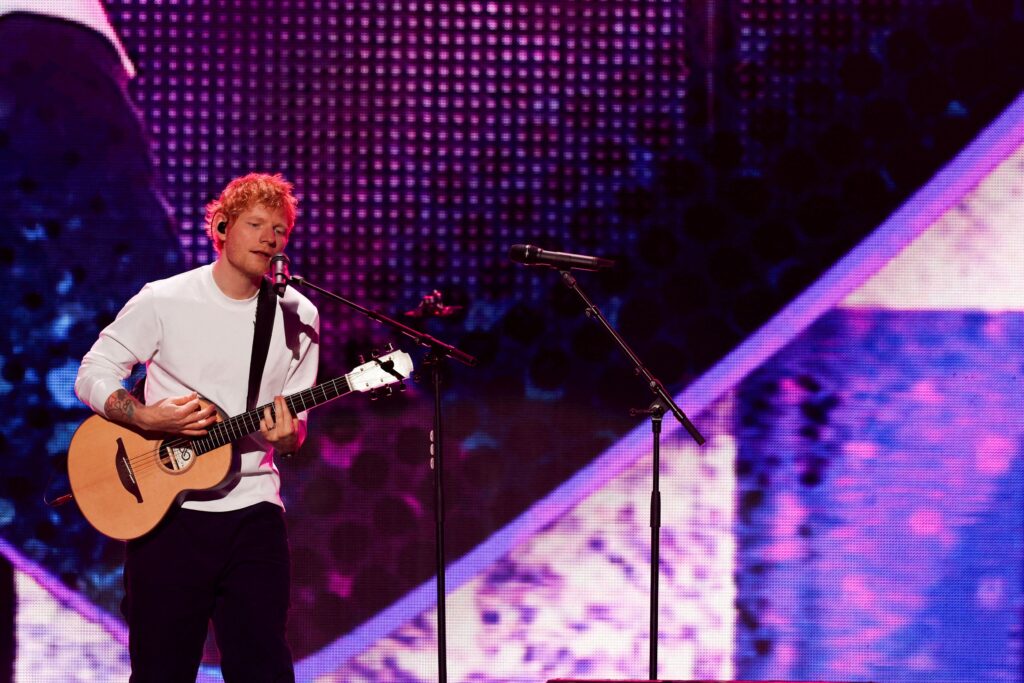
Regarding the Sept. 18 news article “Sheeran’s tour chaos, explained”:
The First Amendment does not indemnify the speaker against the consequences of the speech, nor does it extend to speech on private property. If a ticket is purchased to listen to an entertainer sing songs, that does not extend to wanting to hear the entertainer share personal political or religious beliefs. Just because someone hands you a microphone and puts you on a stage does not mean you get to do or say whatever you wish without possible repercussions.
Jack Cassidy, Annandale
The most frustrating thing about the debate over the Palestinian-Israeli conflict online is that the collective response has devolved into throwing stones instead of stopping to ask whether the actions move people any closer to their goals.
The Ed Sheeran and Macklemore mess is a prime example. What Sheeran says, and whether more acts drop out, will neither impact the war nor improve the well-being of Palestinians. If Israel were at all influenced by public opinion, it would have changed course when much of the world condemned its actions.
If people could collectively learn to skip over these rushes to judgment and instead concentrate their efforts on actions that move them closer to their goals — such as those who later made donations to people in harm’s way or amplified the messages that the powerful sought to suppress — the world would be better off.
Michelle M. Wu, Alexandria
Liability alone won’t make AI safe
The Sept. 10 editorial “AI hysteria jumps the shark” is right that tort liability can make AI companies more diligent, but I disagree with its dismissal of AI safety agreements between the U.S. and China. We need both domestic and international solutions.
The editorial cites a legal investigation of the cyberattack on Hugging Face as an example of using the liability system to hold AI developers accountable. But many, if not most, of the biggest cyberthreats against Americans are posed by foreign actors. So, too, are numerous AI-enabled biological threats.
Negotiating a deal with China, verifying compliance and addressing breaches is a tall order, but there is no viable substitute.
When President Donald Trump and Chinese leader Xi Jinping meet Thursday, they should focus on reaching a narrow bilateral agreement to address some of the catastrophic AI safety risks that both America and China have an obvious interest in confronting. My suggestion would be to strike a deal to tackle major biological threats and reduce the risk of another global pandemic. That would be difficult, but not impossible, to achieve.
Simon Hedlin, Washington
The Sept. 10 editorial argued that “liability offers better discipline than overbearing legislation.” In fact, the “catch me if you can” strategy of artificial intelligence developers illustrates the flaws of a liability approach.
U.S. courts resolve major liability cases very slowly because big corporations typically mount multiple time-consuming defenses. Judicial remedies may be ineffective for catastrophic damages. The collapse of just two large financial institutions would likely surpass the enormous equity of a responsible AI developer.
We do not think, however, that federal regulators will be smart or fast enough to police AI sensibly. They would have to anticipate problems with cutting-edge AI models that are poorly understood by law-abiding developers while also avoiding overregulation that limits innovation and minimizing damage from lawless actors. In general, regulators are more effective in assessing and managing risks after the fact, when they are better understood. The most important federal rules also face lengthy bureaucratic and judicial reviews.
We urge industry and the federal government to adopt a 60-day pause, with the National Academies of Sciences or the Office of Science and Technology Policy convening a task force to develop standards and guidance for AI and a strategy to address threats from adversaries and lawless actors. Congress could respond to heightened concerns about AI by providing a limited antitrust exemption for work of the task force.
Arthur Fraas, Chevy Chase
Randall Lutter, Harbert, Michigan
Arthur Fraas is a former chief of the Natural Resources, Energy and Agriculture Branch at the Office of Information and Regulatory Affairs. Randall Lutter is a senior fellow at the Manhattan Institute.
I welcome the debate over AI and its future. Questions as to whether it’s moving too fast and not taking into account its potential dangers are valid.
But for those painting a doomsday scenario, I urge them to take a deep breath. This world of ours has been living under the threat of nuclear annihilation for decades. Yet, we go on about our lives.
But this technology cannot go unchecked. It needs to be tempered by common sense, wisdom and restraint. A pause now is justified until we can apply these safeguards.
Phil Serpico, New York
The threat of rogue AI is real, even if only vaguely defined at present. But fettering U.S. AI labs without ironclad international agreements is a fool’s errand, as is the idea that any such agreement can be trusted until we can be assured that rogue AI bots can be kept in check by their creators. The mutual assured destruction paradigm that has held the nuclear risk harnessed is not analogous.
Is it possible to establish an early warning alarm within all AI projects at their inception, a tocsin for a toxic agent, that cannot be corrupted by the agent itself? These certainly are interesting times.
Paul Bloustein, Cincinnati
Letter submissions
Send letters to [email protected].
Submissions must be exclusive to The Post and should include the writer’s address and day and evening telephone numbers. Letters are subject to editing and abridgment. Please do not send letters as attachments. Because of the volume of material we receive, we are unable to acknowledge submissions; writers whose letters are under consideration for publication will be contacted.
The post The Sheeran-Macklemore mess is about speech. It’s also about consequences. appeared first on Washington Post.